Calculate Nip Roller Torque for T1=10 lbs and T2=20 lbs

  • Context: Undergrad 
  • Thread starter Thread starter tomizzo
  • Start date Start date
  • Tags Tags
    Roller Torque
Click For Summary
SUMMARY

The torque on each driven nip roller can be calculated using the formula that relates torque to the difference in tension on either side of the roller. Given an input tension (T1) of 10 lbs and an output tension (T2) of 20 lbs, the torque can be determined by the equation: Torque = (T2 - T1) * radius. Assuming the radius for each driven nip is the same, the torque for each nip roller is directly influenced by the tension values provided. Understanding the relationship between tension and torque is crucial for accurate calculations in roller systems.

PREREQUISITES
  • Basic understanding of mechanical torque
  • Knowledge of tension forces in roller systems
  • Familiarity with the concept of nip rollers
  • Ability to perform calculations involving radius and tension
NEXT STEPS
  • Research the principles of mechanical torque calculations
  • Learn about the mechanics of nip rollers and their applications
  • Study the effects of tension variations on roller performance
  • Explore advanced torque calculation methods in mechanical engineering
USEFUL FOR

Mechanical engineers, manufacturing professionals, and anyone involved in the design and operation of roller systems will benefit from this discussion.

tomizzo
Messages
113
Reaction score
2
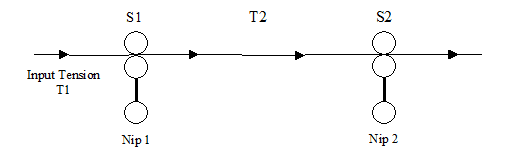
I'm wondering if someone could help me. I'm curious what the torque in each driven roller would be in the following picture.
ReGYoVm.png


Say for example I want the input tension(T1) to be 10 lbs and the output tension(T2) to be 20 pounds. Assume the radius for each driven nip is the same. Also assume there is a brake upstream somewhere. I am having difficulties in figuring out what the torque would be for each of the nips. I don't care about the speed of each nip but am only curious about the torque. I just don't understand how each nip isolates input and output tension. Any help?
 
Physics news on Phys.org
The torque on the roller is equal to the difference in tension on either side of a roller.
The tension force in the material is parallel to and equivalent to surface force on the roller, which can be interpreted as a torque of roller radius pounds.
If the output tension is zero,
then S2 = T2
and T2 = T1 + S1 etc
Make sure you get the signs correct.
 

Similar threads

  • · Replies 1 ·
Replies
1
Views
7K
Replies
9
Views
2K
  • · Replies 18 ·
Replies
18
Views
3K
  • · Replies 15 ·
Replies
15
Views
4K
  • · Replies 10 ·
Replies
10
Views
8K
  • · Replies 7 ·
Replies
7
Views
5K
  • · Replies 8 ·
Replies
8
Views
7K
Replies
5
Views
2K
  • · Replies 6 ·
Replies
6
Views
31K
  • · Replies 3 ·
Replies
3
Views
4K