Glxblt76
- 7
- 1
Dear Physics Forums members,
I have a research problem that involves electrostatics. My education is as a chemist, and thus I struggle to accurately represent my problem, so I thought that you guys could help me (and would be interested in the exercise).
Here is an image to summarize my problem.
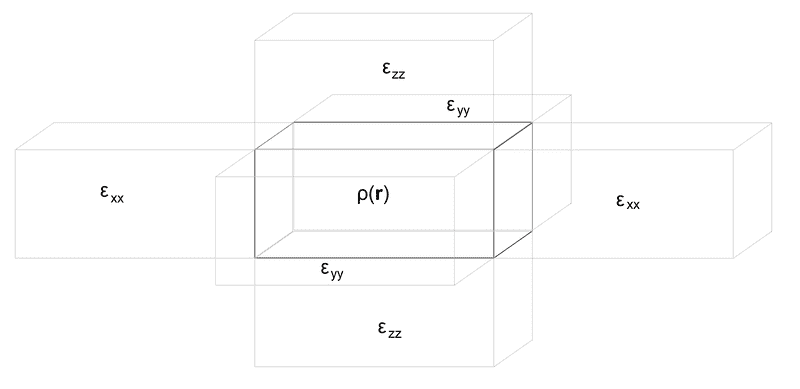
So, in the starting point of my problem, I have my space divided into orthogonal cuboids. The cuboid at the center is particular: there is a charge distribution within it, ρ(r) and its dielectric constant is that of vacuum. All other orthogonal cuboids contain homogeneous, but not isotropic, continua. In the x direction, the dielectric constant is εxx, the component of the dielectric constant tensor ε, in y direction it is εyy, and in z direction it is εzz.
I explicitely represent three cuboids around the central cuboid in each direction, for a total of 73 - 1 = 342 cuboids. This big cuboid is immersed into a continuum that corresponds to the average value of the dielectric constant tensor ε.
What I would like to write is the equation for the polarization energy of this system (i. e. the energy change caused by replacing a conventional cuboid by a cuboid containing the charge distribution ρ(r) and with the dielectric constant of vacuum).
The system is electrostatic, i e there is no variation of the magnetic field with time. It obeys the two equations:
∇E = ρ/ε0
∇×E = 0
I know the dimension of the cuboid (the 3 lengths a, b and c from which the cuboid can be reconstructed).
I'm a bit lost and I don't know where to start.
Do some people have suggestions?
All the best!
I have a research problem that involves electrostatics. My education is as a chemist, and thus I struggle to accurately represent my problem, so I thought that you guys could help me (and would be interested in the exercise).
Here is an image to summarize my problem.
So, in the starting point of my problem, I have my space divided into orthogonal cuboids. The cuboid at the center is particular: there is a charge distribution within it, ρ(r) and its dielectric constant is that of vacuum. All other orthogonal cuboids contain homogeneous, but not isotropic, continua. In the x direction, the dielectric constant is εxx, the component of the dielectric constant tensor ε, in y direction it is εyy, and in z direction it is εzz.
I explicitely represent three cuboids around the central cuboid in each direction, for a total of 73 - 1 = 342 cuboids. This big cuboid is immersed into a continuum that corresponds to the average value of the dielectric constant tensor ε.
What I would like to write is the equation for the polarization energy of this system (i. e. the energy change caused by replacing a conventional cuboid by a cuboid containing the charge distribution ρ(r) and with the dielectric constant of vacuum).
The system is electrostatic, i e there is no variation of the magnetic field with time. It obeys the two equations:
∇E = ρ/ε0
∇×E = 0
I know the dimension of the cuboid (the 3 lengths a, b and c from which the cuboid can be reconstructed).
I'm a bit lost and I don't know where to start.
Do some people have suggestions?
All the best!
Attachments

Last edited: