chengbin
- 26
- 0
If a person has reached terminal velocity (say 50m/s), and he opens his parachute, and I want to find his speed 2 seconds after he opens his parachute, can I do this?
Solve the equation m dv/dt = mg - kv^2 and substitute k with 1/2 pCdA and substitute the value for p, Cd, and A to find velocity?
If I can, can I do this shortcut to simplify work?
The proper way of doing it would be to solve this differential equation m dv/dt = mg - kv^2 given the condition when t = 0, v = 50. But solving that would be a lot of work, and it is easy to make a mistake somewhere as my calculus skills is rusty. I can find a solution for m dv/dt = mg - kv^2 for when t = 0, v = 0 from wikipedia
http://en.wikipedia.org/wiki/Terminal_velocity
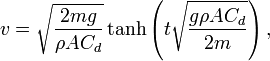
Substitute my values in, I get a number, let that be x. The velocity of a freefall object with no air resistance after 2 seconds is 9.8(2) = 19.6 m/s. The velocity slowed by drag can be found by 19.6 - x. Then I just do 50 - (19.6 - x) to get my velocity after 2 seconds.
If this doesn't work, is there a differential equation solver that will solve my equation? Thanks
Solve the equation m dv/dt = mg - kv^2 and substitute k with 1/2 pCdA and substitute the value for p, Cd, and A to find velocity?
If I can, can I do this shortcut to simplify work?
The proper way of doing it would be to solve this differential equation m dv/dt = mg - kv^2 given the condition when t = 0, v = 50. But solving that would be a lot of work, and it is easy to make a mistake somewhere as my calculus skills is rusty. I can find a solution for m dv/dt = mg - kv^2 for when t = 0, v = 0 from wikipedia
http://en.wikipedia.org/wiki/Terminal_velocity
Substitute my values in, I get a number, let that be x. The velocity of a freefall object with no air resistance after 2 seconds is 9.8(2) = 19.6 m/s. The velocity slowed by drag can be found by 19.6 - x. Then I just do 50 - (19.6 - x) to get my velocity after 2 seconds.
If this doesn't work, is there a differential equation solver that will solve my equation? Thanks