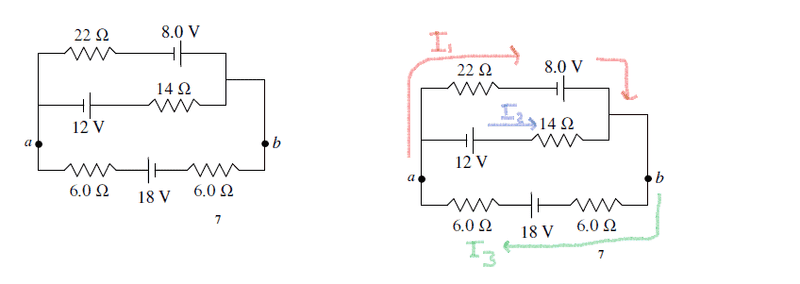
Calculate the current through the 22ohm resistor (Kirchhoff's Rules)

Click For Summary

Homework Help Overview

The discussion revolves around calculating the current through a 22Ω resistor and determining the voltage across points a and b in a circuit using Kirchhoff's Rules. Participants are analyzing the circuit's behavior based on the provided equations and values.

Discussion Character

  • Exploratory, Conceptual clarification, Mathematical reasoning

Approaches and Questions Raised

  • The original poster attempts to apply Kirchhoff's Junction Rule and Loop Rule to derive equations for the currents in the circuit. They express uncertainty about how to calculate the voltage across the specified points and whether to sum resistances in series.
  • Some participants question the correctness of the original equations and suggest clarifications regarding the signs of voltage changes and the approach to calculating voltage across the resistors.
  • Others explore different paths in the circuit to verify voltage calculations, comparing results from different approaches.

Discussion Status

The discussion is active, with participants providing feedback on each other's calculations and reasoning. Some guidance has been offered regarding the interpretation of voltage changes and the application of Kirchhoff's Laws. Multiple interpretations of the voltage calculation approach are being explored, but there is no explicit consensus on the final values.

Contextual Notes

Participants are working within the constraints of a homework assignment, which may limit the information they can share or the methods they can use. There is an ongoing discussion about the assumptions made regarding the circuit configuration and the values used in calculations.

shashaeee
Messages
30
Reaction score
0
From the image attached:
physics2.png


A. Calculate the current through the 22Ω resistor.
B. What is the voltage across ab


Here is what I've done:
A. )
I labelled the currents and applied the Junction Rule
I1 + I2 = I3

-I1*22Ω + 8V + 13*6Ω + 18V - I3*6Ω = 0
-I1*22Ω + 8V + I2*14Ω - 12V = 0

Which I rearrange into:

2.17A - I1*1.83 = I3 and

I2 = 0.29A + I1*1.57

Inserting these two equations into I1 + I2 = I3

I1 = (2.17A - I1*1.83) - (0.29A + I1*1.57)
I1 = 0.43A

I3 = 2.17A - (0.43A)*1.83
I3 = 1.38A

I2 = 0.29A + (0.43A)*1.57
I2 = 0.96A

Therefore the current through the 22Ω will be 0.43A ?


B.) For this question, I really don't know how to tackle this, do I just do V=I3*R + 18v ?

For R, do I just add up the resistors (6Ω + 6Ω) in series?
 
Physics news on Phys.org
shashaeee said:
-I1*22Ω + 8V + 13*6Ω + 18V - I3*6Ω = 0
-I1*22Ω + 8V + I2*14Ω - 12V = 0

In the first equation above, the third term would be -I3*6 rather than +I3*6, but I think that's what you meant. Your work following that looks correct, and your answers for the currents look correct.

B.) For this question, I really don't know how to tackle this, do I just do V=I3*R + 18v ?

For R, do I just add up the resistors (6Ω + 6Ω) in series?

You want to think of starting at point a and going by any path to point b and add up the voltage changes along the path. Looks like you chose a path along the bottom leg. Yes, you can add the two 6Ω resistors because they are in series. But note that as you go from a to b, you go from the + terminal to the - terminal of the battery. So, that's a negative change of -18V. See what you get and then try a couple of other paths from a to b and see if you get the same answer. Keep in mind that when you go through a resistor in a direction opposite to the current, the voltage change is positive.
 
Thank you for your response!

So I tried two ab paths: through the I1 current and the I3 current

This is what I've gotten:

Vab (bottom) = I3*(6Ω+6Ω) - 18v = -1.40v
Vab (top) = -I1*22Ω +8v = -1.40v
 
shashaeee said:
Thank you for your response!

So I tried two ab paths: through the I1 current and the I3 current

This is what I've gotten:

Vab (bottom) = I3*(6Ω+6Ω) - 18v = -1.40v
Vab (top) = -I1*22Ω +8v = -1.40v
That looks close to the correct answer. No doubt there's some round off error.

See this link for the same problem a couple of weeks ago: Find the current and the voltage; the Circuit Problem
 
Last edited:

Similar threads

  • · Replies 4 ·
Replies
4
Views
2K
Replies
22
Views
4K
Replies
16
Views
2K
Replies
1
Views
2K
Replies
6
Views
4K
  • · Replies 4 ·
Replies
4
Views
4K
  • · Replies 8 ·
Replies
8
Views
2K
  • · Replies 3 ·
Replies
3
Views
4K
  • · Replies 7 ·
Replies
7
Views
6K
  • · Replies 6 ·
Replies
6
Views
2K