Calculate the electric field due to a charged disk (how to do the integration?)

Click For Summary

Homework Help Overview

The discussion revolves around calculating the electric field due to a charged disk, focusing on the integration process involved in determining the electric field components. Participants explore the implications of symmetry in the problem and the necessity of integrating over different variables.

Discussion Character

  • Exploratory, Assumption checking, Mathematical reasoning

Approaches and Questions Raised

  • Participants discuss the setup of integrals for calculating the electric field, questioning the treatment of the unit vector and the necessity of integrating over angles. Some express confusion about the contributions of different charge elements and how they affect the overall field calculation.

Discussion Status

Several participants have provided insights into the integration process, particularly regarding the need to account for angular components in the electric field calculations. There is an ongoing exploration of how to properly set up the integrals and the implications of symmetry on the results.

Contextual Notes

Participants note the importance of considering the geometry of the charge distribution and the resulting electric field components. The discussion highlights the challenges of integrating over both radial and angular dimensions, particularly in relation to cylindrical symmetry.

zenterix
Messages
774
Reaction score
84
Homework Statement
A disc of radius ##R## is uniformly charged with total charge ##Q>0##. Determine the direction and magnitude of the electric field at a point P lying a distance ##x>0## from the center of the disc along the axis of symmetry of the disc.
Relevant Equations
I know how to solve this problem. The electric field vector points in only one direction, so there is really only one integral to do. However, I attempted to do the full integral, expecting the other two directions to cancel out, but my integrals don't seem to work out to the correct values. This is thus a question about integration.

Here I set up the integral for the electric field due to the disk at a point ##P##:

$$d\vec{E}_p=\frac{k_edq}{r_{dq,p}^2}\hat{r}_{dq,p}$$

$$dq=2\pi r dr \frac{Q}{\pi R^2}=\frac{2Qrdr}{R^2}$$

$$\vec{r}_{dq,p}=\vec{r}_{o,p}-\vec{r}_{o,dq}=x\hat{k}-r\hat{r}$$

$$r_{dq,p}=\sqrt{x^2+r^2}$$

$$\implies \vec{E}_p=\frac{2k_eQrdr}{R^2(x^2+r^2)^{3/2})}(x\hat{k}-r\hat{r})$$

$$\vec{E}_p=\frac{2k_eQ}{R^2}\left[\int_0^R \frac{rx}{(x^2+r^2)^{3/2}}dr\hat{k}-\int_0^R \frac{r^2}{(x^2+r^2)^{3/2}}dr\hat{r}\right]$$
I am interested in particular in the second integral, in the ##\hat{r}## direction.

Here is my depiction of the problem:
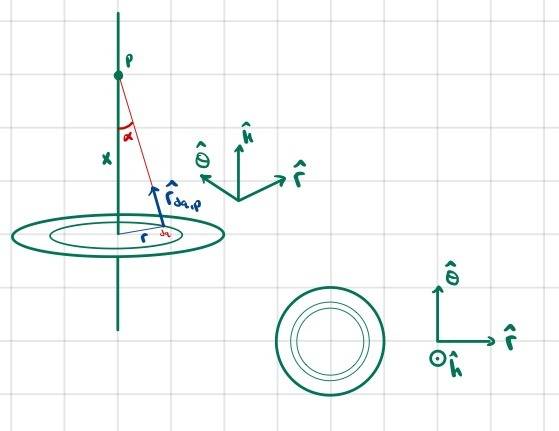
1636756487584.jpeg
As far as I can tell, due to the symmetry of the problem, this integral should be zero.

$$\int_0^R \frac{r^2}{(x^2+r^2)^{3/2}}dr\hat{r}$$

I don't believe I need to integrate anything inside ##\hat{r}##; it depends on an angle relative to some axis but not on ##r##.

$$r=x\tan{\alpha}$$
$$dr=x \sec^2{\alpha}d\alpha$$

$$(x^2+r^2)^{3/2}=(x^2(1+\frac{r^2}{x^2}))^{3/2}=x^3(1+\tan^2{\alpha})^{3/2}=x^3\sec^3{\alpha}$$

So the integral becomes

$$\int \frac{x^2\tan^2{\alpha} x \sec^2{\alpha}}{x^3\sec^3{\alpha}}d\alpha$$
$$=\int \frac{\tan^2{\alpha}}{\sec{\alpha}}d\alpha$$

$$=\int \frac{\sin^2{\alpha}}{\cos{\alpha}}d\alpha$$

$$=\int \frac{1}{\cos{\alpha}}d\alpha-=\int_0^R \cos{\alpha}d\alpha$$

$$=(\ln|\sec{\alpha}+\tan{\alpha}| - \sin{\alpha})$$

Note that

$$r=x\tan{\alpha}$$
$$\implies \sin{\alpha}=\frac{r}{(x^2+r^2)^{1/2}}$$
$$\implies \cos{\alpha}=\frac{x}{(x^2+r^2)^{1/2}}$$

The integral result in terms of ##r## is then

$$(\ln|\frac{(x^2+r^2)^{1/2}}{x}+\frac{r}{x}|-\frac{r}{(x^2+r^2)^{1/2}}) \big|_0^R$$

Which is not zero.

I don't know if I messed up setting up the integral, or in the integration itself.
 
  • Like
Likes   Reactions: Delta2
Physics news on Phys.org
The issue with your work is that the unit vector ##\hat{\boldsymbol{r}}## depends on the angle ##\varphi## of the charge element in the ring around the ##x## axis. If you want to evaluate the horizontal component of the electric field explicitly, you'll need to e.g. write it out in Cartesians,\begin{align*}
dE_y = \dfrac{Q}{4\pi^2 \epsilon_0 R^2} \dfrac{r^2}{(x^2 + r^2)^{3/2}} \cos{\varphi} dr d\varphi \\
dE_z = \dfrac{Q}{4\pi^2 \epsilon_0 R^2} \dfrac{r^2}{(x^2 + r^2)^{3/2}} \sin{\varphi} dr d\varphi
\end{align*}and do a double integral over ##r## and ##\varphi##. Since they're separable, and the angle ranges over ##[0,2\pi]##, you can see immediately that both will be zero as expected from the cylindrical symmetry.
 
  • Like
Likes   Reactions: PeroK and zenterix
I would get potential which is scalar, easier to handle than vector
\phi(x)=k_e \frac{Q}{\pi R^2}\int_0^R \frac{2\pi r dr}{\sqrt{x^2+r^2}}
Then
E=-\nabla \phi
 
  • Like
Likes   Reactions: Delta2, PhDeezNutz and zenterix
ergospherical said:
The issue with your work is that the unit vector ##\hat{\boldsymbol{r}}## depends on the angle ##\varphi## of the charge element in the ring around the ##x## axis. If you want to evaluate the horizontal component of the electric field explicitly, you'll need to e.g. write it out in Cartesians,\begin{align*}
dE_y = \dfrac{Q}{4\pi^2 \epsilon_0 R^2} \dfrac{r^2}{(x^2 + r^2)^{3/2}} \cos{\varphi} dr d\varphi \\
dE_z = \dfrac{Q}{4\pi^2 \epsilon_0 R^2} \dfrac{r^2}{(x^2 + r^2)^{3/2}} \sin{\varphi} dr d\varphi
\end{align*}and do a double integral over ##r## and ##\varphi##. Since they're separable, and the angle ranges over ##[0,2\pi]##, you can see immediately that both will be zero as expected from the cylindrical symmetry.
I thought I didn't have to worry about ##\varphi## because I wrote the integral in terms of infinitesimal rings. ##dq## is the charge on an infinitesimal ring When I integrate only over ##r##, aren't I summing up all the rings already?

I can see the intuition that I do need to somehow integrate over something that will cancel out, and the ##\hat{r}## vectors all cancel each other out when we consider ##\varphi## from 0 to ##2\pi##, but I can't understand the intuition based on the sum of the rings.
 
If you want to find the vertical component of the electric field, then you can exploit the cylindrical symmetry by using ring-shaped charge elements of area ##2\pi r dr##. (The factor of ##2\pi## is equivalent to what you'd get if you wrote the double integral over the measure ##rdr d\varphi##, separated the ##r## and ##\varphi## integrals and put ##\displaystyle{\int_{0}^{2\pi}} d\varphi = 2\pi##.)

If you're considering the horizontal field, however, points at different angles around the ring produce contributions to the field at ##P## with different projections onto the ##y## and ##z## axes (depending on the angle). Different points on the ring are no longer equivalent, so you have no choice but to break it up into even smaller bits of area, ##rdrd\varphi##.
 
  • Like
Likes   Reactions: PeroK and zenterix
They seem to cancel in different ##\theta##.
1636761668941.jpeg
 
zenterix said:
I thought I didn't have to worry about ##\varphi## because I wrote the integral in terms of infinitesimal rings. ##dq## is the charge on an infinitesimal ring When I integrate only over ##r##, aren't I summing up all the rings already?
The field due to the ring points along the z-axis, so you've already integrated out x- and y- components. Try doing the full integral for the field of a ring of charge. That's where you'll see the cancellation occurs.
 
They definitely do cancel, that is clear by simple inspection.

You are totally right about adding ##\varphi##, my question is more about where in my original calculations I missed adding that in.

And here's what I came up with.

There was a step where I wrote

$$\vec{r}_{dq,p}=\vec{r}_{o,p}-\vec{r}_{o,dq}$$

The issue is I wrote an expression for ##\vec{r}_{o,dq}##, the vector from the origin to ##dq##, but ##dq## is actually a ring. There isn't a single vector that points to it.

I need to actually consider a small ##dq## on the ring.

Previously I had

##dq_{ring}=\frac{2rQdr}{R^2}##

But now, I calculate a small charge on the ring

##dq=\frac{dq_{ring}}{2\pi r}=\frac{rQdrd\varphi}{\pi}##

Now the vector ##\vec{r}_{o,dq}## actually points to this small charge on the ring, which has a ##d\varphi## term in it.

$$d\vec{E}_p=\frac{k_erQdrd\varphi}{\pi(x^2+r^2)^{3/2}}(x\hat{k}-r\hat{r})$$

Now when we sub in ##\hat{r}=\cos{\varphi}\hat{i}+\sin{\varphi}\hat{j}##. The resulting integrals in ##\hat{i}## and ##\hat{j}## are 0 as expected.

Also, in the ##\hat{k}## direction we get the same result as before as well:

$$\frac{k_eQ}{R^2\pi}\int_0^{2\pi} \int_0^R \frac{rx}{(x^2+r^2)^{3/2}}drd\varphi$$
$$=\frac{2k_eQ}{R^2}\left [ \frac{x}{|x|} - \frac{x}{(x^2+r^2)^{3/2}} \right ]$$

Now, when this problem was done in a textbook, the symmetry argument was used to not do the integral in the ##\hat{r}## direction. However, the integral in the ##\hat{k}## direction (if my calculations above are correct) is also a double integral. Yet when using the symmetry argument we use a single integral to calculate the ##\hat{k}## direction electric field.

I just read this


ergospherical said:
If you want to find the vertical component of the electric field, then you can exploit the cylindrical symmetry by using ring-shaped charge elements of area ##2\pi r dr##. (The factor of ##2\pi## is equivalent to what you'd get if you wrote the double integral over the measure ##rdr d\varphi##, separated the ##r## and ##\varphi## integrals and put ##\displaystyle{\int_{0}^{2\pi}} d\varphi = 2\pi##.)

If you're considering the horizontal field, however, points at different angles around the ring produce contributions to the field at ##P## with different projections onto the ##y## and ##z## axes (depending on the angle). Different points on the ring are no longer equivalent, so you have no choice but to break it up into even smaller bits of area, ##rdrd\varphi##.
and I think it answers my doubts about why it is that when we consider just the ##\hat{k}## direction we can just integrate over rings, but the full problem considering all directions means we can't use rings.
 
Last edited:
  • Like
Likes   Reactions: Delta2 and ergospherical

Similar threads

  • · Replies 9 ·
Replies
9
Views
1K
  • · Replies 3 ·
Replies
3
Views
1K
  • · Replies 12 ·
Replies
12
Views
2K
Replies
3
Views
3K
  • · Replies 5 ·
Replies
5
Views
1K
  • · Replies 6 ·
Replies
6
Views
2K
  • · Replies 97 ·
4
Replies
97
Views
6K
Replies
2
Views
2K
  • · Replies 13 ·
Replies
13
Views
4K
  • · Replies 13 ·
Replies
13
Views
862