Calculate the resistance to add in parallel to balance this bridge circuit

Click For Summary

Homework Help Overview

The discussion revolves around calculating the resistance to add in parallel to balance a bridge circuit, specifically when the voltmeter reading is zero. The subject area includes circuit analysis and the application of Ohm's law and parallel resistance formulas.

Discussion Character

  • Exploratory, Assumption checking, Problem interpretation

Approaches and Questions Raised

  • Participants explore the implications of a zero voltmeter reading, questioning how it relates to the potential drops across different branches of the circuit. Some express confusion over the effective resistance and the number of equations needed to solve for the unknown resistance.

Discussion Status

The discussion is active, with participants offering insights into the relationships between currents in the circuit. Some have suggested writing equations based on the currents through different resistors, while others are questioning the completeness of the information provided in the problem setup.

Contextual Notes

There is uncertainty regarding the total voltage source in the circuit, with some participants suggesting that it may not be shown in the diagram. This has led to discussions about the assumptions that need to be made regarding the circuit's operation.

Saibot
Messages
12
Reaction score
6
Homework Statement
Find resistance R if the voltmeter reading is zero in the circuit below.
Relevant Equations
V = IRtotal, 1/R = 1/R1 + 1/R2
The reading on the voltmeter is 0.
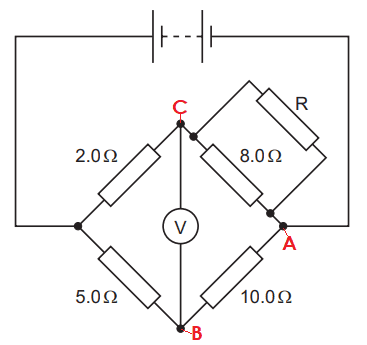
circuit.png


I figure the potential drop through line AB must be the same as the potential drop through AC (since voltmeter is zero). As such, the 10 Ohm resistor has the same as the effective resistance of the parallel branch.

1/10 = 1/8 + 1/R
1/R = -0.025
R = -40 Ohms

This is clearly wrong. Help please!
 
Physics news on Phys.org
Saibot said:
Homework Statement: Find resistance R if the voltmeter reading is zero in the circuit below.
Relevant Equations: V = IRtotal, 1/R = 1/R1 + 1/R2

The reading on the voltmeter is 0.
View attachment 337192

I figure the potential drop through line AB must be the same as the potential drop through AC (since voltmeter is zero). As such, the 10 Ohm resistor has the same as the effective resistance of the parallel branch.

1/10 = 1/8 + 1/R
1/R = -0.025
R = -40 Ohms

This is clearly wrong. Help please!
I don't know if there is a trick to this, it is true that the voltage drop from AB is the same as AC. There must be different currents the branches though. So they don't have the same effective resistance as far as I can tell.

I'm having some trouble finding enough equations, ( I'm getting 2 equations in 3 unknows), but maybe I'm missing it.
 
If the voltmeter reads zero, it means that the potential difference between C and B is zero. If you replace the voltmeter with a resistor, there will be no current through it. It follows that whatever current goes through the 2 Ω resistor must go through the parallel combination. Likewise, whatever current gos through the 5 Ω resistor must go through the 10 Ω resistor. What does this suggest to you? Write some equations down involving the two currents that I mentioned.
 
kuruman said:
If the voltmeter reads zero, it means that the potential difference between C and B is zero. If you replace the voltmeter with a resistor, there will be no current through it. It follows that whatever current goes through the 2 Ω resistor must go through the parallel combination. Likewise, whatever current gos through the 5 Ω resistor must go through the 10 Ω resistor. What does this suggest to you? Write some equations down involving the two currents that I mentioned.
Is the total voltage source supposed to be known, and just not shown in the diagram? I really can't find that 3rd independent equation. It seems to me that something is missing...the entire circuit could very well be at zero volts (no current flowing in either branch), and the voltmeter would be none the wiser.
 
  • Like
Likes   Reactions: Saibot
erobz said:
Is the total voltage source supposed to be known, and just not shown in the diagram? I really can't find that 3rd independent equation. It seems to me that something is missing...the entire circuit could very well be at zero volts (no current flowing in either branch), and the voltmeter would be none the wiser.
You do have to assume that a nonzero p.d. is supplied by the accumulators.
 
  • Like
Likes   Reactions: Saibot and erobz
kuruman said:
If the voltmeter reads zero, it means that the potential difference between C and B is zero. If you replace the voltmeter with a resistor, there will be no current through it. It follows that whatever current goes through the 2 Ω resistor must go through the parallel combination. Likewise, whatever current gos through the 5 Ω resistor must go through the 10 Ω resistor. What does this suggest to you? Write some equations down involving the two currents that I mentioned.
Got it, thank you. The current through the top is larger than the current through the bottom. Man, it seems so obvious now.
 
  • Like
Likes   Reactions: erobz
Thanks for your input everyone!
 

Similar threads

  • · Replies 14 ·
Replies
14
Views
1K
Replies
9
Views
1K
  • · Replies 6 ·
Replies
6
Views
2K
Replies
3
Views
2K
  • · Replies 2 ·
Replies
2
Views
683
  • · Replies 1 ·
Replies
1
Views
770
  • · Replies 7 ·
Replies
7
Views
2K
Replies
4
Views
2K
Replies
9
Views
2K
  • · Replies 4 ·
Replies
4
Views
2K