Calculate the speed of car for maximum economy

Join the discussion
Registration is free. Ask a follow-up in this thread, or start your own.
5 replies · 1K views
chwala
Gold Member
Messages
2,844
Reaction score
434
Homework Statement
see attached
Relevant Equations
differentiation
This is the problem,

1640834034666.png


This is the textbook solution ; i think the textbook solution is not correct!
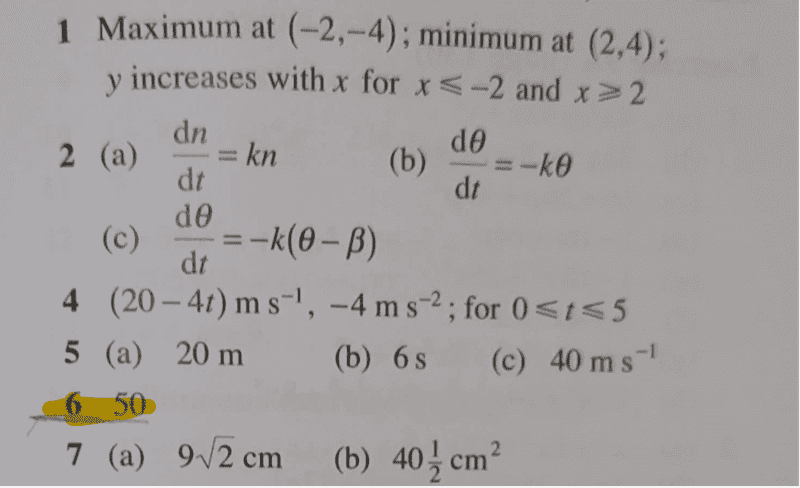
1640834121291.png


My thought,
##S_{max}## will be given by $$\frac {dy}{dS}=0$$
$$\frac {dy}{dS}=\frac {-1}{400}S+\frac {1}{5}=0$$
$$S=80$$
It is maximum economy because ##y{''}<0##, i.e by use of the second derivative test.
 
Last edited:
Physics news on Phys.org
chwala said:
chwala said:
View attachment 294885
My thought,
$$S_{max}=\frac {dy}{dS}=0$$
This equation doesn't make sense, as it says that ##S_{max} = \frac {dy}{dS}## (not true) and that ####S_{max} = 0## (also not true).
I understand what you're trying to say, but this isn't the right way to say it.
chwala said:
$$\frac {dy}{dS}=\frac {-1}{400}S+\frac {1}{5}=0$$
$$S=80$$
It is maximum economy because ##y{''}<0##, i.e by use of the second derivative test.
I get 80 (km/hr) as well.
 
Mark44 said:
This equation doesn't make sense, as it says that ##S_{max} = \frac {dy}{dS}## (not true) and that ####S_{max} = 0## (also not true).
I understand what you're trying to say, but this isn't the right way to say it.

I get 80 (km/hr) as well.
Let me re-phrase that...
 
Mark44 said:
Setting dy/dS to 0 is one way of finding extreme points, one of which may or may not be a maximum point.
That's why we use the second derivative test to ascertain that...Looks like textbook guys were after all wrong. Cheers Mark.
 
chwala said:
That's why we use the second derivative test to ascertain that.
My point is that extreme points can be found at 1) points at which the derivative is 0; 2) endpoints of the domain, in case the domain is limited; 3) points at which the derivative doesn't exist, but the underlying function is defined.
Examples of cases 2 and 3:
##f(x) = \sqrt x## (case 2) -- The derivative is never zero, but the function has a global minimum at x = 0.
##g(x) = |x|## (case 3) -- The derivative is never zero, and fails to exist at x = 0, at which g has a global minimum.
