Calculate the speed of other car

  • Context: High School 
  • Thread starter Thread starter CatAteMyHW
  • Start date Start date
  • Tags Tags
    Car Speed
Click For Summary
SUMMARY

This discussion focuses on methods to calculate the speed of another car (CarB) while driving, using a stationary reference point (pointA) and timing measurements. The proposed formula for calculating CarB's speed is ((z-x)/(y-1)) times the speed of the observer's car (CarA). The conversation highlights the limitations of this method, particularly in scenarios involving acceleration or deceleration, and suggests that using a radar gun is a more accurate alternative. Participants agree that the calculations can yield reasonable estimates under stable conditions, with an error margin of less than ±10% on highways.

PREREQUISITES
  • Understanding of basic physics concepts, particularly Newtonian physics.
  • Familiarity with speed calculation formulas.
  • Knowledge of parallax error and its implications in measurements.
  • Experience with timing measurements in a moving vehicle context.
NEXT STEPS
  • Research the use of radar guns for speed measurement in vehicles.
  • Explore advanced methods for calculating speed using GPS technology.
  • Learn about the effects of acceleration and deceleration on speed calculations.
  • Investigate the principles of parallax error and how to minimize it in real-world applications.
USEFUL FOR

Drivers, automotive enthusiasts, physics students, and anyone interested in practical applications of speed measurement techniques while driving.

CatAteMyHW
Messages
8
Reaction score
0
Hello everyone!
I was just wondering that while driving, is there a way to calculate speed of an other car that passes you?
I worked out a way but I needed more heads on this [that's what she..meh] so here's it:
When the car traveling faster than me goes pass me(me - carA;other car - carB), I fix a stationary point (pointA) ahead of carB on the road (like a tree). Now when carB passes that pointA, I start counting. I keep counting till I myself (CarA) reaches that pointA and note down the value (say x). Now while still counting I again fix another point (pointB) ahead of CarB and note down the value (say y) when it reaches there. Finally I note down the value (say z) when I (CarA) reach that pointB.
From this CarB's speed turns out to be ((z-x)/(y-1)) times my speed.
Now there's a lotta assumptions here because I wanted an "easy" method.
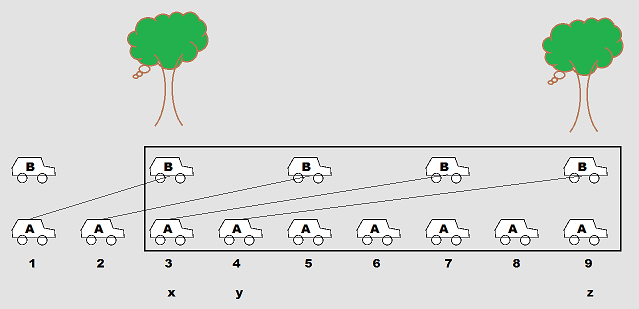
attachment.php?attachmentid=30700&stc=1&d=1292533130.png

That was my take, could there be other methods (perhaps better than this)?
 

Attachments

  • car.png
    car.png
    5 KB · Views: 650
Physics news on Phys.org
The easy method is to get yourself a radar gun and hold it out of your window. Add your own vehicle speed to the reading, and Bob's your uncle.

edit: Oops. I wrote that wrong the first time. Edited to fix.
 
Last edited:
Yes. That was the first thing on my mind but I realized buying one (or using it where I live) wouldn't be too easy for me for some reasons.
But isn't all-done-in-head way much cooler? I can see how this would seem trivial to you guys calculating and exploring speeds much much greater than vehicles. Now I'm not an expert in relativity and tensors and stuff but I'm a curious guy still exploring Newtonian physics and mathematics applicable in real world. With that I'll admit that I may be stoned when I first thought of all this :redface:
 
Why the denominator is y-1, it seems to me it has to be just y. (z-x)*your_speed=the distance between trees, and y is the time for car B to travel this distance.

Still this way u calculate the average speed over the distance between the trees, if the car accelerates a lot (or deccelerates) between the trees this calculation gives a result which is not close to the speed of carB as it reaches tree B.
 
Delta² said:
Why the denominator is y-1
Yea, thanks for seconding on that. I calculated it to be just 'y' myself. But when posting, I looked at the stunningly accurate graphic(/s) I made in MS paint and saw that carB is covering twice the distance than carA in each 'second' so something must've been wrong in my calculation d'oh!
Delta² said:
Still this way u calculate the average speed over the distance between the trees, if the car accelerates a lot (or deccelerates) between the trees this calculation gives a result which is not close to the speed of carB as it reaches tree B.
Yup, lotta assumptions there to tone down the calculations. On a highway though, it's safe to say error would be less that ±10%, yes? After all, it's ultimately you who decides when is the right time to apply this to minimize error.
 
If you know the length of your car you could just count out the time he takes to move from about your rear bumper to the front. So V= L/t where L is the length of your car. His speed is then your speed + V. This will only be accurate if his speed is not a huge amount greater then yours.

It is not easy to judge just when a car in front of you passes so object. As your diagram shows there is a lot of parallax involved. Any of these methods are a guesstimate at best.
 
I think the mistake with the diagram is that you start from 1, where i believe you should start from 0.

I guess the error will not be big if you do the calculations when the velocities of both vehicles seem to be constant (like in big straight lines when the vehicles have reach their top speed).
 
Delta² said:
I guess the error will not be big if you do the calculations when the velocities of both vehicles seem to be constant (like in big straight lines when the vehicles have reach their top speed).
Yup. In fact my intent was to have something better than just guessing "That car must've been above 100!". So as long as I take the measurements in just the right conditions I can guess with a level of certainty.
Integral said:
As your diagram shows there is a lot of parallax involved.
Yup. Though I'm relying on the brain's 3-D perception for minimizing parallax error:
attachment.php?attachmentid=30708&stc=1&d=1292618683.jpg

Integral said:
If you know the length of your car you could just count out the time he takes to move from about your rear bumper to the front.
hmm that's intriguing! Although you have to be know (by looking in rear-view) long before...
And wouldn't parallax be worse? I mean I always have trouble judging distances in rear-view rather than in front of me.
 

Attachments

  • car.jpg
    car.jpg
    42 KB · Views: 534

Similar threads

  • · Replies 16 ·
Replies
16
Views
2K
  • · Replies 49 ·
2
Replies
49
Views
5K
  • · Replies 20 ·
Replies
20
Views
4K
  • · Replies 1 ·
Replies
1
Views
2K
  • · Replies 26 ·
Replies
26
Views
7K
  • · Replies 4 ·
Replies
4
Views
4K
  • · Replies 5 ·
Replies
5
Views
5K
  • · Replies 2 ·
Replies
2
Views
1K
  • · Replies 10 ·
Replies
10
Views
5K
  • · Replies 4 ·
Replies
4
Views
596