Calculate Voltage Across 4k Resistor in Simple Diode Circuit

Click For Summary
SUMMARY

This discussion focuses on calculating the voltage across a 4 kilo-ohm resistor in a simple diode circuit. The voltage across the resistor is determined using the formula \(\frac{4k}{2k+4k} \times 8 \text{ Volts} = 5.3 \text{ Volts}\). When the diode is reversed, it does not conduct, and the voltage at point X remains at 5.3 Volts, as the forward-biased diode allows the 8V battery to charge a 2V battery without adding the voltages directly. The circuit behaves similarly to a Zener diode when considering the voltage drop across the components.

PREREQUISITES
  • Understanding of basic electrical circuit theory
  • Familiarity with Ohm's Law and voltage division
  • Knowledge of diode operation, including forward and reverse bias
  • Ability to interpret circuit diagrams and perform voltage calculations
NEXT STEPS
  • Study the principles of voltage division in resistive circuits
  • Learn about diode characteristics and their applications in circuits
  • Explore the behavior of Zener diodes in voltage regulation
  • Investigate the effects of reverse bias on diode functionality
USEFUL FOR

Electronics students, circuit designers, and hobbyists interested in understanding diode behavior and voltage calculations in simple circuits.

snowJT
Messages
117
Reaction score
0
I have an interesting question about this circuit... if I were to calculate the voltage from point X to ground... essentially all it is, is voltage across the 4 kilo-ohm resistor because if it went the route of the diode, it would lose an additional 2.7 volts.. so its going to take the better path.. right? Thats how it works doesn't it?

so... we have... \frac{4k}{2k+4k} * 8 Volts = 5.7 V

Now... let's say we reversed the diode... wouldn't then.. we push 1.7V towards point X right? Now... does that 1.7 volts add up with the 5.7V, does the 5.7 volts push against the 1.7V. The voltage I know is still 5.7 volts even if the diode was reversed... but is that because the voltage won't go that way due to there being more across the 4 kilo-ohm resistor?

Picture of circuit:
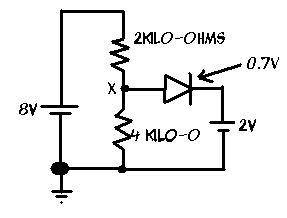
CIRCUIT.jpg
 
Last edited:
Engineering news on Phys.org
I got 5.3333333333 Volts using your method, and if the diode was forward biased, why wouldn't point X be 2.7 Volts? I think this will cause some current to oppose the 2V source
 
For the original circuit the Diode/Battery is the functional equivilent of a zener diode.
Try reworking your answer in terms of this.

For the case where the diode is reversed.
What is the basic function of a diode?
What happens when a diode is reverse biased?
 
oops I ment to write 5.3 not 5.7 for everything

When a diode is reversed current doesn't go through it.

But what I'm wondering is why you don't add the resultant voltage with the 5.3V
 
Last edited:
Yes, the voltage at X is 5.3V. Subtract 0.7V from 5.3V and it's still more than 2V. So the 8V battery is charging the 2V battery through the diode, which if forward-biased.

I'm not sure I understand your last question. Please clarify.
 

Similar threads

Replies
12
Views
2K
  • · Replies 3 ·
Replies
3
Views
3K
  • · Replies 16 ·
Replies
16
Views
7K
Replies
7
Views
3K
  • · Replies 13 ·
Replies
13
Views
3K
  • · Replies 9 ·
Replies
9
Views
8K
  • · Replies 38 ·
2
Replies
38
Views
5K
  • · Replies 7 ·
Replies
7
Views
4K
Replies
12
Views
2K
Replies
12
Views
3K