Calculating acceleration from electric motor

Click For Summary

Discussion Overview

The discussion revolves around calculating the acceleration of an electric motorcycle based on motor specifications and performance metrics. Participants explore the implications of various factors such as torque, drag, and gearing on acceleration calculations, while seeking to refine the initial approach to ensure accurate performance predictions.

Discussion Character

  • Technical explanation
  • Debate/contested
  • Mathematical reasoning

Main Points Raised

  • One participant outlines their method for calculating acceleration, incorporating wheel radius, motor torque, and drag force, but expresses uncertainty about the drag force application.
  • Another participant argues that drag force should not be treated as causing torque at the motor shaft and suggests a different approach to calculating net force on the motorcycle.
  • Some participants clarify the relationship between torque, drag force, and acceleration, indicating that the initial equations may lead to confusion.
  • A suggestion is made to measure the power required by towing an unpowered bike to gather empirical data on performance, acknowledging that this method may not account for all losses.
  • A participant mentions using torque curve data from the motor manufacturer and identifies potential inaccuracies in their calculations due to frictional losses and rotational inertia.

Areas of Agreement / Disagreement

Participants express differing views on the correct application of drag force in the calculations, with some agreeing on the need to adjust the approach while others maintain that the original method may still yield valid results. The discussion remains unresolved regarding the best method for incorporating drag and other losses into the acceleration calculations.

Contextual Notes

Participants note limitations in their calculations, including assumptions about mechanical losses, the impact of rotational inertia, and the accuracy of drag coefficients derived from wind tunnel data.

vinrow
Messages
2
Reaction score
0
I am in the process of designing an electric motorcycle, and would like to approximate the acceleration from various motors to inform my decision. I have written simple software to produce performance graphs, but my results seem a bit off - so i'd like to check my calculations.

Here is the basic setup:
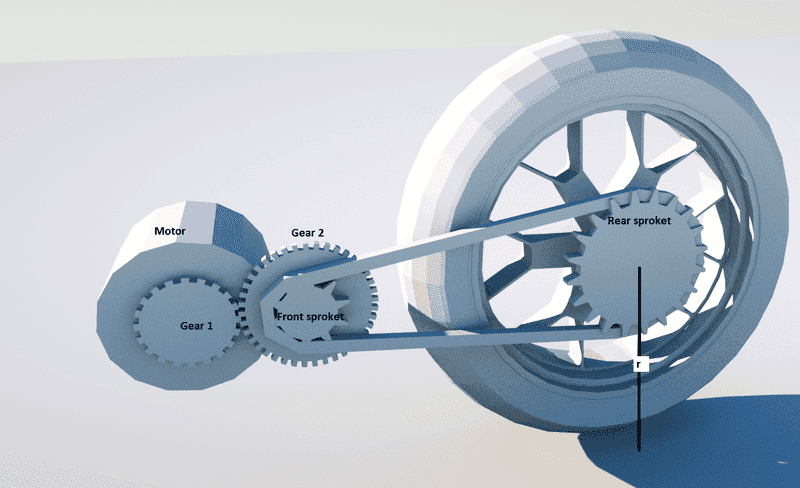
sketch.png


To simplify things I first calculated the effective radius of the wheel based on the gearing (as if driving the wheel directly from the motor):
r = Wheel radius / (Gear2/Gear1) * (RearSproket/FrontSproket)

Then used: Motor torque (T) = Fd and F=ma to get a = T/mr.

From this I calculate velocity at time intervals using: v = u+at and distance: S=ut + 0.5at^2

Now the bit where I think I'm going wrong (if not already) - Incorporating drag.
Using the drag equation: https://wikimedia.org/api/rest_v1/media/math/render/svg/144ce01ab76e5e8a0662dbf0f5b922abfa726e9c I am using a coefficient of 0.5, and area of 0.4m^2.
When calculating the torque at the rear wheel, I'm doing (Motor torque * 0.9) - (Drag force * r). The 0.9 is just to add a bit of mechanical loss. But I can't work out if I'm applying the drag correcly. Any input welcome.
 
Engineering news on Phys.org
Drag force does not cause a torque about the motor shaft as your equation implies. The drag force had nothing to do with the gear ratio.

To find the net force on the bike the drag force should be subtracted from the force the wheel applies to the road.

You will also need to account for the torque curve of the motor, electric motors generally produce max torque at zero rpm and zero torque at max rpm.
 
  • Like
Likes   Reactions: vinrow
billy_joule said:
Drag force does not cause a torque about the motor shaft as your equation implies. The drag force had nothing to do with the gear ratio.

Instead of doing ##ma = \frac{T}{r} - F_d##, he seems to do ##mar = T - F_d r##, which gives the same results.

@vinrow, you should check this acceleration simulator and the theory behind with it.
 
  • Like
Likes   Reactions: vinrow and billy_joule
jack action said:
Instead of doing ##ma = \frac{T}{r} - F_d##, he seems to do ##mar = T - F_d r##, which gives the same results.
Ah yes, I see.
 
One option might be to tow an un powered bike behind a car. Measure the tension in the tow rope and you can measure the power required at various speeds or during acceleration etc. Use a long rope or other methods to avoid slipstream effects.

Won't account for all losses (eg those in the motor) but even so should give good data.
 
  • Like
Likes   Reactions: vinrow
Thanks for the input everyone, so the calculations seem correct. @billy_joule yes I am using torque curve data obtained from the manufacturer of the motor. The main reason for the simulation is because they have two similar motors and I'm not sure which would be best.
@jack action Thanks for the link. After looking at it I think my inaccuracies are due to not having enough frictional losses, and also not taking into consideration things like rotational inertia.
@CWatters Interesting idea but probably overkill for what I need. My drag coefficient and area are taken from wind tunnel data of the bike I would use - so should be at least in the ball park. I don't need amazing precision, just enough to evaluate the motors I'm looking at.
 

Similar threads

Replies
9
Views
2K
  • · Replies 8 ·
Replies
8
Views
3K
  • · Replies 6 ·
Replies
6
Views
4K
Replies
6
Views
2K
  • · Replies 8 ·
Replies
8
Views
7K
  • · Replies 19 ·
Replies
19
Views
4K
Replies
58
Views
9K
Replies
3
Views
2K
Replies
2
Views
3K
Replies
2
Views
4K