Calculating area of an annulus

  • Thread starter Thread starter ShizukaSm
  • Start date Start date
  • Tags Tags
    Area
Click For Summary
SUMMARY

The area of an annulus can be calculated using the formula A = 2πR'dR', where R' is the radius and dR' is the width of the annulus. The derivation involves recognizing that the squared term dR'^2 is negligible in the context of infinitesimals. By approximating the change in area when the radius changes, the differential A'dR = 2πR dR effectively represents the area of the annulus. This understanding clarifies the relationship between the area of a disk and the annulus formed by a slight increase in radius.

PREREQUISITES
  • Understanding of basic calculus concepts, particularly differentiation.
  • Familiarity with the geometry of circles and annuli.
  • Knowledge of infinitesimal quantities and their properties.
  • Basic algebra skills for manipulating equations.
NEXT STEPS
  • Study the concept of differentials in calculus to deepen understanding of approximations.
  • Learn about the properties of infinitesimals and their applications in calculus.
  • Explore geometric interpretations of calculus concepts, particularly in relation to area calculations.
  • Investigate the use of Taylor series for approximating functions and their applications in physics.
USEFUL FOR

Students of physics, mathematics enthusiasts, and anyone interested in understanding calculus applications in geometry and area calculations.

ShizukaSm
Messages
85
Reaction score
0
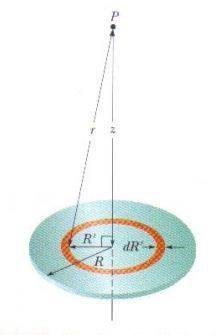
My physics book when providing proof of the electric potential of a disk tells me that the area of a ring with radius R' and width dR' is 2 \pi R'dR'
ringofcharge.JPG

The problem is, I have no idea how he arrives at this conclusion. Here is my attempt:
A = \pi (R'+dR')^2 - PiR'^2\\ A = \pi(R'^2 + dR'^2 + 2R'dR') - \pi R'^2 \\ A = \pi dR'^2 + 2 \pi R' dR'
Which is, of course, different from what my book says:
A = \pi dR'^2 + 2 \pi R' dR' \neq 2 \pi R'dR'
 
Physics news on Phys.org
Notice that dR'^2 is the square of an infinitesimal quantity, which we take to be zero. So your derivation works out.
 
When doing infinitesimal proofs like this any squared terms are negligible - for example your dR'^2 should be thrown out.

An alternate way to see the result is if you cut the ring and lay it out flat it's a rectangle (almost) with side lengths easily calculated.
 
I will drop the primes so as not to confuse with the derivative. What your text is using is the differential approximation to the annulus area. You have a circle of area ##A=\pi R^2##. The approximate change in area when ##R## is changed by an amount ##dR## is the differential ##A'dR = 2\pi R dR## which approximates the exact change, which you have calculated. For small ##dR## you can ignore the ##dR^2## term.

[Edit] Wow! Two other answers just while I was typing. That's life in PF.
 
Ohh, I see ! Thanks to you three, that perfectly cleared my doubt.
 
A disk of radius R has area \pi R^2. A disk of radius R+ dR has area \pi(R+ dR)^2= \pi R^2+ 2\pi RdR+ \pi(dR)^2. The area of the annulus between them is 2\pi RdR+\pi (dR)^2. If dR is much smaller than R, that is approximatelyu 2\pi RdR.
 

Similar threads

  • · Replies 19 ·
Replies
19
Views
2K
  • · Replies 9 ·
Replies
9
Views
2K
Replies
3
Views
2K
Replies
4
Views
4K
  • · Replies 13 ·
Replies
13
Views
5K
  • · Replies 11 ·
Replies
11
Views
1K
Replies
4
Views
1K
  • · Replies 10 ·
Replies
10
Views
6K
  • · Replies 33 ·
2
Replies
33
Views
3K
  • · Replies 8 ·
Replies
8
Views
2K