Calculating buckling strength of steel pipe for non-axial load

Click For Summary
SUMMARY

This discussion focuses on calculating the buckling strength of steel pipes under non-axial loads, specifically for a 33' tall chaotic pendulum design. The applied force at the fixed end of the pipe is approximately 2800N. Key calculations include the moment of inertia (I), bending moment (M), and bending stress (sigma), with recommendations to ensure that the ratio of outside diameter (OD) to wall thickness (t) does not exceed 40. The maximum allowable bending stress should be limited to 120-125 MPa to maintain a safety factor.

PREREQUISITES
  • Understanding of moment of inertia (I) calculations
  • Knowledge of bending stress and its calculation
  • Familiarity with the properties of steel grades, specifically ASTM A-36 and Grade A pipe
  • Basic principles of structural engineering and flexural buckling
NEXT STEPS
  • Research the "Specification for Structural Steel Buildings (ANSI/AISC 360-10)" for detailed guidelines
  • Learn about Euler's formula for flexural buckling in structural engineering
  • Explore advanced calculations for bending moments in cantilever beams
  • Investigate the mechanical properties of different steel grades and their implications on design
USEFUL FOR

Structural engineers, mechanical engineers, and anyone involved in the design and analysis of steel structures, particularly those working with non-axial loads and buckling analysis.

sudnak
Messages
3
Reaction score
0
Hello All,

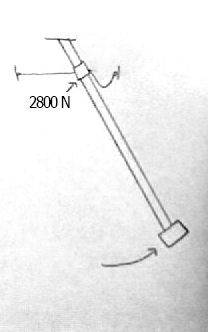
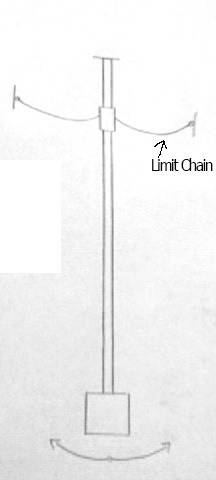
I am in the process of creating a 33' tall chaotic pendulum, and cannot find any calculations for the buckling strength of pipe. The pendulum swings from side to side, but is stopped as it goes too far one way or another by a limiting cable attached to a sleeve over the pendulum. So, essentially I have a pipe supported on one end and free on the other, and there will be a force applied to the end of the pipe. I need to know how to calculate the amount of force that different size pipes can take before they buckle. The force from the load, calculated at the fixed end of the pipe, is about 2800N. See picture for details. So, what formulas can I use to find this? Would I calculate section modulus and moment of inertia? Thanks for all the help!
pend force 1.jpg


pend force 2.jpg
 
Engineering news on Phys.org
sudnak: Ensure d2/t does not exceed 40, and then your steel pipe will not flexurally buckle, where d2 = pipe outside diameter (OD), and t = pipe wall thickness.

Yes, compute moment of inertia (I). Also compute bending moment (M) on the pipe at the cable. Then compute sigma = M*c/I. Ensure sigma does not exceed 170 MPa.

Because you have the cable tensile force, you can compute bending moment M, but you will need the distance from the pivot to the cable attach point, the distance from the pivot to the mass, the mass of the mass, and the angle between a vertical line and the pipe when the cable tensile force is 2800 N.
 
Last edited:
What is c in your M*c/I?
 
c = OD/2, where OD is outside diameter of the pipe.
 
You haven't specified the type of piping material or grade you are using. For ordinary pipe material, the maximum tensile strength is lower than that for ordinary steel (30 ksi for Grade A pipe v 36 ksi for ASTM A-36 steel). I would limit the max. bending stress to 120-125 MPa (18 ksi) to give yourself a reasonable factor of safety.
 
Awesome, thank you so much for the recommendations, I cannot tell you how much it helps!
 
Hi, i have some annotations:
- In this case, the kind of stress is bending, not buckling.
- I recommend you to consult the "Specification for Structural Steel Buildings (ANSI/AISC 360-10)": http://www.aisc.org/WorkArea/showcontent.aspx?id=26516 (go to F.8 chapter).
 
Last edited by a moderator:
mauchitoq: No, sudnak is correctly referring to flexural buckling, as well as bending stress. This was covered in post 2. Recheck, e.g., the subject title of the thread.
 
Last edited:
nvn: it's true. But in steel structural engineering, buckling usually is about the behavior explained with Euler formula, and not with the stress failure criteria.
 

Similar threads

Replies
2
Views
2K
  • · Replies 1 ·
Replies
1
Views
8K
  • · Replies 1 ·
Replies
1
Views
3K
Replies
6
Views
10K
Replies
3
Views
2K
  • · Replies 1 ·
Replies
1
Views
7K
Replies
1
Views
3K
Replies
5
Views
2K
  • · Replies 5 ·
Replies
5
Views
2K
Replies
2
Views
2K