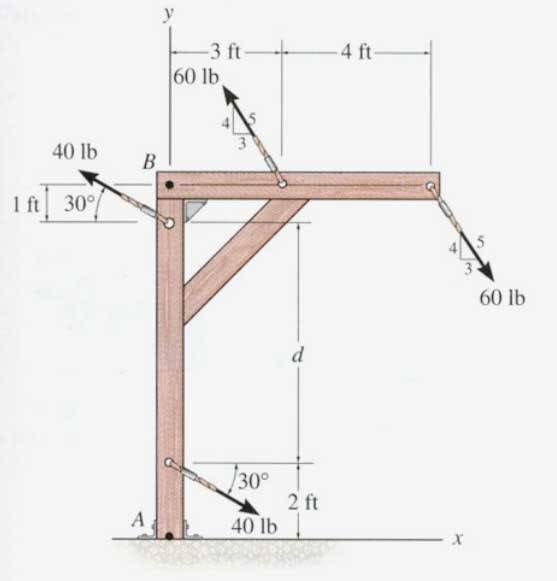
Calculating Couple Moment - Explaining Negative Values

  • Context: High School 
  • Thread starter Thread starter unknown_2
  • Start date Start date
  • Tags Tags
    Couple Moment Negative
Click For Summary
SUMMARY

The discussion centers on calculating couple moments in mechanics, specifically addressing the use of negative values in moment calculations. The formula \(\sum M = \sum Fd\) is applied, with an example yielding a moment of \(-(48 \text{ lb})(4 \text{ ft}) + (40 \text{ lb})(\cos 30)(8 \text{ ft})\). The negative sign indicates a clockwise rotation, which is a standard convention in mechanics. Clarification is sought regarding the distance used in the calculations, with a suggestion that '8 ft' should be replaced with a variable 'd ft'.

PREREQUISITES
  • Understanding of couple moments in mechanics
  • Familiarity with trigonometric functions, specifically cosine
  • Knowledge of rotational dynamics conventions
  • Basic proficiency in force and moment calculations
NEXT STEPS
  • Study the conventions of moment direction in mechanics
  • Learn about the application of trigonometric functions in force calculations
  • Explore examples of couple moment calculations in engineering contexts
  • Investigate the significance of distance variables in moment equations
USEFUL FOR

Students and professionals in mechanical engineering, physics enthusiasts, and anyone involved in structural analysis or dynamics who seeks to understand couple moments and their calculations.

unknown_2
Messages
28
Reaction score
0
Hey, I'm having some difficulty calculating couple moment. i understand that \sumM = \sumFd. here's an example:
question.jpg

it asks to resolve the couple forces.

the answer is:
(4/5)(60lb) = 48lb
and
(40lb)(cos30)

\sumM = -(48lb)(4ft) + (40lb)(cos30)(8ft)

Now, i don't understand why "-(48lb)(4ft)" is negative. I'm not sure when to use a negative value. Can someone explain this to me?

Cheers
 
Physics news on Phys.org
unknown_2 said:
Hey, I'm having some difficulty calculating couple moment. i understand that \sumM = \sumFd. here's an example:
question.jpg

it asks to resolve the couple forces.

the answer is:
(4/5)(60lb) = 48lb
and
(40lb)(cos30)

\sumM = -(48lb)(4ft) + (40lb)(cos30)(8ft)

Now, i don't understand why "-(48lb)(4ft)" is negative. I'm not sure when to use a negative value. Can someone explain this to me?

Cheers

It's a matter of convention. Typically, the clockwise direction is negative and counter-clockwise is positive. So if the applied force causes rotation in the clockwise direction, the moment is negative and vice-versa.

CS
 
I don't see where '8 ft' comes in. Shouldn't that be 'd ft'?
 

Similar threads

  • · Replies 3 ·
Replies
3
Views
3K
Replies
24
Views
5K
  • · Replies 3 ·
Replies
3
Views
4K
  • · Replies 10 ·
Replies
10
Views
3K
  • · Replies 1 ·
Replies
1
Views
2K
  • · Replies 5 ·
Replies
5
Views
2K
Replies
4
Views
3K
Replies
3
Views
2K
  • · Replies 4 ·
Replies
4
Views
7K
  • · Replies 14 ·
Replies
14
Views
2K