Calculating Electric Field Near Two Wires Using Vector Notation

Click For Summary
SUMMARY

The discussion focuses on calculating the electric field near two parallel wires using vector notation. Participants emphasize the importance of applying unit vector notation and vector addition to determine the total electric field. The electric field due to each wire can be calculated independently, with the direction being radially outward from the wires. The conversation clarifies that the total electric field is found by summing the individual fields rather than assuming cancellation.

PREREQUISITES
  • Understanding of electric fields and their properties
  • Familiarity with vector notation and vector addition
  • Knowledge of trigonometric functions for direction calculations
  • Basic principles of electrostatics, particularly for uniformly charged wires
NEXT STEPS
  • Study the principles of electric fields generated by charged wires
  • Learn about vector addition in physics, particularly in electrostatics
  • Explore unit vector notation and its applications in physics
  • Investigate the effects of multiple charge distributions on electric fields
USEFUL FOR

Students studying electromagnetism, physics educators, and anyone interested in understanding electric fields generated by charged conductors.

tscuseria
Messages
1
Reaction score
0
I'm not asking for the solutions, I just need to know what methods to use.
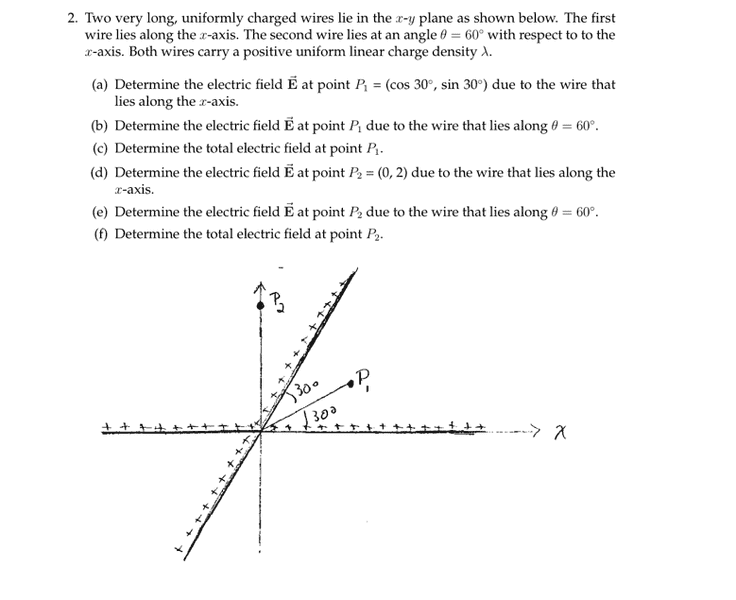
Homework Statement

bprZ9.png


The Attempt at a Solution


I got this equation using this method
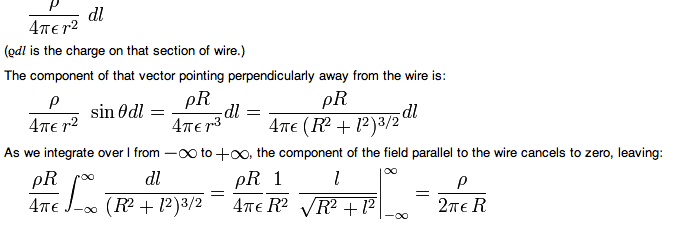
hq4KL.png


but I don't know how to apply it to the questions. I think I need to be using unit vector notation as well?

Also, it asks for the total field, but don't both wires cancel each other out?
 
Physics news on Phys.org
If By ρ you mean λ ...

What do you think R is in your eqn?

Using that you can easily find Electric field due to 2 wires independently and also using some trigo you can also find the directions (directions are radially outwards from long uniformly charged wires)
Then just sum the individual E using vector additions law.
 

Similar threads

  • · Replies 6 ·
Replies
6
Views
2K
  • · Replies 7 ·
Replies
7
Views
3K
Replies
14
Views
3K
  • · Replies 5 ·
Replies
5
Views
2K
Replies
14
Views
5K
Replies
7
Views
3K
  • · Replies 10 ·
Replies
10
Views
3K
Replies
6
Views
2K
  • · Replies 1 ·
Replies
1
Views
2K
  • · Replies 68 ·
3
Replies
68
Views
8K