Nevolute
- 3
- 0
Homework Statement
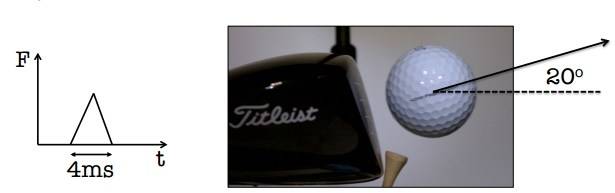
You hit a golf ball (mass 50g) squarely with the club face from ground level on a flat golf course. The ball leaves the club at an angle of 20 degrees above horizontal and travels 250m before hitting the ground. The force vs time graph below shows the force exerted on the ball by the club. Find the maximum value of the force applied to the ball by the club. Ignore air resistance.
The attempt at a solution
I feel like we are missing one variable. So we know the distance the ball travels but no initial speed. I looked at kinematics equations but I can't solve because we are not given any speed or time (aside from the time of the impulse). I can't use energy equations because we don't know h for Potential Energy = mgh. Can't use Kinetic Energy =1/2mv^2 because we don't know v. Can't use any of the kinematics equations because we are missing either time or v initial or delta y.
Basically, the graph gives us the time it takes for the change in p (momentum represented as mass and velocity) to occur. The initial momentum of the golf ball is 0 and the final momentum can be known only with velocity, which is a consideration of distance and time.
We know how far the ball travels but not the time it spends in the air nor the height it attains (can't use trig with the angle since the motion is projectile like and thus parabolic). If we knew how hard the ball was struck we could calculate a velocity or if we knew either the time or height attained by the ball, we could calculate a speed to find the momentum/force imparted to the ball be the club. I don't think this problem is solvable with the current data.
Anyone have any insight into this?
You hit a golf ball (mass 50g) squarely with the club face from ground level on a flat golf course. The ball leaves the club at an angle of 20 degrees above horizontal and travels 250m before hitting the ground. The force vs time graph below shows the force exerted on the ball by the club. Find the maximum value of the force applied to the ball by the club. Ignore air resistance.
The attempt at a solution
I feel like we are missing one variable. So we know the distance the ball travels but no initial speed. I looked at kinematics equations but I can't solve because we are not given any speed or time (aside from the time of the impulse). I can't use energy equations because we don't know h for Potential Energy = mgh. Can't use Kinetic Energy =1/2mv^2 because we don't know v. Can't use any of the kinematics equations because we are missing either time or v initial or delta y.
Basically, the graph gives us the time it takes for the change in p (momentum represented as mass and velocity) to occur. The initial momentum of the golf ball is 0 and the final momentum can be known only with velocity, which is a consideration of distance and time.
We know how far the ball travels but not the time it spends in the air nor the height it attains (can't use trig with the angle since the motion is projectile like and thus parabolic). If we knew how hard the ball was struck we could calculate a velocity or if we knew either the time or height attained by the ball, we could calculate a speed to find the momentum/force imparted to the ball be the club. I don't think this problem is solvable with the current data.
Anyone have any insight into this?
