Calculating Gravity: Mass, Radius & Wall Thickness

  • Context: Undergrad 
  • Thread starter Thread starter Timothy Schablin
  • Start date Start date
  • Tags Tags
    Gravity
Click For Summary

Discussion Overview

The discussion revolves around calculating gravitational effects for two objects with the same mass and radius, where one is hollow with a specified wall thickness. Participants explore the appropriate radius to use in the gravity equation and clarify the distinction between individual object gravity and mutual gravitational attraction.

Discussion Character

  • Technical explanation
  • Conceptual clarification
  • Debate/contested
  • Mathematical reasoning

Main Points Raised

  • Some participants question whether to use the total radius or the wall thickness in the gravity equation for the hollow object.
  • One participant states the gravity equation as $$mg = \frac{GMm}{r^2}$$, emphasizing that ##r## is the distance between the centers of mass.
  • Another participant proposes a formula that includes both the radius of the hollow section and the total radius, suggesting $$g = Gm/(R+r)(R-r)$$ but expresses uncertainty about its correctness.
  • Several participants clarify that the focus is on the gravity of each individual object rather than the gravitational attraction between them.
  • A participant references Newton's shell theorem, indicating that gravitational effects can be treated as if the mass is concentrated at the center of the object.
  • One participant explains that gravity depends on the distance from the mass, noting it follows an inverse square law.
  • Another participant discusses how their own gravity varies based on distance from their body, suggesting that non-spherical shapes complicate gravitational calculations.
  • A later reply challenges the correctness of the previous participant's calculations, stating that Newton's shell theorem does not apply to non-spherical objects and suggests a more complex integration approach for accurate results.

Areas of Agreement / Disagreement

Participants express differing views on the appropriate radius to use in the gravity calculations, and there is no consensus on the validity of the proposed formulas or the implications of the shell theorem for non-spherical objects.

Contextual Notes

Participants note the complexity of gravitational calculations for non-spherical objects and the need for integration of mass density to accurately determine gravitational effects at various points.

Timothy Schablin
Messages
17
Reaction score
0
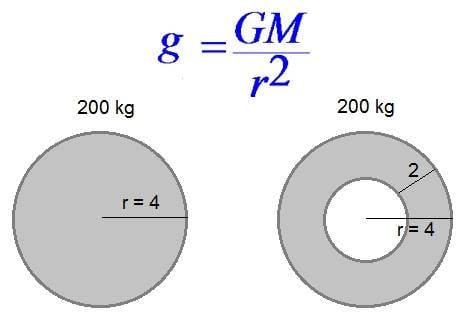
Consider the 2 objects in the pic. They both have the same mass of 200 kg. They both have a radius of 4 meters. However, the object on the right is hollow, with the walls being 2 meters thick. For the gravity equation, and the object on the right, does one use a radius of 4 squared, or the wall thickness of 2 squared?

a>
object_1.jpg
 
Physics news on Phys.org
Timothy Schablin said:
Consider the 2 objects in the pic. They both have the same mass of 200 kg. They both have a radius of 4 meters. However, the object on the right is hollow, with the walls being 2 meters thick. For the gravity equation, and the object on the right, does one use a radius of 4 squared, or the wall thickness of 2 squared?

a>
View attachment 207047
Outside of either object, the mass acts as a point mass at the center as far as gravitational attraction is concerned.
 
Just to avoid confusion, we're looking for gravity of each individual object, not the attraction between them.

I was actually thinking of a formula that included the radius of the hollow section (r) and total radius (R).

g = Gm/(R+r)(R-r)

Not so sure tho... Its probably just the normal formula of g = Gm/r^2
 
Timothy Schablin said:
Just to avoid confusion, we're looking for gravity of each individual object, not the attraction between them.

I was actually thinking of a formula that included the radius of the hollow section (r) and total radius (R).

g = Gm/(R+r)(R-r)

Not so sure tho... Its probably just the normal formula of g = Gm/r^2
So, did you not believe what I told you in post #2 ?
 
Timothy Schablin said:
Just to avoid confusion, we're looking for gravity of each individual object, not the attraction between them.

I was actually thinking of a formula that included the radius of the hollow section (r) and total radius (R).

g = Gm/(R+r)(R-r)

Not so sure tho... Its probably just the normal formula of g = Gm/r^2
It's not obvious, but Newton proved that you can use the center of the object. (see https://en.wikipedia.org/wiki/Shell_theorem )
 
Thanks. Shell theorem is good reading.
 
Timothy Schablin said:
Just to avoid confusion, we're looking for gravity of each individual object, not the attraction between them.
What is the difference? Or am I missing something? The Earth is attracted to a small object as much as the small object is attracted to the Earth.

1st example: Knowing the Earth radius is ##r = 6\ 371\ 000\ m## and its mass ##M = 5.972 \times 10^{24}\ kg## what is the acceleration ##g## felt by a human of mass ##m = 75\ kg## near its surface?
$$mg = \frac{GMm}{r^2}$$
$$g = \frac{GM}{r^2}$$
$$g = \frac{(6.674 \times 10^{-11}) \times (5.972 \times 10^{24})}{(6\ 371\ 000)^2}$$
$$g = 9.82\ m/s^2$$
2nd example: Knowing the Earth radius is ##r = 6\ 371\ 000\ m## and its mass ##M = 5.972 \times 10^{24}\ kg## what is the acceleration ##g_h## felt by the Earth towards a human of mass ##m = 75\ kg## near its surface?
$$Mg_h = \frac{GMm}{r^2}$$
$$g_h = \frac{Gm}{r^2}$$
$$g_h = \frac{(6.674 \times 10^{-11}) \times (75)}{(6\ 371\ 000)^2}$$
$$g_h = 1.23 \times 10^{-22}\ m/s^2$$
The Earth is accelerating towards the human just like the human is accelerating towards the Earth. The Earth will not move because there is probably another human of the same mass on the other side of the planet that balances that acceleration, but the «human gravity» is still there.
 
Timothy Schablin said:
Just to avoid confusion, we're looking for gravity of each individual object, not the attraction between them.
jack action said:
What is the difference? Or am I missing something?
As I read it, "the gravity of each individual object" is intended to mean the acceleration of an ideal test particle under the influence of the object's gravity, that is, the quantity ##Gm/r^2## for these spherically symmetric objects, and the question is what is the approriate value of ##r## to use in the calculation.
 
  • #10
Nugatory said:
As I read it, "the gravity of each individual object" is intended to mean the acceleration of an ideal test particle under the influence of the object's gravity, that is, the quantity ##Gm/r^2## for these spherically symmetric objects, and the question is what is the approriate value of ##r## to use in the calculation.
But with the addition of the equation ##g=\frac{GM}{r^2}## found in the OP, that would suggests that ##r## is always the distance from the center of mass of the object to a point on the outside surface of the object (where the ideal test particle is), no matter the shape of that object. That is what I was trying to point out.

My "gravity" - if I have a mass of 75 kg, measure 180 cm high and 40 cm wide - is 6.18 X 10⁻⁹ m/s2 (##r## = 90 cm) for a particle on top of my head and 1.25 X 10⁻⁷ m/s2(##r## = 20 cm) for one on the side of my waist. If I was a sphere, then my ""gravity" would be the same for any point at my surface since the distance ##r## would be the same everywhere.
 
  • #11
Your gravity depends on how far away you are measuring it. It's an inverse square law.
 
  • #12
jack action said:
My "gravity" - if I have a mass of 75 kg, measure 180 cm high and 40 cm wide - is 6.18 X 10⁻⁹ m/s2 (##r## = 90 cm) for a particle on top of my head and 1.25 X 10⁻⁷ m/s2(##r## = 20 cm) for one on the side of my waist. If I was a sphere, then my ""gravity" would be the same for any point at my surface since the distance ##r## would be the same everywhere.
Since you are not a sphere, Newton's shell theorem does not apply and a simple inverse square calculation will not work. The results above are not correct.

You would have to integrate your body mass density divided by r3 and multiplied by ##\vec{r}## over the volume of your body to get the net gravitational effect on a test particle at a particular point.
 
Last edited:
  • Like
Likes   Reactions: jack action
  • #13
how do i mark this as 'resolved'?
 
  • #14
Timothy Schablin said:
how do i mark this as 'resolved'?
You don't - that's only for threads in the homework section.
 

Similar threads

  • · Replies 4 ·
Replies
4
Views
1K
  • · Replies 7 ·
Replies
7
Views
2K
  • · Replies 12 ·
Replies
12
Views
2K
  • · Replies 14 ·
Replies
14
Views
2K
  • · Replies 10 ·
Replies
10
Views
2K
  • · Replies 138 ·
5
Replies
138
Views
9K
  • · Replies 30 ·
2
Replies
30
Views
3K
  • · Replies 10 ·
Replies
10
Views
1K
  • · Replies 32 ·
2
Replies
32
Views
3K
  • · Replies 14 ·
Replies
14
Views
2K