Calculating Heat Energy in a Refrigerator - Solving for Qh and Qc

Click For Summary

Homework Help Overview

The discussion revolves around calculating the heat energy involved in the process of cooling water to ice within a refrigerator, specifically focusing on the heat exhausted into the room as the water transitions from 288 K to 258 K. The problem involves concepts from thermodynamics, particularly the coefficient of performance (COP) of refrigerators.

Discussion Character

  • Mixed

Approaches and Questions Raised

  • Participants explore various methods to calculate the heat energy, including the use of the Brayton-cycle model and the relationship between heat removed and temperature changes. There are questions about the assumptions regarding the temperatures and the need for specific heat values.

Discussion Status

Some participants have suggested simplifying the problem by focusing on the heat removal process rather than the details of the refrigeration cycle. There is ongoing exploration of how to calculate the heat lost by the water and the relationship between Qc and Qh, with some guidance provided on using specific heat and latent heat values.

Contextual Notes

Participants express uncertainty about the required parameters, such as the number of moles and pressure, and the appropriateness of using the Brayton-cycle model for a system involving water. The discussion reflects a mix of assumptions and clarifications regarding the thermodynamic principles at play.

dekoi
100 mL of water at 288 K is placed in the freezer compartment of a refrigerator with a coefficient of performance of 4.0. How much heat energy is exhausted into the room as the water is changed to ice at 258 K?

(The answer is 5.34 x 10^4 J)

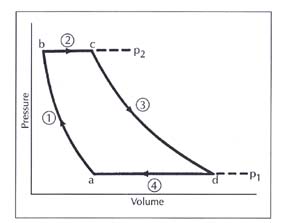
I tried using the Brayton-cycle refrigerator to understand this problem.
ffdsptech0424a.jpg


I am assuming that the lower isobar is the part of the graph that I need to analyze, where the low-temperature heat exchanger warms the gas and cools the refrigerator. With this method, I know that [tex]Q = nC_v\Delta T[/tex]. However, I cannot think of a way to find the number of moles (n).

I also don't know if my reasoning is correct (that is, only using the lower isobar of the graph to answer my question).

I am also assuming that my lower temperature (258 K) is equivalent to Tc, and my higher temperature (288 K) is equivalent to Th.
I am not sure if this is correct, however.

I have realized that I need to use work (in) to answer the question, because K = Q / W.

However, the work for an isobar is W = pV, and I do not know the pressure, and am unable to find it since I do not know the number of moles.

Any advice will be greatly appreciated, thank you.
 
Physics news on Phys.org
Seems like you are overcomplicating things. How much "heat" must be removed from the water to (1) cool it to freezing, (2) freeze it, and (3) cool it to its final temperature?
 
From the other thread (double posted):
https://www.physicsforums.com/showthread.php?t=101662

You don't know, or have to know, the details of the cycle. All you have to do is find [itex]Q_H = W + Q_C[/itex] where:
[tex]COP = Q_C/W[/tex]

[tex]Q_C[/tex] is the heat lost by the water (you have to take into account temperature change + heat of fusion).

dekoi said:
What is COP?

And I don't think we are required to know heat of fusion, so there must be some other way to solve the problem.

COP = Coefficient of performance = Qc/W (for a refrigerator)

Of course you have to know the heat of fusion! How else do you determine how much heat is removed from the water? If you use 33.4 KJ/100g and add the heat lost due to temperature decrease you will get the right answer.

AM
 
Last edited by a moderator:
Doc Al said:
Seems like you are overcomplicating things. How much "heat" must be removed from the water to (1) cool it to freezing, (2) freeze it, and (3) cool it to its final temperature?
Am I finding Q for each step of the reaction, and then finding the overall Qh?Also, am I able to use the reversed Brayton-cycle as my model for the refrigerator, because that is for an ideal gas refrigerator, and my refrigerator has water (which is not an ideal gas).
 
Last edited by a moderator:
dekoi said:
Am I finding Q for each step of the reaction, and then finding the overall Qh?
You are simply finding how much heat must be removed from the water in order to take it from one temperature to another. This is Qc, not Qh!


Also, am I able to use the reversed Brayton-cycle as my model for the refrigerator, because that is for an ideal gas refrigerator, and my refrigerator has water (which is not an ideal gas).
Forget about the details of the cycle. All you need to know is the COP, which is given. (I think you are confusing the water in this refrigerator with the working fluid in a Brayton-cycle refrigerator. This water is just something being cooled by the refrigerator; it's not the working fluid!)
 
Okay, so I understand that I am not using the Brayton-cycle refrigerator.

So, how do I find Qc from the information given?
What is Qc equal to?
nCpT?
or something else?

What is Cp for water?
 
[tex]K = Qc / W_{in}[/tex]

therefore,
[tex]Qc = (K)(W_{in})[/tex]

But what is [tex]W_{in}[/tex]?
[tex](P)(\Delta V)[/tex]?
But I do not know the pressure... I only know the two volumes.

I think I can find moles by taking the density of the water to be 1000 kg/L...
but then i get n = 5555.56 mol, which I thought was rather large.
 
Last edited by a moderator:
dekoi said:
[tex]K = Qc / W_{in}[/tex]
therefore,
[tex]Qc = (K)(W_{in})[/tex]
But what is [tex]W_{in}[/tex]?
[tex](P)(\Delta V)[/tex]?
But I do not know the pressure... I only know the two volumes.
I think I can find moles by taking the density of the water to be 1000 kg/L...
but then i get n = 5555.56 mol, which I thought was rather large.
Read the above responses again. We have given you all you need to know.

Use [itex]Q = Cm\Delta T[/itex] and [itex]Q_f = mH_f[/itex] where C is the specific heat (water = 4186 J/Kg*deg.K, ice = 2020 J/Kg*deg.K, and Hf = latent heat = 3340 J/Kg. Add all that up. That gives you Qc. Then use the relationship between Qc and COP to find Qh.

AM
 
Last edited:
Andrew Mason said:
Read the above responses again. We have given you all you need to know.
Use [itex]Q = Cm\Delta T[/itex] and [itex]Q_f = mH_f[/itex] where C is the specific heat (water = 4186 J/Kg*deg.K, ice = 2020 J/Kg*deg.K, and Hf = latent heat = 3340 J/Kg. Add all that up. That gives you Qc. Then use the relationship between Qc and COP to find Qh.
AM

I think that's what I will have to do...
I was unsure at first because I don't recall learning that, but I looked back in my textbook and it's here...

Well I'm going to see my professor today anyway, just in case.

Thanks :)
 

Similar threads

  • · Replies 2 ·
Replies
2
Views
2K
Replies
2
Views
4K
  • · Replies 6 ·
Replies
6
Views
6K
  • · Replies 3 ·
Replies
3
Views
1K
  • · Replies 2 ·
Replies
2
Views
3K
Replies
2
Views
274
  • · Replies 3 ·
Replies
3
Views
2K
  • · Replies 2 ·
Replies
2
Views
1K
Replies
25
Views
2K
  • · Replies 3 ·
Replies
3
Views
2K