Work required to extract heat from a refrigerator

guyvsdcsniper
Messages
264
Reaction score
37
Homework Statement
A reversible refrigerator engine extracts heat from
the inside of a refrigerator compartment kept at 8°C and rejects unwanted
heat QH to its 20°C exterior. Find the work required to extract one calorie
from the interior of the refrigerator compartment
Relevant Equations
dQ/T=0
The answer key says the work done should be +.043cal. I am getting a negative sign.

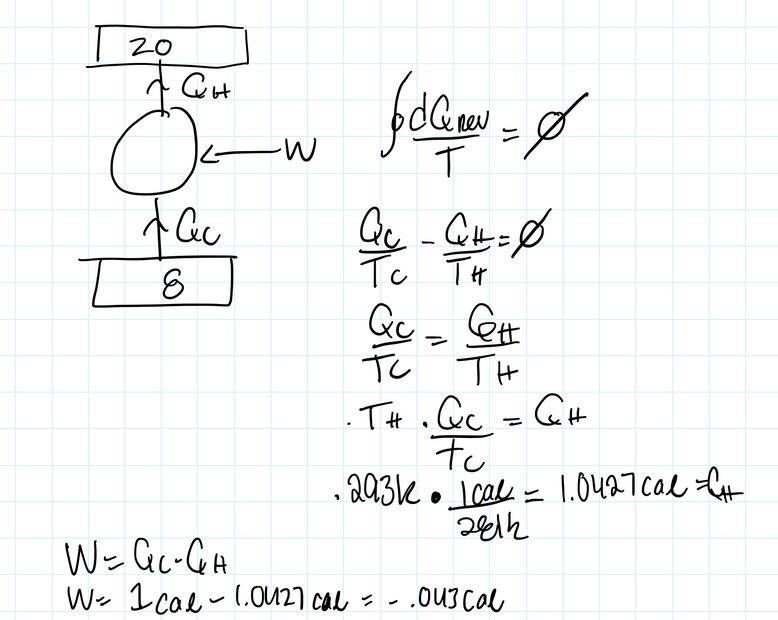
I have posted my work in the attached image.
My logic is that since this a reversible engine we can say the integral of dQ/T=0. Looking at the cycle, Qc isi being absorbed (Qc>0) and Qh is being rejected (Qh<0). Then we can say Qc/Tc-Qh/Th=0.

Solving for Qh, we get 1.0427cal.
We also know W= the integral of dQ. So we can say W=Qc-Qh.

Doing so makes me get a negative sign.

I guess from my perspective the negative indicates the system is doing work, hence W<0.

Am I doing something wrong/looking at the situation from a different perspective by getting this negative sign?
IMG_0347.jpg
 
  • Like
Likes   Reactions: Delta2
Physics news on Phys.org
quittingthecult said:
Homework Statement:: A reversible refrigerator engine extracts heat from
the inside of a refrigerator compartment kept at 8°C and rejects unwanted
heat QH to its 20°C exterior. Find the work required to extract one calorie
from the interior of the refrigerator compartment
Relevant Equations:: dQ/T=0

The answer key says the work done should be +.043cal. I am getting a negative sign.

I have posted my work in the attached image.
My logic is that since this a reversible engine we can say the integral of dQ/T=0. Looking at the cycle, Qc isi being absorbed (Qc>0) and Qh is being rejected (Qh<0). Then we can say Qc/Tc-Qh/Th=0.
If ##Q_c>0## and ##Q_h<0##, then ##\frac{Q_C}{T_C}-\frac{Q_H}{T_H}## will be positive. You should either have a plus sign in between or use absolute values.

quittingthecult said:
Solving for Qh, we get 1.0427cal.
We also know W= the integral of dQ. So we can say W=Qc-Qh.
Look at the arrows in your diagram. The energy coming into the system is ##|W|+Q_c##, and the energy going out is ##|Q_h|##. Conservation of energy requires ##|Q_h| = |W| + Q_c##.

quittingthecult said:
Doing so makes me get a negative sign.

I guess from my perspective the negative indicates the system is doing work, hence W<0.
The usual convention is if the system does work on the environment, ##W## is positive. Are you using a different convention or did you make a mistake?
 
  • Like
Likes   Reactions: BvU and guyvsdcsniper
vela said:
If ##Q_c>0## and ##Q_h<0##, then ##\frac{Q_C}{T_C}-\frac{Q_H}{T_H}## will be positive. You should either have a plus sign in between or use absolute values.Look at the arrows in your diagram. The energy coming into the system is ##|W|+Q_c##, and the energy going out is ##|Q_h|##. Conservation of energy requires ##|Q_h| = |W| + Q_c##.The usual convention is if the system does work on the environment, ##W## is positive. Are you using a different convention or did you make a mistake?
Ah your right. I overthought this way too hard. I should have just looked at the arrows.

Thank you, your response has helped me realize the mistake i made.
 
  • Like
Likes   Reactions: BvU

Similar threads

Replies
1
Views
1K
  • · Replies 2 ·
Replies
2
Views
3K
  • · Replies 5 ·
Replies
5
Views
2K
  • · Replies 20 ·
Replies
20
Views
3K
  • · Replies 23 ·
Replies
23
Views
5K
  • · Replies 6 ·
Replies
6
Views
3K
  • · Replies 11 ·
Replies
11
Views
3K
  • · Replies 1 ·
Replies
1
Views
2K
  • · Replies 3 ·
Replies
3
Views
2K
  • · Replies 2 ·
Replies
2
Views
3K