Discussion Overview
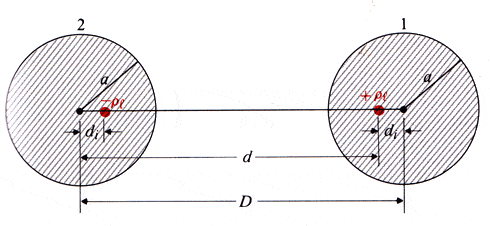
The discussion revolves around calculating image line charges for multiple conductors, specifically in the context of determining the capacitance of two transmission wires when additional conductors are introduced. Participants explore the implications of these additional conductors on the configuration of image charges and the overall capacitance.
Discussion Character
- Exploratory
- Technical explanation
- Conceptual clarification
- Debate/contested
- Mathematical reasoning
Main Points Raised
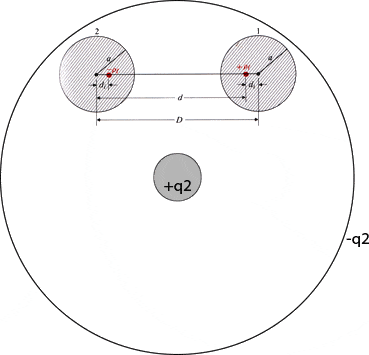
- One participant questions how the addition of two more conductors affects the placement of image line charges and whether this can be analyzed analytically.
- Another participant seeks clarification on whether the conductors are part of a coaxial cable and inquires about the connections of the charges to a voltage source.
- A participant clarifies that the conductors are connected to different voltage sources, complicating the analysis of capacitance and the placement of image charges.
- One participant suggests using Gauss' Law to approach the problem but expresses uncertainty about determining the electric field near the conductors and calculating capacitance.
Areas of Agreement / Disagreement
Participants do not reach a consensus on how to approach the problem, with multiple competing views on the configuration of the conductors and the implications for image charges and capacitance calculations.
Contextual Notes
There are limitations regarding the assumptions about the configuration of the conductors and their connections to voltage sources, which may affect the analysis of image charges and capacitance. The discussion also highlights unresolved mathematical steps in applying Gauss' Law.
Who May Find This Useful
This discussion may be useful for students and professionals interested in electrostatics, capacitance calculations, and the application of image charge methods in complex conductor configurations.