Calculating Mass with a Frictionless Pulley: A Physics Problem

  • Thread starter Thread starter koomba
  • Start date Start date
  • Tags Tags
    Pully
Click For Summary
SUMMARY

The discussion centers on calculating the mass m1 in a physics problem involving a frictionless pulley system. Given mass M2 of 0.150 kg and an acceleration a of 1.10 m/s² in a gravitational field of 9.81 m/s², the formula derived is M1 = M2 (1-a/g)/(1+a/g). This formula effectively allows for the calculation of m1 based on the relationship between the masses and acceleration. The user confirmed the formula's accuracy after performing the calculations.

PREREQUISITES
  • Understanding of Newton's Second Law of Motion
  • Basic knowledge of pulley systems in physics
  • Familiarity with gravitational acceleration (9.81 m/s²)
  • Ability to manipulate algebraic equations
NEXT STEPS
  • Study the principles of Newton's Laws of Motion
  • Learn about the dynamics of frictionless pulley systems
  • Explore advanced problems involving multiple masses and accelerations
  • Investigate real-world applications of pulley systems in engineering
USEFUL FOR

Students of physics, educators teaching mechanics, and anyone interested in solving problems related to dynamics and pulley systems.

koomba
Messages
9
Reaction score
0
Ok I've been working on this problem for a while, and I'm kinda new to physics, so bear with me. So here it is:

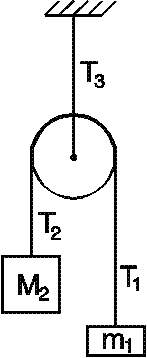
Heres the picture of the problem:
prob68_Atwood1.gif


A frictionless pulley with zero mass is attached to the ceiling, in a gravity field of 9.81 m/s2. Mass M2=0.150 kg is being accelerated downward with a=1.10 m/s2. Calculate the mass m1.

Just assume there is no compression/stretching of the rope on this problem. ALso, I guess the acceleration of M1 would be -1.10 m/s^2, correct? Beyond this I'm really confused. Any help would be greatly appreciated! Thanks.

Steven
 
Physics news on Phys.org
I suspect a/g = (M2- M1) / (M2 + M1). Then (M2 + M1) a/g = M2 - M1 . and
M1 a/g + M1 = M2 -M2 a/g so M1 = M2 (1-a/g)/(1+a/g) .
 
I'll see what kind of numbers I get with that, thanks!

Edit: Hey looks like that worked out, thanks man! :biggrin:
 
Last edited:
The book claims the answer is that all the magnitudes are the same because "the gravitational force on the penguin is the same". I'm having trouble understanding this. I thought the buoyant force was equal to the weight of the fluid displaced. Weight depends on mass which depends on density. Therefore, due to the differing densities the buoyant force will be different in each case? Is this incorrect?

Similar threads

  • · Replies 3 ·
Replies
3
Views
2K
  • · Replies 17 ·
Replies
17
Views
3K
  • · Replies 15 ·
Replies
15
Views
6K
  • · Replies 102 ·
4
Replies
102
Views
8K
Replies
25
Views
4K
  • · Replies 18 ·
Replies
18
Views
1K
  • · Replies 5 ·
Replies
5
Views
1K
  • · Replies 22 ·
Replies
22
Views
1K
  • · Replies 2 ·
Replies
2
Views
1K
  • · Replies 4 ·
Replies
4
Views
2K