Calculating Minimum Values for Artificial Gravity in Centripetal Force Wheels

  • Context: Undergrad 
  • Thread starter Thread starter julianwitkowski
  • Start date Start date
  • Tags Tags
    Minimum Value
Click For Summary

Discussion Overview

The discussion revolves around calculating the minimum radius and minimum RPM required for artificial gravity using a centripetal force wheel. Participants explore the mathematical relationships involved, particularly focusing on the equations governing centripetal acceleration and the implications of using different units of measurement.

Discussion Character

  • Exploratory
  • Mathematical reasoning
  • Technical explanation

Main Points Raised

  • One participant expresses a desire to calculate minimum RPM and radius for achieving a specific percentage of Earth gravity within a certain height using centripetal force.
  • Another participant suggests using angular velocity (ω) instead of RPM, stating that centripetal acceleration can be expressed as ω²r.
  • Some participants indicate that calculus may not be necessary for solving the problem, while others argue that partial derivatives could be relevant.
  • Concerns are raised about unit mismatches, specifically between RPM and radians per second, which could affect the calculations.
  • One participant mentions finding an equation on Wikipedia and questions its accuracy, suggesting that it may contain significant errors.
  • Several participants discuss the relationship between gravitational acceleration and centripetal acceleration, with equations provided for both.
  • There is a mention of needing to factor out variables in the equations, with requests for guidance on how to do so while maintaining the integrity of the calculations.

Areas of Agreement / Disagreement

Participants express differing views on whether calculus is necessary for the problem, with some asserting it is not needed while others maintain that partial derivatives are applicable. There is also a lack of consensus on the best approach to handle unit conversions and the implications of the equations presented.

Contextual Notes

Participants note potential limitations related to unit mismatches and the need for clarity in the equations used. There is also an acknowledgment of unresolved mathematical steps in the discussion.

Who May Find This Useful

This discussion may be of interest to students and enthusiasts of physics and mathematics, particularly those exploring concepts of artificial gravity and centripetal force calculations.

julianwitkowski
Messages
133
Reaction score
0
Hey thanks for reading:)

I'm trying to learn calc and I thought it would help if I could figure out how to do this...

For school I have a physics paper on artificial gravity and how it could work... I didn't post this in HW help because It's more of a written thing and I just got sidetracked by boredom.

Basically my idea is to find the min rpm and min radius for an artificial gravity via centripetal force wheel based on the percentage of Earth gravity you want within said height of the floor.

r = radius
μ = rpm
g = 9.81
n = distance from floor to keep % within

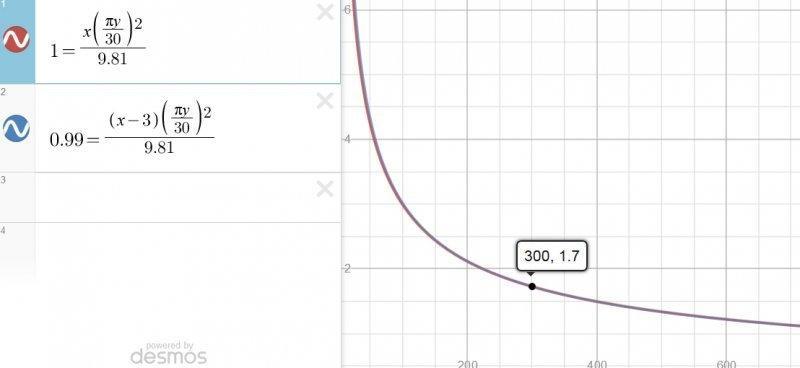
1 = r (π⋅μ /30)2 / g

0.99 = (r-n)(π⋅μ /30)2 / g

I set some parameters in this graph to keep local g within 3meters of the floor be within 99% of Earth.

My algebra and calc still aren't good enough to do this although I am dying to find out.

I can do this easily with derivative problems using only one variable but I don't want to be cheap and set a proportion for radius to rpm, Without doing that I suspect this might have to be solved with partial derivatives but I don't really know.

I solved it with a graph first, here is what it looks like... Just two lines intersecting,

Is there some general format to solve where two lives intersect?

x = radius
y = rpm
1.jpg
I'm not sure what my next step should be here..
I think I need a decent hint to get going..

I don't know if this is going the right direction although wolfram was able to solve it so maybe its on the right track at least... p = percentage difference from 100% g.

1 - [r (π⋅μ /30)2 / g] + [(r-n)(π⋅μ /30)2 / g + p] = 1

If you read this far, thank you.

:)
 
Physics news on Phys.org
You'd be better off using ω as angular velocity. Then, the centripetal acceleration is given by ##ω^2r##.

Unfortunately, you don't need any calculus to solve this!
 
Last edited:
  • Like
Likes   Reactions: julianwitkowski
This actually would be solved with partials, as you said. Here, check this out: http://tutorial.math.lamar.edu/Classes/CalcIII/RelativeExtrema.aspx

Hopefully you've gotten far enough in your calc studies to understand that. Another thing that I want to point out is that you have unit mismatch going on. You're using RPM (revolutions per minute) you want rPS (radians per second). This will allow you to get the proper values.

On the other hand, you can't really find a minimum for both. You can only find a correct value for one with respect for the other.
 
  • Like
Likes   Reactions: julianwitkowski
BiGyElLoWhAt said:
Another thing that I want to point out is that you have unit mismatch going on. You're using RPM (revolutions per minute) you want rPS (radians per second).

Thanks, but I'm concerned about the equation now. I originally found the equation on wikipedia about a year ago just looking around, you should check out the page for artificial gravity. Seems like a pretty big mistake for wikipedia to keep because they've kept it up this whole time. I'm certainly no experts so I'd have to leave this up to you guys to change...

Thank you for your advice and the link :)

PeroK said:
Unfortunately, you don't need any calculus to solve this!

Well that wouldn't too unfortunate because it's not a calculus course... but I think I see what you mean.

I found μ like this because you can factor out r...

1 - [r (π⋅μ / 30)2 / g] + [(r-n)(π⋅μ / 30)2 / g + p] = 1 ⇒ 900 g p = π² μ² n

However, I don't see how to factor out mu and keep r instead... Any leads?
 
Last edited:
You have:

##g = w^2r##
##a = w^2(r-n)##

Where a is the acceleration a distance n from the floor. And that's pretty much all you need.
 
  • Like
Likes   Reactions: julianwitkowski
PeroK said:
You have:

##g = w^2r##
##a = w^2(r-n)##

Where a is the acceleration a distance n from the floor. And that's pretty much all you need.

Ok well it sounds like I'm making this much more complicated than it needs to be.
I better read up on this because I've never really used this from what I've learned so far.

Thanks :)
 
for w = ##\frac{|v| sin(θ)}{|r|}## theta must be in radians as a description of the velocity?
 
julianwitkowski said:
for w = ##\frac{|v| sin(θ)}{|r|}## theta must be in radians as a description of the velocity?

##w = \frac{d\theta}{dt} = \frac{v}{r}##

w is in radians per second.
 
  • Like
Likes   Reactions: julianwitkowski

Similar threads

  • · Replies 6 ·
Replies
6
Views
1K
  • · Replies 20 ·
Replies
20
Views
1K
Replies
16
Views
1K
  • · Replies 3 ·
Replies
3
Views
3K
  • · Replies 8 ·
Replies
8
Views
3K
  • · Replies 10 ·
Replies
10
Views
2K
Replies
1
Views
2K
  • · Replies 3 ·
Replies
3
Views
3K
  • · Replies 1 ·
Replies
1
Views
3K
  • · Replies 14 ·
Replies
14
Views
2K