Calculating Moment: Addition of Torque Components

  • Thread starter Thread starter Saptarshi Sarkar
  • Start date Start date
  • Tags Tags
    Addition Moment
Click For Summary
The discussion revolves around calculating torque components and the confusion between direct addition and vector addition. The user calculated torque components as T_x = 18 * Fcos(30) and T_y = 5 * Fsin(30), arriving at the correct answer through direct addition despite concerns about the method. It was clarified that the torque vector is derived from the cross product of the force vector and the lever arm vector, with both components being perpendicular to the lever arm at point A. The user concluded that since both torque components point in the same direction, they can be added directly. This highlights the importance of understanding the relationship between torque, force components, and their respective directions.
Saptarshi Sarkar
Messages
98
Reaction score
13
Homework Statement
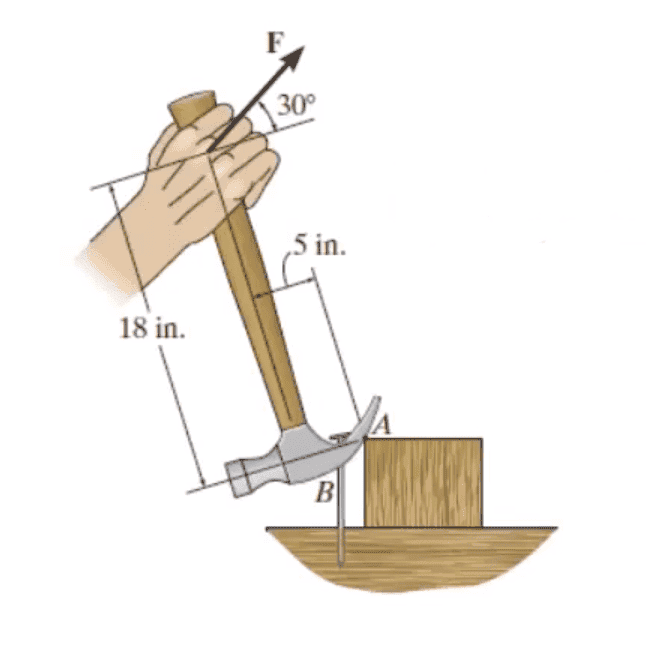
In order to pull out the nail at B, as shown in the figure, the force F exerted on the handle of the hammer must produce a clockwise moment of 500 lb-in about point A. Determine the required magnitude of force F.
Relevant Equations
##T=F\times l##
First of all, sorry for the units. This is a problem I found on the internet and am confused about the solution.

I calculated the two components of the moment (torque) to be
Screenshot_2.png


##T_x = 18\times Fcos(30)## and ##T_y=5\times Fsin(30)##

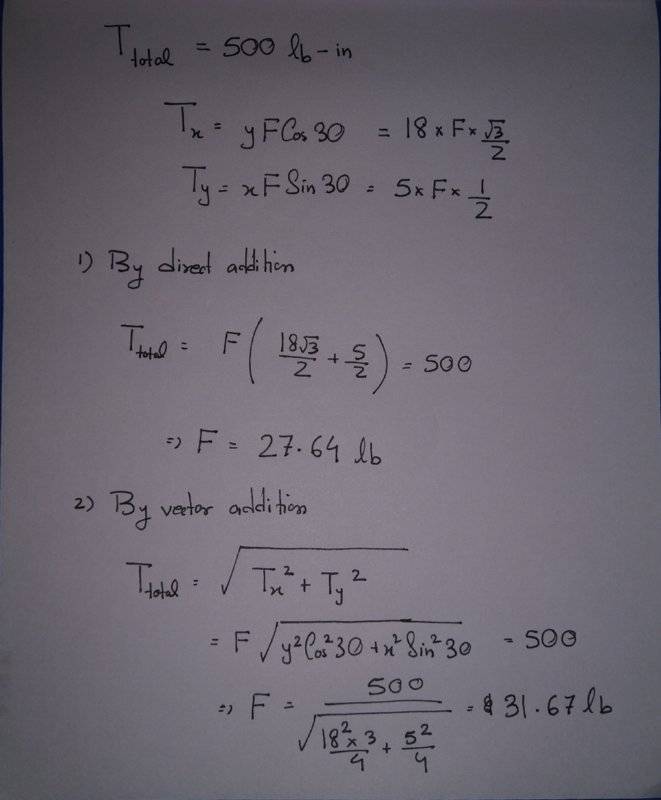
The problem is, I got the proper answer (the two options were 27.64 lb and 55.28 lb) by direct addition of the two components but did not get it by vector addition (for magnitude).
IMG_20200223_014448.jpg


I am not sure how I got the correct answer using a seemingly incorrect method.
 
Physics news on Phys.org
The torque vector is the cross product of the force vector and the lever arm vector. So what direction is it in?
 
  • Informative
Likes Saptarshi Sarkar
Solution #1 is correct because both components of F (x and y) are perpendicular to the lever of each respect to the point A, where the moment said to be applied.
Solution #2 is incorrect because you are mixing torque with your effort to determine F from its x and y components.
 
haruspex said:
The torque vector is the cross product of the force vector and the lever arm vector. So what direction is it in?

Got it. Both of the them are pointing in the same direction, so it should be added normally. Thanks!
 
The book claims the answer is that all the magnitudes are the same because "the gravitational force on the penguin is the same". I'm having trouble understanding this. I thought the buoyant force was equal to the weight of the fluid displaced. Weight depends on mass which depends on density. Therefore, due to the differing densities the buoyant force will be different in each case? Is this incorrect?

Similar threads

  • · Replies 7 ·
Replies
7
Views
1K
Replies
4
Views
2K
  • · Replies 9 ·
Replies
9
Views
4K
  • · Replies 13 ·
Replies
13
Views
3K
  • · Replies 25 ·
Replies
25
Views
2K
  • · Replies 22 ·
Replies
22
Views
3K
  • · Replies 3 ·
Replies
3
Views
2K
  • · Replies 24 ·
Replies
24
Views
1K
  • · Replies 5 ·
Replies
5
Views
2K
  • · Replies 9 ·
Replies
9
Views
2K