Calculating Net Force of Particle 5: A Problem Overview

Click For Summary
SUMMARY

The discussion focuses on calculating the net force acting on particle 5, given specific charge values and the Coulomb's constant. The net force is derived using the formula ##F_{net} = (F_{3} - F_{1})\hat i + (F_{2} + F_{4})\hat j##, with individual forces calculated as ##F_{1} = 1.627 * 10^{-26}N##, ##F_{2} = 6.508 * 10^{-26}N##, ##F_{3} = 1.627 * 10^{-26}N##, and ##F_{4} = 1.627 * 10^{-26}N##. The discussion reveals a critical error in assuming the y-component of the force remains unchanged during rotation, emphasizing that both components must adjust to maintain the vector's magnitude. The final positions of particles 1 and 3 are corrected to ##x=-0.071995## and ##x=0.071995##, respectively.

PREREQUISITES
  • Understanding of Coulomb's Law and electrostatic forces
  • Familiarity with vector components and their manipulation
  • Knowledge of trigonometric functions, specifically tangent
  • Ability to solve equations involving square roots and force calculations
NEXT STEPS
  • Study the implications of vector rotation in physics, particularly in force calculations
  • Learn about Coulomb's Law and its applications in electrostatics
  • Explore the concept of vector magnitudes and directions in two-dimensional space
  • Investigate common mistakes in force calculations and how to avoid them
USEFUL FOR

Physics students, educators, and anyone involved in solving electrostatic force problems will benefit from this discussion, particularly those focusing on vector analysis and force interactions.

Fontseeker
Messages
30
Reaction score
4
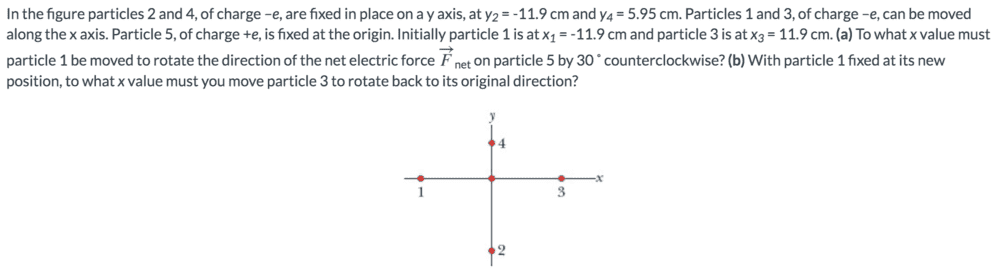
I have the following problem:

Screen Shot 2019-08-30 at 6.41.21 PM.png

So, I know the following:
##q_1 = -e##
##q_2 = -e##
##q_4 = -e##
##q_5 = e##
##e = 1.6*10^{-19}##
##k = 9*10^{9}##

Now, I can get the current ##F_{net}## of particle 5 with this information:

##F_{net} = (F_{3} - F_{1})\hat i + (F_{2} + F_{4})\hat j##
##F_{1} = k * \frac{e * e}{x_1^2} = 1.627 * 10^{-26}N##
##F_{2} = k * \frac{e * e}{y_2^2} = 6.508 * 10^{-26}N##
##F_{3} = k * \frac{e * e}{x_3^2} = 1.627 * 10^{-26}N##
##F_{4} = k * \frac{e * e}{y_4^2} = 1.627 * 10^{-26}N##

Now, I can break up ##F_{net}## into components:
##F_{x} = (1.627 * 10^{-26} - 1.627 * 10^{-26})N =0N##
##F_{y} = (6.508 * 10^{-26} - 1.627 * 10^{-26})N = 4.881 * 10^{-26}N##

To rotate ##F_{net}## by 30 degrees, I know the y component will not change, so I can make this assumption:
##\tan \theta= \frac{F_x}{F_{y}}##
so
##{F_x} = \tan \theta * F_{y} = \tan 30 * 4.881 * 10^{-26}N = 2.818 * 10^{-26}N##
and since it is rotating counterclockwise, the x component must be negative:
##{F_x} = -2.818 * 10^{-26}N##
Now, to find the new position, r, of particle 1 to get this new ##{F_x}## for the net charge of particle 5
##{F_x} = {F_3} - {F_1}##
##{F_1} = {F_3} - {F_x}##
##k * \frac{e * e}{r^2} = {F_3} - {F_x}##
##r = \sqrt {\frac{k * e * e}{{F_3} - {F_x}}}##
##r = \sqrt {\frac{k * e * e}{1.627 * 10^{-26} - (-2.818 * 10^{-26})}}##
##r = \sqrt {\frac{k * e * e}{1.627 * 10^{-26} + 2.818 * 10^{-26}}}##
##r = 0.071995m##

So, the new position of particle 1 is at (0.071995m, 0), which is my answer for part A. Now, for part B, the new position of particle 3 would have to be (-0.071995m, 0). However, this is the wrong answer. Does anyone see my mistake?
 
Last edited by a moderator:
Physics news on Phys.org
I believe by rotation it means rotation without changing the magnitude of the vector. In your calculations the magnitude of ##F_{net}## does not remain constant as it rotates. I believe the core of your mistake lies in this line
Fontseeker said:
To rotate FnetFnetF_{net} by 30 degrees, I know the y component will not change, so I can make this assumption
I think the y component must also change so that the new ##F_x## and the new ##F_y## result in a vector that has the same magnitude as before.
 
Delta2 said:
I believe by rotation it means rotation without changing the magnitude of the vector. In your calculations the magnitude of ##F_{net}## does not remain constant as it rotates. I believe the core of your mistake lies in this line

I think the y component must also change so that the new ##F_x## and the new ##F_y## result in a vector that has the same magnitude as before.
If the y component will also change, then I would have several unknowns. I wouldn't know the position of particle 1, particle 4, and particle 2.
 
  • Like
Likes   Reactions: Delta2
Hm yes you are right, upon closer examination of the statement, it just states "to rotate the direction" and not to "rotate the vector"
Hold on while i check the rest of your work.
 
Hi, sorry for the late response, i really had to leave.

The only mistake I see is at the sign of the position of particle 1, it must be at ##x=-0.071995## while the new position of particle 3 at ##x=0.071995## if we take the x-axis to be positive at the right. You lost information about the sign because you took the positive square root, while there is the negative square root also that is ##-\sqrt {K\frac{ee}{F_3-F_x}}## which is also a valid solution to the equation. We have to choose the negative solution because only then the force from particle 1 to particle 5 is towards to the left and since we want the total force on x-axis to be towards to the left.

Another mistake i see that does not affect your end results is that since if we look at the statement for the ##y_2## and ##y_4## it should be
##F_2=1.627\times 10^{-26}## and ##F_4=6.508\times 10^{-26}##
Also since it seems that by ##F_n## ##n=1,2,3,4## you denote the magnitude of the force, the equation about ##F_{net}## should be
##\vec{F_{net}}=(F_3-F_1)\hat i+(F_4-F_2)\hat j##
However you denote as ##F_x## not only the magnitude but the direction since you give it a negative value , so you actually mixing things up denoting by ##F_n## the magnitude and by ##F_x## magnitude and direction. It should be better if you stated ##\vec{F_x}=-2.818\times 10^{-26}\hat i##. But then again this doesn't affect your end result.
 
Last edited:
Delta2 said:
Hi, sorry for the late response, i really had to leave.

The only mistake I see is at the sign of the position of particle 1, it must be at ##x=-0.071995## while the new position of particle 3 at ##x=0.071995## if we take the x-axis to be positive at the right. You lost information about the sign because you took the positive square root, while there is the negative square root also that is ##-\sqrt {K\frac{ee}{F_3-F_x}}## which is also a valid solution to the equation. We have to choose the negative solution because only then the force from particle 1 to particle 5 is towards to the left and since we want the total force on x-axis to be towards to the left.

Another mistake i see that does not affect your end results is that since if we look at the statement for the ##y_2## and ##y_4## it should be
##F_2=1.627\times 10^{-26}## and ##F_4=6.508\times 10^{-26}##
Also since it seems that by ##F_n## ##n=1,2,3,4## you denote the magnitude of the force, the equation about ##F_{net}## should be
##\vec{F_{net}}=(F_3-F_1)\hat i+(F_4-F_2)\hat j##
However you denote as ##F_x## not only the magnitude but the direction since you give it a negative value , so you actually mixing things up denoting by ##F_n## the magnitude and by ##F_x## magnitude and direction. It should be better if you stated ##\vec{F_x}=-2.818\times 10^{-26}\hat i##. But then again this doesn't affect your end result.
thanks
 
Fontseeker said:
thanks
What does your textbook answer key says, is x=-0.071995 the correct answer (for particle 1)?
 
Delta2 said:
What does your textbook answer key says, is x=-0.071995 the correct answer (for particle 1)?
yes
 
  • Informative
Likes   Reactions: Delta2

Similar threads

  • · Replies 6 ·
Replies
6
Views
2K
Replies
6
Views
2K
Replies
11
Views
1K
Replies
9
Views
2K
  • · Replies 11 ·
Replies
11
Views
2K
  • · Replies 1 ·
Replies
1
Views
1K
  • · Replies 7 ·
Replies
7
Views
806
  • · Replies 1 ·
Replies
1
Views
5K
Replies
3
Views
2K
  • · Replies 9 ·
Replies
9
Views
2K