Calculating R and S using Parametric Equations of Lines for Rhombus Proofs

  • Topic:
  • Thread starter Thread starter Milly
  • Start date Start date
Join the discussion
Registration is free. Start your own thread to ask a follow-up.
4 replies · 3K views
Milly
Messages
21
Reaction score
0
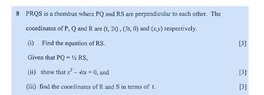
I can get (i) but couldn't get to prove the (ii).
 

Attachments

  • image.jpg
    image.jpg
    22.4 KB · Views: 129
Mathematics news on Phys.org
It looks like the coordinates of vertex $S$ would be useful. The distance from the mid-point of $\overline{PQ}$ to $R$ will be the same as the distance between the mid-point of $\overline{PQ}$ to $S$. These three points must also be collinear. This will give you two equations in two unknowns. :D
 
Yeah i got the (ii) part. But now I am stuck at the (iii) part. :/
 
MarkFL said:
It looks like the coordinates of vertex $S$ would be useful. The distance from the mid-point of $\overline{PQ}$ to $R$ will be the same as the distance between the mid-point of $\overline{PQ}$ to $S$. These three points must also be collinear. This will give you two equations in two unknowns.
Calculations involving division of segments in a given ratio are easier without involving distances. The coordinates of the segment ends and of the division point are related using the same ratio. In this case, if $S(x_1,y_1)$, then
\[
\begin{aligned}
2t&=\frac{x+x_1}{2}\\
t&=\frac{y+y_1}{2}
\end{aligned}\qquad(1)
\]
since the coordinates of the center of the rhombus are $(2t,t)$.

I first equated $PR$ and $RQ$, which gave me
\[
y=x-t.\qquad(2)
\]
Then I used $RS=2PQ$, which implies $x^2-4tx=0$. The latter equations has two solutions for $x$, but they lead to the same coordinates of $R$ and $S$ using (1) and (2).
 
Hi Milly,
If you know about the parametric equations of lines, you can cut to the chase and calculate R and S directly.

2nix4.png