Discussion Overview
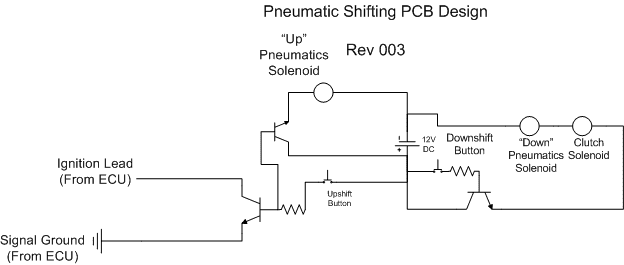
The discussion revolves around determining the appropriate size of resistors needed for a circuit involving TIP41C transistors and solenoids. Participants explore the implications of transistor saturation, current requirements, and circuit design considerations, including the use of Darlington pairs and biasing techniques.
Discussion Character
- Technical explanation
- Debate/contested
- Exploratory
- Mathematical reasoning
- Experimental/applied
Main Points Raised
- One participant suggests calculating resistance using the formula R = V/I, proposing a resistor value based on a continuous base current of 3A.
- Another participant emphasizes the importance of knowing the current draw of the loads and the need for transistors to saturate, indicating that the current gain at saturation is typically 10 or less.
- Participants discuss the current requirements for solenoids, with estimates ranging from 0.5A to 1.5A each, leading to a calculation that Ib must be greater than 150 mA.
- There is a query about the significance of Ib and its relationship to the base current, with a clarification that Ib is the current into the base of the transistor.
- One participant suggests researching "solenoid driver" designs to better understand the circuit requirements and operation modes (momentary vs. latched). They also mention the need for a flywheel diode to protect the transistor from current surges.
- A participant proposes using a Darlington pair to amplify current output, indicating a misunderstanding of current gain requirements in their initial circuit design.
- Participants share links to datasheets and design resources, discussing the importance of biasing and the configuration of the transistor in the circuit.
- There is mention of specific solenoid specifications, including coil currents of 300 mA and 500 mA, but some participants express confusion about how to apply these values in their design.
- One participant shares a simple circuit design found online, asking for clarification on the connections and functionality of the circuit.
- Another participant provides a link to a bias circuit for the TIP41 transistor, indicating a willingness to assist with the design process when the original poster is ready.
Areas of Agreement / Disagreement
Participants express various viewpoints on the current requirements and design considerations for the circuit, with no clear consensus reached on the best approach or specific resistor values needed. Multiple competing views on the circuit design and component specifications remain unresolved.
Contextual Notes
Participants note the importance of understanding solenoid properties and the need for proper biasing of transistors, but there are uncertainties regarding the exact specifications and configurations required for the circuit. Some assumptions about current draw and transistor operation are not fully clarified.