Calculating Support Reaction Force for an Impulse-Driven Bumper Project

Click For Summary
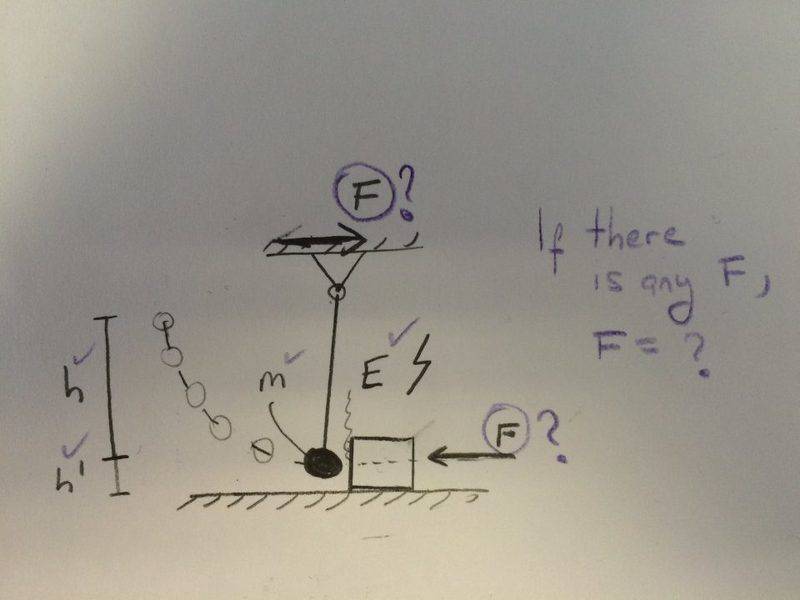
The discussion revolves around calculating the support reaction force for a bumper project involving a pendulum and a block. The main challenge is determining the force transferred to the support during the collision, as the impact time is unknown. It is confirmed that the pendulum drops and strikes the block, which generates an impulse on the pendulum and subsequently on the support. There is a suggestion that if the rod's moment of inertia is neglected, the force on the support may also be negligible. Overall, the conversation emphasizes the need to clarify the conditions of the support and the dynamics of the collision to accurately compute the forces involved.
yilbaris
Messages
6
Reaction score
0
Hi, i have a question..

I need to make a "bumper project" as shown in figure.
I have all the geometric information about system and also know weight and energy which is transferred.
I need to calculate the support reaction but i can not convert the energy to the force without "impact time". (F * t = m * V )

Also, i m not sure is there any reaction force on the supports because it s a pin connection.
Is it possible to calculate F?
IMG_4018.JPG
 
Engineering news on Phys.org
So is the pendulum dropping down and hitting the block or is the block sliding into the pendulum? Before the collision, the pendulum has a well defined angular velocity. I believe you would be able to set up a differential equation using friction and gravity (on the pendulum) and appropriate initial conditions. Would you mind clarifying what you're looking for?
 
Thank you BiGyElLoWhat.

Pendulum is dropping down and hitting the block and yes, angular velocity is known (calculated).

Actually, the main question is that "is there any force transferred to support?" If yes, second step, which is the hardest part, is to calculate amount of force.
 
I think the short answer would be yes.

There is an impulse on the pendulum by the block, and in turn the rod by the pendulum, and as they contact, the ball 'tries' to act as a pivot point about which the rod will rotate. Is the support loose or fixed?

Another thing to consider: If you're neglecting the rod's moment of inertia, (and thus it's kinetic energy), you could probably neglect the force on the support as well, as I would think it should be negligible in comparison. Some one may want to correct me on this fact, though.
 
Thank you for answers..
 
What mathematics software should engineering students use? Is it correct that much of the engineering industry relies on MATLAB, making it the tool many graduates will encounter in professional settings? How does SageMath compare? It is a free package that supports both numerical and symbolic computation and can be installed on various platforms. Could it become more widely used because it is freely available? I am an academic who has taught engineering mathematics, and taught the...

Similar threads

Replies
13
Views
3K
  • · Replies 14 ·
Replies
14
Views
1K
  • · Replies 9 ·
Replies
9
Views
5K
  • · Replies 3 ·
Replies
3
Views
2K
Replies
3
Views
1K
  • · Replies 3 ·
Replies
3
Views
2K
  • · Replies 1 ·
Replies
1
Views
2K
  • · Replies 2 ·
Replies
2
Views
3K
Replies
3
Views
2K
  • · Replies 5 ·
Replies
5
Views
6K