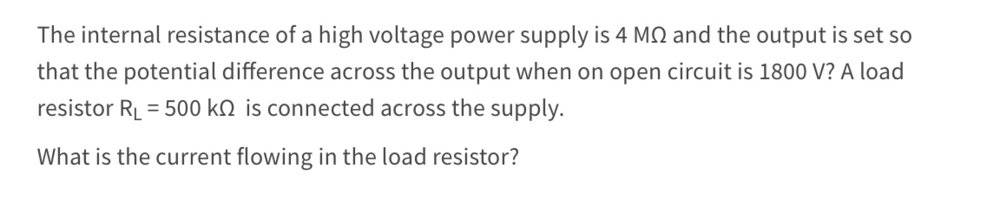
Calculating the current through this load resistor

Click For Summary
SUMMARY

The discussion focuses on calculating the current through a load resistor in a circuit involving a voltage source and internal resistance. The user initially overcomplicates the setup but is guided to simplify it by placing the voltage source in series with its internal resistance. The equivalent resistance is calculated as 4,500,000 ohms, leading to a current calculation using Ohm's Law, resulting in 0.0004 A or 0.4 mA.

PREREQUISITES
  • Understanding of Ohm's Law
  • Knowledge of series and parallel resistor configurations
  • Familiarity with voltage sources and internal resistance
  • Basic circuit analysis skills
NEXT STEPS
  • Study advanced circuit analysis techniques
  • Learn about equivalent resistance in complex circuits
  • Explore practical applications of Ohm's Law in electronics
  • Investigate the effects of internal resistance on circuit performance
USEFUL FOR

Electronics students, hobbyists, and engineers involved in circuit design and analysis, particularly those working with resistive loads and voltage sources.

Bolter
Messages
262
Reaction score
31
Homework Statement
Find current flowing in load resistor
Relevant Equations
V=IR
Hi everyone

950347CA-A9A0-46A8-BAE8-F5B65BB3DDC8.jpeg

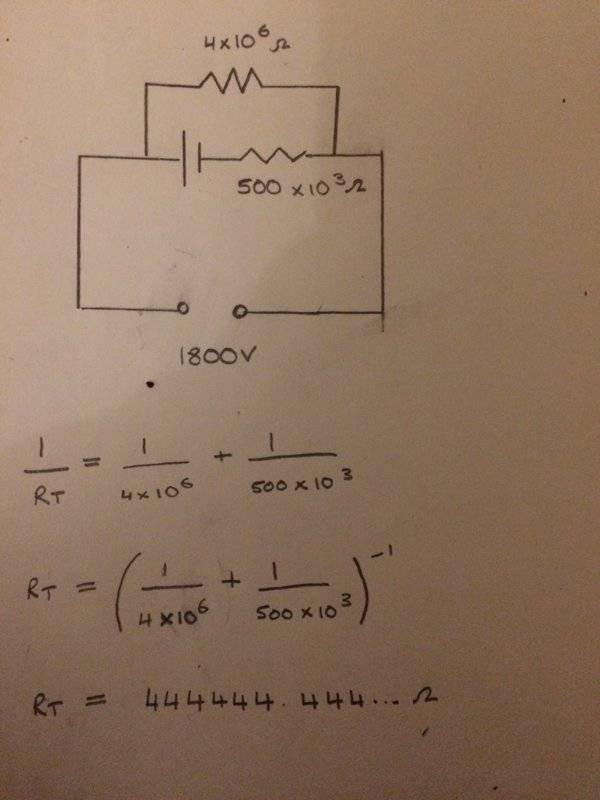
I have drawn what I think what the setup should look like, and worked out the equivalent resistance of the parallel connected resistors
15E10EFB-91AA-455F-A6AA-D8371C3D433F.jpeg


Not so sure where to go next with this problem?

Any help would be greatly appreciated!
 
Last edited by a moderator:
Physics news on Phys.org
I think you might have overcomplicated the setup slightly. The voltage source can be drawn in series with its internal resistance, and the two ends of this arrangement connect to the load resistor. Then it should be straightforward to calculate the current using Ohm's law.
 
etotheipi said:
I think you might have overcomplicated the setup slightly. The voltage source can be drawn in series with its internal resistance, and the two ends of this arrangement connect to the load resistor. Then it should be straightforward to calculate the current using Ohm's law.

If so then then I have 2 resistors in series in the circuit. So the total resistance becomes 500,000 ohms + 4,000,000 ohms = 4,500,000 ohms

Giving I = V/R = 1800/4,500,000 = 0.0004 A or 0.4 mA?
 

Similar threads

  • · Replies 2 ·
Replies
2
Views
1K
Replies
2
Views
1K
  • · Replies 6 ·
Replies
6
Views
2K
Replies
3
Views
2K
Replies
4
Views
2K
Replies
7
Views
1K
  • · Replies 6 ·
Replies
6
Views
1K
Replies
3
Views
2K
  • · Replies 4 ·
Replies
4
Views
2K
Replies
5
Views
6K