Calculating the DTFT of 1: Challenges and Solutions

  • Context: Graduate 
  • Thread starter Thread starter zhaniko93
  • Start date Start date
  • Tags Tags
    Dtft
Click For Summary
SUMMARY

The discussion focuses on calculating the Discrete-Time Fourier Transform (DTFT) of the constant function 1. Participants clarify that the DTFT diverges for all values of ω except for integer multiples of 2π, where it converges to a Dirac delta function representation. Specifically, at ω = 0, the DTFT results in an infinite value, while for ω not equal to 2πk (where k is an integer), the DTFT converges to 0. The conversation emphasizes the importance of understanding geometric series and the properties of the Dirac delta function in this context.

PREREQUISITES
  • Understanding of Discrete-Time Fourier Transform (DTFT)
  • Familiarity with geometric series and their convergence
  • Knowledge of Dirac delta function and its properties
  • Basic concepts of signal processing and distributions
NEXT STEPS
  • Study the properties of the Dirac delta function in signal processing
  • Learn about the convergence criteria for geometric series
  • Explore the relationship between DTFT and inverse DTFT
  • Investigate the application of Fubini's and Tonelli's theorems in sums and integrals
USEFUL FOR

Students and professionals in signal processing, electrical engineering, and applied mathematics who are working with Fourier transforms and need to understand the nuances of DTFT calculations.
zhaniko93
Messages
13
Reaction score
0
Hello.
I'm stuck on calculating DTFT of 1.
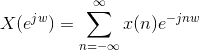
DTFT formula is:
5E%7Bjw%7D%29%20%3D%20%5Csum_%7Bn%20%3D%20-%5Cinfty%7D%5E%7B%5Cinfty%7D%20x%28n%29e%5E%7B-jnw%7D.gif

so dtft of 1 is:
gif.latex?%5Csum_%7Bn%20%3D%20-%5Cinfty%7D%5E%7B%5Cinfty%7De%5E%7B-jnw%7D.gif

1) in case of w=1, sum becomes:
gif.latex?%5Csum_%7Bn%20%3D%20-%5Cinfty%7D%5E%7B%5Cinfty%7D%201.gif

doesn't it diverge?
2) in case of w no 1, how the hell should that sum be calculated?
thanks
 
Physics news on Phys.org
\displaystyle \sum_{n=-\infty}^{\infty} e^{-jn \omega} = \sum_{n=0}^{\infty} e^{-jn \omega} + \sum_{n=-\infty}^{0} e^{-jn \omega} -1 = \sum_{n=0}^{\infty} e^{-jn \omega} + \sum_{n=0}^{\infty} e^{jn \omega} - 1.

When the sum converges, each of the last two sums is a geometric series that you should be able to calculate. The intermediate steps may not be neat, but the final answer is very simple.

However, there are values of \omega for which the series is not convergent. You mention \omega=1. I'm guessing you actually mean \omega=0 or e^{j \omega} = 1. But this is not the only one!
 
Last edited:
Thanks krome.
yes I meant w = 0, so for w=0 the sum doesn't converge. but I found such formula for DFTF of 1:
%202%5Cpi%5Csum_%7Bk%20%3D%20-%5Cinfty%7D%5E%7B%5Cinfty%7D%20%5Cdelta%20%28w%20-%202%5Cpi%20k%29.gif


so for w=0 (and other 2πk numbers) I get 2π. did i get something wrong?
also, for w not equal to 2πk, I get 0, so that sum must converge to 0.
can you give any hint how should I calculate that sum? should I use eulers formula?
 
zhaniko93 said:
so for w=0 (and other 2πk numbers) I get 2π. did i get something wrong?

You don't actually get 2 \pi at \omega = 0, you get infinity. You get 2 \pi \delta ( \omega ) evaluated at \omega = 0, which is infinite or not well-defined at least.

zhaniko93 said:
also, for w not equal to 2πk, I get 0, so that sum must converge to 0.

Yes, that is correct. You should get 0 when \omega \neq 2 \pi k for any integer k.

zhaniko93 said:
can you give any hint how should I calculate that sum? should I use eulers formula?

Do you know how to calculate the geometric series 1+x+x^2+x^3+...? If you do, then you should be able to calculate the two sums I wrote down. Except you run into a problem if x= 1. That's precisely where you get infinity. Otherwise, you should get 0.

So for me, the logic goes as follows:
(1) X( \omega ) = 0 except when \omega = 2 \pi k for some integer k. Therefore, \displaystyle X( \omega ) = \sum_{k= - \infty}^{\infty} c_k \delta ( \omega - 2 \pi k ) for some set of constants c_k.

(2) To determine c_k, use the inverse DTFT: \displaystyle x(n) = \frac{1}{2 \pi} \int_{2 \pi k -\pi}^{2 \pi k + \pi} d \omega \, X( \omega ) e^{jn \omega}. I've picked a particular region of integration of length 2 \pi here. X( \omega ) has periodicity 2 \pi. You are free to pick any full period over which to perform the integral. Plug in \displaystyle X( \omega ) = \sum_{m=- \infty}^{\infty} c_m \delta ( \omega - 2 \pi m ) and interchange the sum and the integral (check out Fubini's or Tonelli's theorems for more rigor regarding such interchanges; this is a mixed case between sums and integrals). You should get \displaystyle x(n) = \frac{c_k}{2 \pi}, which shows that c_k = 2 \pi for all k since x(n) = 1 for all n.
 
zhaniko93 said:
Hello.
I'm stuck on calculating DTFT of 1.
DTFT formula is:
5E%7Bjw%7D%29%20%3D%20%5Csum_%7Bn%20%3D%20-%5Cinfty%7D%5E%7B%5Cinfty%7D%20x%28n%29e%5E%7B-jnw%7D.gif

so dtft of 1 is:
gif.latex?%5Csum_%7Bn%20%3D%20-%5Cinfty%7D%5E%7B%5Cinfty%7De%5E%7B-jnw%7D.gif

1) in case of w=1, sum becomes:
gif.latex?%5Csum_%7Bn%20%3D%20-%5Cinfty%7D%5E%7B%5Cinfty%7D%201.gif

doesn't it diverge?
2) in case of w no 1, how the hell should that sum be calculated?
thanks
In fact, the series
$$\sum_{n=-\infty}^{\infty} e^{-in\omega}$$
diverges for all ##\omega##, because the terms do not converge to zero. Therefore the Fourier transform as defined by the sum does not exist. Your solution involving Dirac delta functions is a solution in the sense of distributions. It takes quite a lot more mathematical horsepower to make it rigorous. The nonrigorous method is to work in reverse: use the integral formula for the inverse Fourier transform to calculate the inverse DTFT of
$$2\pi \sum_{k=-\infty}^{\infty}\delta(\omega - 2\pi k)$$
and show that the result is identically 1. Then in order to conclude that the DTFT of 1 is the indicated sum of Dirac delta functions, you need to employ the fact (if it is indeed a fact) that the DTFT and inverse DTFT are inverses of each other when working with distributions.
 
I don't quite understand, my book said that \delta(n) is 1 for n = 0 and 0 otherwise. now you're saying that it is infinity? is it dirac delta or kroneker delta? how should I distinguish? (on wikipedia, \delta[n] is kroneker and \delta(w) is dirak, so I should distinguish by [] and (), but in my book both are (). My book is Schaum's Outlines of Digital Signal Processing
 
It is definitely the Dirac delta in this case. Any [] vs. () notation is nonstandard. It is very common to use ##\delta()## for either the Dirac or the Kronecker delta. If there is any chance of confusion, a careful author should indicate which one is intended.
 

Similar threads

  • · Replies 1 ·
Replies
1
Views
5K
  • · Replies 2 ·
Replies
2
Views
2K
Replies
1
Views
1K
  • · Replies 2 ·
Replies
2
Views
1K
  • · Replies 1 ·
Replies
1
Views
2K
Replies
4
Views
9K
  • · Replies 1 ·
Replies
1
Views
2K
  • · Replies 3 ·
Replies
3
Views
3K
Replies
1
Views
5K
  • · Replies 9 ·
Replies
9
Views
3K