Calculating the filter capacitor for a power supply

Join the discussion
Ask a follow-up here, or get your own question answered by working scientists, mathematicians and engineers — people, not an autocomplete.
Real named experts · corrections over time · the nuance an AI answer skips
2 replies · 3K views
TheRedDevil18
Messages
406
Reaction score
2
Trying to build a simple 9V power supply using a 7809 voltage regulator and full wave rectifier. The load current from the regulator is 1A. So I = C*dv/dt, therefore,

C = I*t/(delta V)
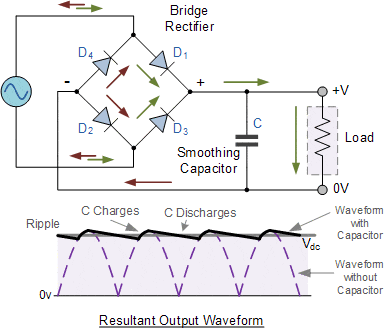
uitiQ.gif


To my understanding t is the time between the two peaks or the time the capacitor supplies the load. So if t is reduced, shouldn't the ripple increase ?, so isn't ripple (delta V) dependent on t ?, if so then why is delta V just arbitrarily chosen without considering t ?
 
Engineering news on Phys.org
1, t is fixed if you are using mains power - at roughly 0.01sec.
2, ripple would increase with t, if you were using a variable frequency supply.
This should be clear from the graph. If the peaks are further apart, the output drops more between peaks.
3, I don't think delta V is arbitrarily chosen. It comes from the permissible ripple. You know delta t, from mains frequency, and I from your spec. Then you calculate C.
Permissible ripple may come from the difference between, the lowest operating voltage of your regulator and the peak value your capacitor charges to.
 
  • Like
Likes   Reactions: davenn
TheRedDevil18 said:
So if t is reduced, shouldn't the ripple increase ?,
look at your graph
TheRedDevil18 said:
So I = C*dv/dt, therefore,
solve for dv
dv = I/C X dt , therefore
increasing Δt increases Δv

you knew that, just you were in a hurry. Think in small patient steps.
 
  • Like
Likes   Reactions: davenn