Calculating the flux through the spherical surfaces at certain radius

Join the discussion
Ask a follow-up here, or get your own question answered by working scientists, mathematicians and engineers — people, not an autocomplete.
Real named experts · corrections over time · the nuance an AI answer skips
13 replies · 2K views
falyusuf
Messages
35
Reaction score
3
Homework Statement
Point charges 5 uC, -3 uC, 2 uC and 10 uC are located at (-12, 0,5). (0, 3,-4),(2, -6, 3) and (3, 0, 0), respectively. Calculate the flux through the spherical surfaces at:
i) r= 1
ii) r= 10
iii) r=15

* u = 10^-6 *
Relevant Equations
Attached below.
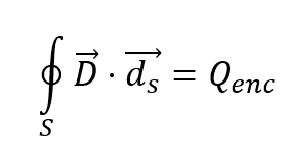
Relevant Equation:
1637442267037.png

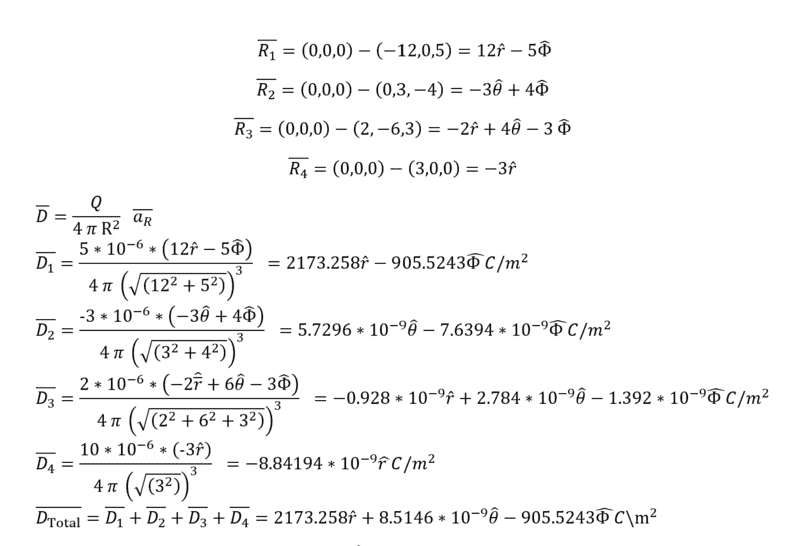
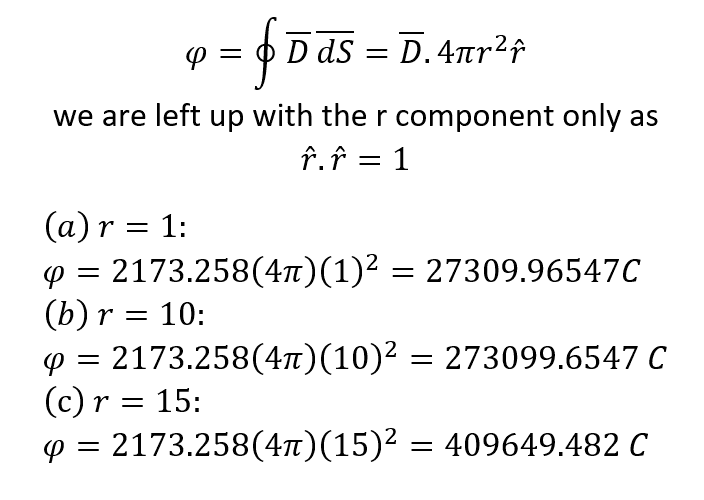
My attempt:
1637444699332.png

1637444677296.png

Could someone please confirm my answer?
 

Attachments
  • 1637444649520.png
    1637444649520.png
    20.4 KB · Views: 189
Physics news on Phys.org
BvU said:
You can't magically greate 10 digit accuracy results from 1 digit givens !

What is ##Q_{enc}## for ##r= 1## ?

##\ ##
Yes the answers I got were not reasonable and tried to figure out my mistakes but I couldn't.

I think it's -3 uC as r in the point (0, 3,-4) is 0, which is less than r=1.
so, the total charge enclosed is -3 uC.
 
I must asssume you have correctly given the problem statement
Calculate the flux through the spherical surfaces at:
i) r= 1
etc. And my interpretation is that such spheres are centered at the origin. So that the enclosed charge is zero for ##r=1##.
And that you are making a fairly simple exercise quite complicated unnecessarily.

Like in the other problem: what are the units for flux in your textbook ?

##\ ##
 
BvU said:
Like in the other problem: what are the units for flux in your textbook ?
It's Coulomb.

1637580341128-png.png
 
BvU said:
And my interpretation is that such spheres are centered at the origin. So that the enclosed charge is zero for r=1.
Sorry, I didn't get it. Could you explain further?
 
falyusuf said:
It's Coulomb.

View attachment 292834
Confusing (for me, at least). SI unit for electric flux is different.

falyusuf said:
Sorry, I didn't get it. Could you explain further?
The exercise asks for the flux through a spherical shell with radius 1 around the origin (then 10, then 15).

I don't understand what you do with your ##\overline{R_1}## etc.

* u = 10^-6 *
There is a ##\mu## under the 'insert symbol' button:
1637581967289.png


But (much better): with a little ##\LaTeX## you can do all kinds of math. ##\mu## becomes ##\mu##

There is a guide button at lower left:

1637582094065.png


##\ ##
 
BvU said:
I don't understand what you do with your R1― etc.
I assume that R1 is the vector between point 1 and the origin and found it by
1637583076411.png
 
BvU said:
What would you need that vector for ?

##\ ##
Get its length and substitute it in this formula:
1637584144098.png
 
1637586213881.png

Seems to me ##\overline {a_R}## is a unit vector. Right ?

This formula calculates ##\overline D## at the origin. Not what you want. The exercise asks for a flux (in your case apparently an electric displacement flux).

##\ ##
 
BvU said:
Seems to me aR― is a unit vector. Right ?
BvU said:
Seems to me aR― is a unit vector. Right ?
Yes. I think about it more and find that it'll be easier to get r from the given points using this formula:
1637589969545.png

and then simply;
1637595565755.png

Right?
 
BvU said:
Makes much more sense to me than post #1 !
And no hassle with 10-digit numbers either :wink:

##\ ##
Thank you so much. Appreciate your help
 
  • Like
Likes   Reactions: BvU