Calculating Voltage Source in AC Circuit

Click For Summary
SUMMARY

This discussion focuses on calculating the unknown voltage source in a series AC circuit containing a resistor, inductor, and load. The key equations utilized include Real Power (P = ˜|V|˜|I|cosφ), Complex Power (S = ˜V˜I*), and Apparent Power (|S| = ˜|V|˜|I|). The approach involves determining the current from the real power equation and calculating the voltage across each component to find the source voltage through phasor summation. The current is calculated as 1 kA from the given apparent power of 10 MVA and voltage of 10 kV.

PREREQUISITES
  • Understanding of AC circuit analysis
  • Familiarity with phasor diagrams
  • Knowledge of power factor and its implications
  • Proficiency in using complex numbers for electrical calculations
NEXT STEPS
  • Study the principles of phasor addition in AC circuits
  • Learn about the implications of power factor in circuit design
  • Explore the use of simulation tools for AC circuit analysis
  • Investigate advanced topics in reactive power management
USEFUL FOR

Electrical engineering students, circuit designers, and professionals involved in power systems who seek to deepen their understanding of AC circuit analysis and voltage source calculations.

MechEngJordan
Messages
16
Reaction score
0
Hello,

I'm currently working on a problem involving the calculation of an unknown voltage source of a circuit containing a resistor, inductor and load in series.

Unfortunately, the problem sheet does not give an answer at the end, so I am unsure as to whether my approach is correct -- hence this post. I suppose I'm really looking for guidance on how to tackle this kind of problem.

1. Homework Statement


Calculate the source voltage and draw the voltage and current phasor diagram for the single phase circuit.
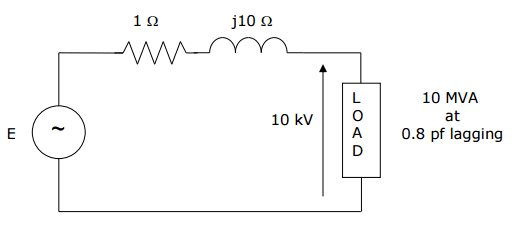
Screenshot (202).png


Homework Equations


Real Power, P = \widetilde{|V|}\widetilde{|I|}cosφ
Complex Power, S = \widetilde{V}\widetilde{I}^*
Apparent Power, |S| = \widetilde{|V|}\widetilde{|I|}
Power Factor, cosφ = \left(\frac{P}{|S|}\right)

The Attempt at a Solution


[/B]
I was undertaking the following approach:

From the load rating and power factor given, the apparent power and phase angle can be deduced; thus the power can be calculated from the power factor relationship.

The current may then be determined from the real power equation.

Now, voltage across each component can be calculated and the phasors summed to determine the source voltage.

Any input would be greatly appreciated. Thanks.
 
Last edited:
Physics news on Phys.org
MechEngJordan said:
Hello,

I'm currently working on a problem involving the calculation of an unknown voltage source of a circuit containing a resistor, inductor and load in series.

Unfortunately, the problem sheet does not give an answer at the end, so I am unsure as to whether my approach is correct -- hence this post. I suppose I'm really looking for guidance on how to tackle this kind of problem.

1. Homework Statement


Calculate the source voltage and draw the voltage and current phasor diagram for the single phase circuit.

View attachment 82508

Homework Equations


Real Power, P = \widetilde{|V|}\widetilde{|I|}cosφ
Complex Power, S = \widetilde{V}\widetilde{I}^*
Apparent Power, |S| = \widetilde{|V|}\widetilde{|I|}
Power Factor, cosφ = \left(\frac{P}{|S|}\right)

The Attempt at a Solution


[/B]
I was undertaking the following approach:

From the load rating and power factor given, the apparent power and phase angle can be deduced; thus the power can be calculated from the power factor relationship.

The current may then be determined from the real power equation.

Now, voltage across each component can be calculated and the phasors summed to determine the source voltage.

Any input would be greatly appreciated. Thanks.
For a series circuit like this, all components have the same current. Start by drawing a current phasor as the reference for everything else. The current is found from 10MVA / 10kV = 1 kA. Then draw the voltage across each component, in-phase, leading or lagging as appropriate. The phasor sum of all the voltages will be the supply voltage.
 
  • Like
Likes   Reactions: MechEngJordan
tech99 said:
For a series circuit like this, all components have the same current. Start by drawing a current phasor as the reference for everything else. The current is found from 10MVA / 10kV = 1 kA. Then draw the voltage across each component, in-phase, leading or lagging as appropriate. The phasor sum of all the voltages will be the supply voltage.

Hi,

Thank you for your reply; it helped confirm my understand of the problem solution.
 

Similar threads

  • · Replies 17 ·
Replies
17
Views
3K
  • · Replies 7 ·
Replies
7
Views
3K
  • · Replies 5 ·
Replies
5
Views
2K
Replies
15
Views
3K
  • · Replies 2 ·
Replies
2
Views
2K
  • · Replies 10 ·
Replies
10
Views
6K
  • · Replies 4 ·
Replies
4
Views
2K
Replies
3
Views
3K
Replies
1
Views
2K
Replies
6
Views
3K