Calculating Volume of Ellipsoidal Propane Tanks

  • Context: MHB 
  • Thread starter Thread starter GroundSpider
  • Start date Start date
  • Tags Tags
    Propane Volume
Click For Summary

Discussion Overview

The discussion revolves around calculating the volume of propane tanks, specifically focusing on tanks with ellipsoidal ends and hemispherical ends. Participants explore the mathematical formulas necessary for determining the overall volume and the volume at a specific height within the tank, addressing both theoretical and practical applications.

Discussion Character

  • Technical explanation
  • Mathematical reasoning

Main Points Raised

  • One participant outlines the need to calculate the volume of propane tanks with ellipsoidal and hemispherical configurations, suggesting that the ellipsoid formula could be adapted for hemispherical tanks.
  • Another participant emphasizes the importance of knowing the area of an ellipse as a foundational step for computing volumes, referencing the general equation of an ellipse.
  • A third participant provides established formulas for the area of an ellipse and the volume of an ellipsoid, noting the conditions under which these formulas apply, particularly regarding the depth of propane in relation to the height of the elliptical end.
  • A later reply expresses gratitude for the provided formulas, indicating their application in developing a specialized calculator for manufacturing a float gauge.

Areas of Agreement / Disagreement

Participants generally agree on the mathematical formulas for calculating the area and volume of ellipsoidal shapes, but there is no consensus on the complexities involved when the propane fill height is less than the height of the elliptical end, as this condition introduces additional challenges.

Contextual Notes

The discussion does not resolve the complexities involved in calculating volumes when the fill height is less than the height of the elliptical end, leaving this aspect open for further exploration.

GroundSpider
Messages
4
Reaction score
0
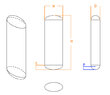
I have a project I am working on that requires me to calculate the overall volume of propane tanks and the volume at a set distance from the bottom of the tank. The tanks come in two major configurations, ellipsoid ends with elliptical tank or hemispherical ends with cylindrical tank. I think the formula for the ellipsoid would work for the hemispherical tanks if we just set the dimensions to make a circle instead of an ellipse. I have attached an image to help clear this up.

W = Width of the ellipse
D = Depth of the ellipse
H = Overall height of tank
P = Height of propane in tank (This is used to calculate overall fill % of the tank)
E = Height of elliptical end

Essentially I need help determining the volume of a section of an ellipsoid end.

View attachment 3315
 

Attachments

  • eliptical tank copy.jpg
    eliptical tank copy.jpg
    31.5 KB · Views: 139
Physics news on Phys.org
In order to compute these volumes, you will need to know the area of an ellipse, so that you can then use this as part of a volume element.

I would begin with the general equation of an ellipse centered at the origin:

$$\frac{x^2}{a^2}+\frac{y^2}{b^2}=1$$

Knowing the ellipse has symmetry across both coordinate axes, we need only find the area in the first quadrant, and then quadruple this result.

So, we need to solve the equation for $y$, and take the positive root...what do we get?
 
If you are just interested in quoting the answer, there are easy formulas for the area of an ellipse and the volume of an ellipsoid. The area of an ellipse with semi-axes $a$ and $b$ is $\pi ab$. The volume of an ellipsoid with semi-axes $a$, $b$ and $c$ is $\frac43\!\pi abc$. Notice that when the semi-axes are all equal, these reduce to the familiar formulas for the area of a circle and the volume of a sphere.

Those formulas should enable you to find the volume of propane provided that the depth of propane is sufficient that it completely fills the hemi-ellipsoidal base of the tank (that is, if $P > E$ in your diagrams). If $P<E$ then the calculation will be harder. The formula given here for the volume of an ellipsoidal cap, where the semi-axes are $a$, $b$ (the horizontal axes) and $c$ (the vertical axis), filled to a depth $h$, is $$\frac{\pi ab}{3c^2}h^2(3c-h).$$
 
Last edited:
Thank you so much Opalg! That is exactly what I needed. I am writing a specialized calculator to facilitate manufacturing of a float gauge that determines the tank's fill level.
 

Similar threads

  • · Replies 26 ·
Replies
26
Views
2K
Replies
50
Views
7K
  • · Replies 4 ·
Replies
4
Views
2K
  • · Replies 2 ·
Replies
2
Views
2K
  • · Replies 1 ·
Replies
1
Views
2K
Replies
1
Views
6K
  • · Replies 1 ·
Replies
1
Views
2K
  • · Replies 2 ·
Replies
2
Views
2K
  • · Replies 56 ·
2
Replies
56
Views
6K
  • · Replies 18 ·
Replies
18
Views
12K