Calculating Volume: Rotating Curves About a Line

  • Thread starter Thread starter tony873004
  • Start date Start date
  • Tags Tags
    Volume
Click For Summary

Homework Help Overview

The discussion revolves around calculating the volume of a solid obtained by rotating the region bounded by the curves y=1/x, x=1, x=2, and y=0 about the x-axis. Participants explore different methods and interpretations related to this problem.

Discussion Character

  • Mixed

Approaches and Questions Raised

  • Participants discuss various methods for setting up the integral, including the disk method and the use of summation. There are questions about the correctness of the initial setup and the limits of integration.

Discussion Status

Some participants have provided clarifications on the mathematical expressions used, while others have pointed out potential errors in the original poster's approach. There is an ongoing exploration of the correct integral setup, and some participants express that the problem is becoming clearer.

Contextual Notes

There are indications of confusion regarding the notation and the setup of the integral, with participants questioning the variable limits and the use of summation in the context of integration.

tony873004
Science Advisor
Gold Member
Messages
1,753
Reaction score
143
Find the volume of the solid obtained by rotating the region bounded by the given curves about the specified line.
y=1/x, x=1, x=2, y=0; about the x-axis

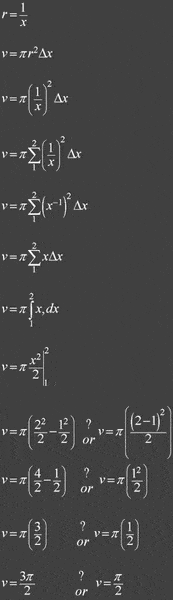
About halfway down, I diverge into two methods. The one on the left I use the method from FrogPad's post in my other thread (or at least my effort to understand the method he describes, btw, thank you). But it gives me 3pi/2. The one on the right gives me the same answer as the back of the book, pi/2. Maybe neither is right, and I coincidentlly got the right answer using the method on the right :bugeye:

Also, am I using the right symbols, etc.?
vol2.gif
 
Physics news on Phys.org
Why do you start off with a summation? Also: the limits are unclear (what is the variable?).

The volume of the solid you obtain by rotating f(x) about the x-axis between x = a and x = b is given by:

[tex]\pi \int\limits_a^b {f\left( x \right)^2 dx}[/tex]

In your specific case, with f(x) = 1/x and the limits given; this comes down to:

[tex]\pi \int\limits_1^2 {\frac{1}{{x^2 }}dx}[/tex]

Can you follow? Can you now compute this integral?
 
...and

[tex](x^{-1})^2\ne x[/tex]

but

[tex](x^{-1})^2= x^{-2}[/tex]

with the limits, your left-hand column would be right (assuming the integrand is right, as above or in prev. post)
 
You started off fine. I don't know why you "diverged" as you put it.
(It would also, by the way,be better to write more than just math symbols in your work: explain what you are doing and what each formula represents.)

Using the "disk" method you can imagine the volume divided into many thin disk with center on the x-axis, thickness [itex]\Delta x[/itex], and radius equal to the y value= [itex]\frac{1}{x}[/itex]. The area of each disk is [itex]\pi r^2= \pi \frac{1}{x^2}[/itex] and so the volume is [itex]\pi \frac{1}{x^2} \Delta x[/itex]. The approximate volume of the whole figure then is the Riemann Sum [itex]\Sigma \pi \frac{1}{x^2}\Delta x[/itex].
Now, for some reason, you have [itex]\Sigma \pi x \Delta x[/itex].
Surely you know that 1/x2 is not x!
(Are you subtracting exponents- that's for multiplication, not repeated powers. xmxn= xm+n but (xn)m= xmn. (x-1)2= x-2.

Now take the limit as the number of disks goes to infinity: the Riemann Sum [itex]\Sigma \pi \frac{1}{x^2}\Delta x[/itex] becomes the integral
[tex]\pi \int_1^2 \frac{1}{x^2}dx= \pi \int_0^1 x^{-2} dx[/itex]<br /> That should be easy to integrate.[/tex]
 
Last edited by a moderator:
Others have pointed out the errors in your OP. If you are about to integrate:
[tex]\pi \mathop {\int} \limits_{1} ^ 2 x \ dx[/tex], the way in the left is correct.
You should note that:
[tex]\mathop {\int} \limits_{a} ^ b x \ dx = F(b) - F(a)[/tex], where F is the antiderivative of f.
And in this case, you'll have: [tex]F(x) = \frac{1}{2} x ^ 2 + C[/tex].
 
Last edited:
TD said:
Why do you start off with a summation? Also: the limits are unclear (what is the variable?).
The first few problems from the notes were done that way. I guess to show us why the integral is set up that way. After the first few examples, the teacher skips that step.

HallsofIvy said:
...(It would also, by the way, to more than just math symbols in your work: explain what you are doing and what each formula represents.)...
Point well taken, especially when I give up for the night and try to pick it up in the morning.

I re-did it and got the correct answer. I'll post my solution anyway, just in case I did something wrong and coincidentally got the right answer.

Thanks for all your explanations. This is starting to become clear. :smile:
vol3.gif
 
Nice LaTex style :smile:

For the limits, you can just put the numbers.
 

Similar threads

  • · Replies 9 ·
Replies
9
Views
3K
  • · Replies 1 ·
Replies
1
Views
2K
  • · Replies 8 ·
Replies
8
Views
2K
  • · Replies 13 ·
Replies
13
Views
2K
Replies
2
Views
1K
  • · Replies 4 ·
Replies
4
Views
2K
Replies
3
Views
2K
  • · Replies 1 ·
Replies
1
Views
2K
Replies
4
Views
2K
  • · Replies 3 ·
Replies
3
Views
1K