Calculating Work and Kinetic Energy in a Cart Experiment

Click For Summary
SUMMARY

The forum discussion centers on calculating work and kinetic energy in a physics experiment involving a 1.212 kg cart attached to a string with hanging masses. Participants highlight discrepancies between the work done by tension and the change in kinetic energy, suggesting that only the mass of the cart should be used for kinetic energy calculations, not the total mass of the system. Experimental errors, such as inaccurate tension measurements and potential energy considerations, are identified as key factors affecting the results. The consensus emphasizes the importance of precise measurements and correct mass usage in calculations.

PREREQUISITES
  • Understanding of Newton's laws of motion
  • Familiarity with kinetic energy calculations
  • Knowledge of work-energy principle
  • Experience with experimental physics setups
NEXT STEPS
  • Review the work-energy theorem in classical mechanics
  • Learn about accurate tension measurement techniques
  • Study the impact of potential energy in mechanical systems
  • Explore common experimental errors in physics labs
USEFUL FOR

Students in physics courses, educators teaching mechanics, and anyone conducting experiments involving work and energy calculations will benefit from this discussion.

sallychan
Messages
21
Reaction score
0
Mentor's Note: This post and another have been merged at the member's request in order to attach their results.

1. Homework Statement


See the attached picture for the lab setup. It is all about releasing a cart of 1.212 kg attached with a string and hanging masses.
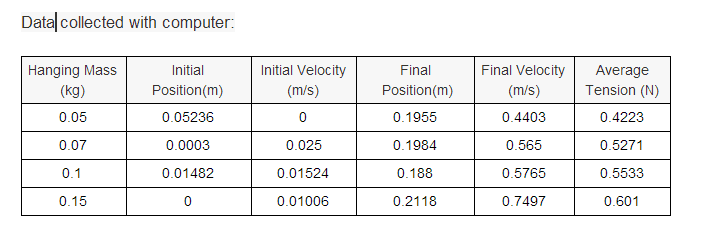
I recorded the Initial and final velocity, initial and finial position, and the tension force .

Ps. I follow the instructions on the lab manual to do calculations. It did not say I have to consider potential energy.

Homework Equations


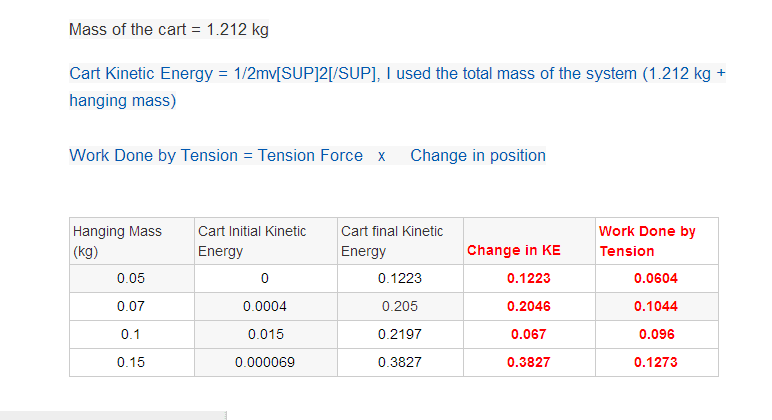
The work done by tension is supposed to equal to the change in kinetic energy of the cart, but I don't know why I can't get that result.
So I wonder which mass should I use to calculate the Change in Kinetic Energy of the Cart? The mass of the hanging mass only? The mass of the cart only? Or the total mass of the system?

The Attempt at a Solution


Work done by tension = Tension force x (final position - initial position)

Change in Kinetic Energy of the Cart = 1/2 MVfinal2 - 1/2 MVinitial2I appreciate your help!

Data collected with computer:
date.png


Calculations

cal.png


The problem is that Change in KE and the Work Done by Tension have huge difference!
 

Attachments

  • 1.png
    1.png
    1.6 KB · Views: 573
Last edited by a moderator:
Physics news on Phys.org
How did you calculate the tension in the string?

Where does the KE of the cart come from? Where is that energy initially?
 
I use computer to collect data for tension. I guess the energy of the dart comes from the hanging mass.
 
PeroK said:
How did you calculate the tension in the string?

Where does the KE of the cart come from? Where is that energy initially?
I use computer to collect data for tension. I guess the energy of the dart comes from the hangingmass.
 
sallychan said:
I use computer to collect data for tension. I guess the energy of the dart comes from the hangingmass.

What answers did you get and why do you think they are wrong?
 
PeroK said:
What answers did you get and why do you think they are wrong?

The work done by tension is supposed to equal to the change in kinetic energy of the cart, but I don't know why I can't get that result. There is a huge difference between the work and change in kinetic energy.
 
How can anyone help if you don't say what results you've got? Your computer could be giving you the wrong answer.
 
I've merged sallychan's latest post with the original in order to add the results. Please see the original post once more.
 
The numbers clearly don't add up in a number of ways. How does a computer measure tension in a string? If the tension is measured incorrectly, then that would explain some of your problems.

Part of the problem might be that you are adding the mass of the hanging weight in yout KE calculation.
sallychan said:
Mentor's Note: This post and another have been merged at the member's request in order to attach their results.

1. Homework Statement


See the attached picture for the lab setup. It is all about releasing a cart of 1.212 kg attached with a string and hanging masses.
I recorded the Initial and final velocity, initial and finial position, and the tension force .

Ps. I follow the instructions on the lab manual to do calculations. It did not say I have to consider potential energy.

Homework Equations


The work done by tension is supposed to equal to the change in kinetic energy of the cart, but I don't know why I can't get that result.
So I wonder which mass should I use to calculate the Change in Kinetic Energy of the Cart? The mass of the hanging mass only? The mass of the cart only? Or the total mass of the system?

The Attempt at a Solution


Work done by tension = Tension force x (final position - initial position)

Change in Kinetic Energy of the Cart = 1/2 MVfinal2 - 1/2 MVinitial2I appreciate your help!

Data collected with computer:
View attachment 80065

Calculations

View attachment 80066

The problem is that Change in KE and the Work Done by Tension have huge difference!

I'd say the most likely explanations are:

a) The cart is only about 0.6 Kg.

b) The computer measures the tension at about half what it really is.

c) The computer measures the final velocity greater than it really is.

d) The cart is on a slight downslope.

Note that if you do consider PE of the hanging mass you have the added problem that the KE of the cart is greater than the PE lost by the hanging mass.

In other words, you've found significant experimental errors in the set-up.
 
Last edited:
  • #10
PeroK said:
The numbers clearly don't add up in a number of ways. How does a computer measure tension in a string? If the tension is measured incorrectly, then that would explain some of your problems.

Part of the problem might be that you are adding the mass of the hanging weight in yout KE calculation.I'd say the most likely explanations are:

a) The cart is only about 0.6 Kg.

b) The computer measures the tension at about half what it really is.

c) The computer measures the final velocity greater than it really is.

d) The cart is on a slight downslope.

Note that if you do consider PE of the hanging mass you have the added problem that the KE of the cart is greater than the PE lost by the hanging mass.

In other words, you've found significant experimental errors in the set-up.
Yea I guess the data I got is probably not accurate.

By the way,I am just asking, when I calculate the KE of the cart, should I use the mass of the cart only or the total mass of the system?
And should I consider PE of the hanging mass?
 
  • #11
You don't need the PE of the hanging mass, although it was a useful check that your data made sense, or not.

If you are using the tension in the string, then the work done is accelerating the cart, so you should only use the mass of the cart.
 
  • Like
Likes   Reactions: sallychan
  • #12
PeroK said:
You don't need the PE of the hanging mass, although it was a useful check that your data made sense, or not.

If you are using the tension in the string, then the work done is accelerating the cart, so you should only use the mass of the cart.

Got it. Thank you so much for clearing up my confusions :)
 

Similar threads

Replies
18
Views
2K
  • · Replies 16 ·
Replies
16
Views
1K
  • · Replies 1 ·
Replies
1
Views
2K
Replies
3
Views
2K
Replies
7
Views
2K
  • · Replies 58 ·
2
Replies
58
Views
3K
Replies
18
Views
3K
  • · Replies 9 ·
Replies
9
Views
2K
Replies
4
Views
3K
  • · Replies 3 ·
Replies
3
Views
3K