Calculating Work Done by a Rope on a Sled

Click For Summary

Homework Help Overview

The discussion revolves around calculating the work done by a rope on a sled being dragged at a constant speed along a horizontal path. The sled's weight and the tension in the rope are provided, along with the angle of inclination of the rope.

Discussion Character

  • Exploratory, Assumption checking, Mathematical reasoning

Approaches and Questions Raised

  • Participants discuss the definition of work done in relation to force and displacement. There are attempts to calculate displacement using different equations, and some participants express uncertainty about the correct application of formulas and values.

Discussion Status

The discussion is ongoing, with participants providing guidance on how to approach the problem. Some have suggested simpler methods for calculating displacement, while others are questioning the accuracy of the values used in the calculations. There is no explicit consensus on the correct approach yet.

Contextual Notes

Participants are working under the constraints of a homework assignment, which may limit the information they can use or the methods they can apply. There are indications of confusion regarding the application of physics concepts and formulas.

kbyws37
Messages
67
Reaction score
0
A sled is dragged along a horizontal path at a constant speed of 1.5 m/s by a rope that is inclined at an angle of 30.0° with respect to the horizontal (see the figure below). The total weight of the sled is 470 N. The tension in the rope is 250 N. How much work is done by the rope on the sled in a time interval of 5.00 s?
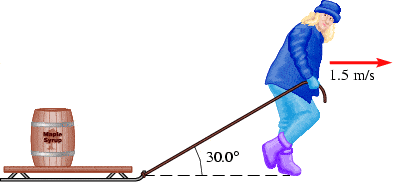
fig024.gif


I'm not sure if I'm on the right track.
I'm using the equation
W=K+U =E
E = (mv^2)/2 + mgy
but i don't know where I would put time and where

250cos(30) would go.

or maybe I'm just totally off.
 
Physics news on Phys.org
Think about the definition of work done (in terms of force).
 
You know the velocity, and you know the time. So, you know the displacement, too. I'm sure you'll know how to carry on from this point. :smile:
 
I used x = ((Vi + Vf)t)/2 and found the displacement to be 3.75
Then I used the equation:

E = (mv^2)/2 + mgx = W
= ((470)(1.5^2))/2 + ((470)(9.8)(3.75))
= a huge number (which is not correct)

If i use the equation
W = F*x*cos()
W = 470*3.75*cos(30)
W = 1526.37
which says that I am wrong
 
kbyws37 said:
I used x = ((Vi + Vf)t)/2 and found the displacement to be 3.75

Ever heard of the simple expression for constant velocity [tex]x = v\cdot t[/tex]?
 
kbyws37 said:
I used x = ((Vi + Vf)t)/2 and found the displacement to be 3.75
Although radou's equation is simpler to use your equation above is valid. If you substitute in the the correct values you should obtain the correct answer. However, 3,75 is not correct. The rest of your working;
kbyws37 said:
If i use the equation
W = F*x*cos()
Looks good except for the erroneous value for displacement.
 
Last edited:

Similar threads

  • · Replies 5 ·
Replies
5
Views
2K
  • · Replies 3 ·
Replies
3
Views
6K
  • · Replies 3 ·
Replies
3
Views
2K
  • · Replies 2 ·
Replies
2
Views
5K
Replies
1
Views
2K
Replies
46
Views
7K
  • · Replies 4 ·
Replies
4
Views
7K
Replies
6
Views
3K
Replies
4
Views
2K
  • · Replies 4 ·
Replies
4
Views
5K