Calculus 3 Multi-Integration (volume)

Click For Summary
SUMMARY

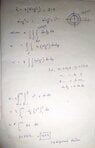
The discussion focuses on calculating the volume of a region defined by concentric cylinders and a paraboloid surface described by the equation z = 4(x² + y²). Participants clarify that a double integral is necessary for this calculation, specifically using cylindrical coordinates. The volume can be computed using the integral V = ∫₀²π∫₁³∫₀⁴ρ² ρ dz dρ dφ, resulting in a volume of 160π. The importance of visual aids, such as sketches and graphing tools, is emphasized for better understanding.

PREREQUISITES
  • Understanding of double and triple integration in calculus
  • Familiarity with cylindrical coordinates
  • Knowledge of paraboloid geometry
  • Experience with graphing tools, such as Graphing Calculator 3
NEXT STEPS
  • Study the application of cylindrical coordinates in volume calculations
  • Learn how to sketch and interpret 3D surfaces, particularly paraboloids
  • Practice solving double integrals with varying limits
  • Explore advanced graphing software for visualizing complex mathematical functions
USEFUL FOR

Students and educators in calculus, particularly those focusing on multi-variable integration, as well as anyone seeking to enhance their understanding of volume calculations in three-dimensional space.

IAmGroot48
Messages
12
Reaction score
5
Homework Statement
In this particular question the following is stated.

Find the volume of the region below z=4(x²+y²), above z=0, and between the two cylinders x²+y²=1² and x²+y²=3².
Relevant Equations
This question doesn't necessarily say if the two cylinders are intersecting each other, so I'm not 100% clear how to go on about this question. If I could get an Idea on how to set this up or solve it. I'd be able to figure out the rest.
Pending
 
Physics news on Phys.org
:welcome:

I'm not sure where the ambiguity is. The cylinders are concentric and the volume in question lies between them.
 
  • Skeptical
Likes   Reactions: IAmGroot48
I feel like I may be over thinking this--I have ADHD so sometimes I have to read things over and over again to imagine what I am trying to do. Am I suppose to use triple integration for this or is this something double integration can do. What throws me off is the cylinder within the cylinder and then the region below z=4(x²+y²). I can't grasp where I am suppose to begin.
 
IAmGroot48 said:
I feel like I may be over thinking this--I have ADHD so sometimes I have to read things over and over again to imagine what I am trying to do. Am I suppose to use triple integration for this or is this something double integration can do. What throws me off is the cylinder within the cylinder and then the region below z=4(x²+y²). I can't grasp where I am suppose to begin.
Initially I would think you could just do a single integration along z because of the symmetry of the surfaces. Can you try making a couple sketches to help you understand the geometry? Do one sketch from the side (say, looking down the x-axis with the y-axis to the right and z upward), and do one sketch in a perspective view looking at an angle down from the side (like along the line x=y=z)...

EDIT -- Mark mentions a double integral below, so I could be wrong about the simplification to a single integration...
 
IAmGroot48 said:
I feel like I may be over thinking this--I have ADHD so sometimes I have to read things over and over again to imagine what I am trying to do. Am I suppose to use triple integration for this or is this something double integration can do. What throws me off is the cylinder within the cylinder and then the region below z=4(x²+y²). I can't grasp where I am suppose to begin.
Can you sketch a graph of the surface ##z = 4(x^2 + y^2)##? It's a paraboloid with its vertex at the origin, its axis along the z-axis, and opening upward. The two cylinders also have their axes along the z-axis.

The volume of the enclosed region can be calculated with a double integral.
 
InkedGraphing_Calculator_3D_jM8InWyBjy_LI.jpg
|

This is what I am getting as far as the sketch. The paraboloid does indeed touch the origin, and then the surface z=0 is shown as a plane at well z=0. so from z=0 to z=4(x²+y²) is the first integration? In other words does the set up look like 4(x²+y²) dydx? and the first integration is from x²+y²=1² (bottom) to x²+y²=3² (top)?

Just Fyi: I am not the type of person who just wants the answer. I want to be able to find the answer myself for the most part but I want to understand why or how.
 
  • Like
Likes   Reactions: berkeman
Mark44 said:
Can you sketch a graph of the surface ##z = 4(x^2 + y^2)##? It's a paraboloid with its vertex at the origin, its axis along the z-axis, and opening upward. The two cylinders also have their axes along the z-axis.

The volume of the enclosed region can be calculated with a double integral.
Was this rhetorical?
 
IAmGroot48 said:
Was this rhetorical?
Parabolic!
 
  • Haha
Likes   Reactions: berkeman
I apologize I'm not sure what you're meaning when you only say parabolic.
 
  • #10
IAmGroot48 said:
I apologize I'm not sure what you're meaning when you only say parabolic.
Only that it's a parabolic question, rather than a rhetorical one.
 
  • #11
I feel there was a funny thrown in there, but its almost got me thinking...slightly sparked an ember...
 
  • Like
Likes   Reactions: berkeman
  • #12
I suggest you look at cylindrical coordinates and figure our the range for ##r## or ##\rho##, whichever you use, for each value of ##z##.
 
  • #13
IAmGroot48 said:
This is what I am getting as far as the sketch.
Wow, nice sketch! What software package did you use to do that?
 
  • #14
IAmGroot48 said:
View attachment 293873|

This is what I am getting as far as the sketch. The paraboloid does indeed touch the origin, and then the surface z=0 is shown as a plane at well z=0. so from z=0 to z=4(x²+y²) is the first integration? In other words does the set up look like 4(x²+y²) dydx? and the first integration is from x²+y²=1² (bottom) to x²+y²=3² (top)?

Just Fyi: I am not the type of person who just wants the answer. I want to be able to find the answer myself for the most part but I want to understand why or how.

berkeman said:
Wow, nice sketch! What software package did you use to do that?
Normally I use autocad. But this is a simple piece of software you can easily get for free. You can get it on Microsoft Store and it's called Graphing Calculator 3, there's a free version and a pro version.
 
  • Like
Likes   Reactions: berkeman
  • #15
PeroK said:
I suggest you look at cylindrical coordinates and figure our the range for ##r## or ##\rho##, whichever you use, for each value of ##z##.
Ill show you the work I've done so far. I think it finally clicked. "I think"
 
  • #16
Also...I am a firm believer every single website should have a Dark Mode from this point on 2022 and above. The bright white colors just murder my eyes...😵

-A Computer Engineer Major
 
  • #17
We used to have different skins that you could choose from. Let me do a little searching...
 
  • #18
IAmGroot48 said:
Was this rhetorical?
No, not at all. I didn't know you had access to a graphing tool.
 
  • #19
IAmGroot48 said:
.I am a firm believer every single website should have a Dark Mode from this point on 2022 and above.
I spoke with the Admin, and he will look at adding a Dark Mode in the 2022 updates. :smile:
 
  • #20
Oh you rock! Thats awesome! I truly believe all websits should have that option. We're moving into a technological generation where a huge majority of our hardware is being ran by software so i feel we need to have dark mode to lessen the health concerns to our eyes. Sounds insane but a huge help to our optical system. Thank you.
 
  • Like
Likes   Reactions: berkeman
  • #21
As for this question. This is what I came up with.
 

Attachments

  • IMG-20211210-WA0062.jpg
    IMG-20211210-WA0062.jpg
    25.9 KB · Views: 149
  • Like
Likes   Reactions: PeroK
  • #22
IAmGroot48 said:
I am a firm believer every single website should have a Dark Mode from this point on 2022 and above. The bright white colors just murder my eyes.
My computers have an option to turn down the brightness. Have you tried that?Personally, I really dislike dark mode, as I find it harder to read, but hey, different strokes for different folks.
 
  • #23
Yeah I am on the computer almost all day, so I need to take breaks from time to time. So even when I am learning to code I put my whole visual studio on a dark type format. I also use a software called Rainmeter to control all of my computers setting. Its an overlay for your whole desktop setting.
 
  • #24

Similar threads

  • · Replies 1 ·
Replies
1
Views
2K
  • · Replies 9 ·
Replies
9
Views
2K
  • · Replies 7 ·
Replies
7
Views
2K
  • · Replies 13 ·
Replies
13
Views
3K
  • · Replies 9 ·
Replies
9
Views
1K
  • · Replies 1 ·
Replies
1
Views
7K
Replies
1
Views
1K
Replies
2
Views
2K
Replies
7
Views
1K
  • · Replies 8 ·
Replies
8
Views
2K