Calculus - find average rate of change of the function over a given interval

Click For Summary

Homework Help Overview

The discussion revolves around finding the average rate of change of the function h(t) = sin(t) over the interval [3π/4, 4π/3]. Participants express challenges related to the sine function and its properties in the context of this calculus problem.

Discussion Character

  • Exploratory, Mathematical reasoning, Assumption checking

Approaches and Questions Raised

  • The original poster attempts to calculate the average rate of change but struggles with the sine function and its implications. Some participants provide insights into specific sine values and their relationships, while others question the calculations and seek clarification on the steps involved in simplifying expressions.

Discussion Status

Participants are actively engaging with the problem, offering corrections and clarifications on mathematical steps. There is a focus on understanding the transition between different forms of the expression, and while some guidance has been provided, multiple interpretations of the calculations are still being explored.

Contextual Notes

There are references to specific angles and their sine values, indicating a potential gap in foundational knowledge that may be affecting the original poster's understanding. The discussion also highlights the need for clarity in mathematical manipulation without resolving the underlying issues.

mastdesi
Messages
3
Reaction score
0
Calculus - please help find average rate of change of the function over a given interval

Homework Statement


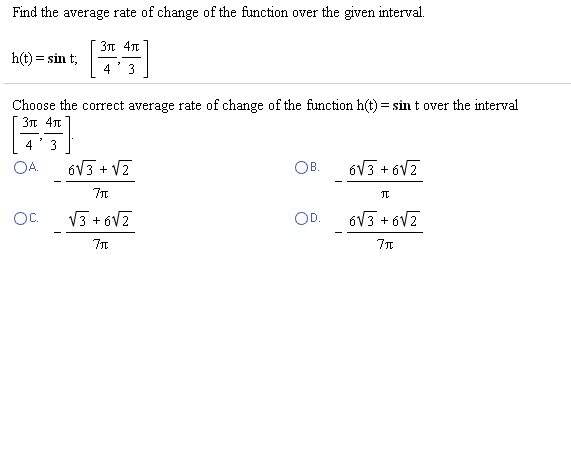
h(t) = sin t, [3pi/4,4pi/3]

please help me solve this, try to give me an explanation on every step please. i checked but i can't find anything on this in the book. i am basically having problem with this because of the sin.

13z31z.jpg


Homework Equations


The Attempt at a Solution


25z5w9l.gif

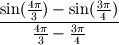
i got to there also but i don't know how to solve the sin part. how does the square root come in.
 
Physics news on Phys.org


Do you know sin(\pi/3) = sin(60 deg.)?
Do you know sin(\pi/4) = sin(45 deg.)?
The sines of these angles are numerically equal to the sines, respectively, of the two angles you showed. There are a few angles whose sine, cosine, and tangent you should memorize.
 
Last edited:


[sin(4π/3) - sin(3π/4)] / (4π/3 - 3π/4)
= (-√3/2 - √2/2) / (7π/12)
= -6(√3 - √2) / (7π)

this is what i got but its none of the 4 multiple choice answers. what's wrong in here?


Your last line should be -6(√3+√2)/(7π)

You didn't factor the - sign properly


Thank you very much. but if you guyz can please explain a lil clearly to me how do u go from this step : (-√3/2 - √2/2) / (7π/12))
to this:
= -6(√3 - √2) / (7π)


mastdesi said:
thank you very much. But if you guyz can please explain a lil clearly to me how do u go from this step : (-√3/2 - √2/2) / (7π/12))
to this:
= -6(√3 - √2) / (7π)

(-√3/2 - √2/2) / (7π/12)) = -1/2(√3 + √2) * 12/(7π) = -6(√3 + √2)/(7π)

BTW, my earlier post was slightly off: sin(π/3) = -sin(4π/3). Looks like you caught that.
 

Similar threads

Replies
2
Views
2K
Replies
8
Views
2K
  • · Replies 1 ·
Replies
1
Views
6K
  • · Replies 9 ·
Replies
9
Views
3K
  • · Replies 3 ·
Replies
3
Views
2K
  • · Replies 8 ·
Replies
8
Views
4K
Replies
3
Views
1K
  • · Replies 14 ·
Replies
14
Views
4K
  • · Replies 13 ·
Replies
13
Views
2K
  • · Replies 1 ·
Replies
1
Views
2K