Can a Bridge Voltage Divider be Used to Calculate Voltage Gain?

Click For Summary

Homework Help Overview

The discussion revolves around the application of a bridge voltage divider to calculate voltage gain in a circuit. Participants are exploring the validity of different methods for determining voltage gain based on provided diagrams and teacher corrections.

Discussion Character

  • Exploratory, Conceptual clarification, Problem interpretation

Approaches and Questions Raised

  • Participants are comparing their methods with a teacher's approach, questioning the equivalence of the voltage gain calculations, and discussing the implications of their findings. There are also concerns about understanding and clarity in communication.

Discussion Status

The discussion is ongoing, with participants providing insights and clarifications about their methods. Some guidance has been offered regarding the relationship between the different approaches, but no consensus has been reached on the correctness of the calculations.

Contextual Notes

There is mention of language barriers affecting communication, and participants express uncertainty about their calculations, particularly regarding the equivalent impedance.

Pablo3
Messages
11
Reaction score
1
Thread moved from the technical physics forums, so no Homework Help Template is shown.
Good morning,I'm french and I need help for this exercice.
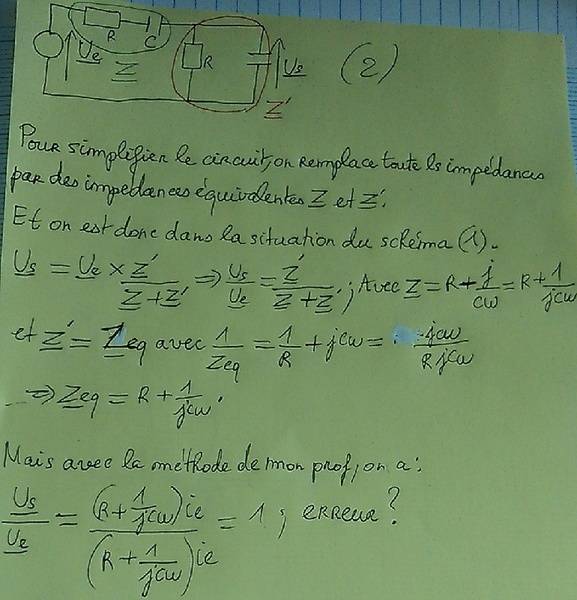
It's a exercice it is an exercise on the voltage gain,and on the first scheme there are the correction of my teatcher,but I but I was wondering if we can't calculate the voltage gain with a bridge voltage divider like I did.(It's in french but only the formula are important).
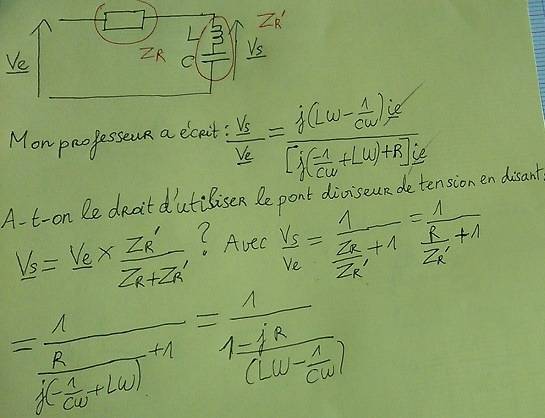
The second scheme,it's the same thing(the method of my teacher ,and bridge voltage divider),but is it good?
160109064247913760.jpg

160109064312572686.jpg
 
  • Like
Likes   Reactions: Merlin3189
Physics news on Phys.org
First diagram: yes. One more step and you can see that the ##V_s\over V_e## ratios are identical !

Second diagram: I don't see what your professeur did ?

But you want to check your ##1\over Z_{eq}## !
 
Hello,thank you for your help :),so my teacher did not do the second exercise,but I tried to use his methode.
His method is in red on this diagram(or scheme ):
Is-it a question?
No I don't want to check my 1/Zeq,this calculation is right I think but I have not always trusted me.
I must speak better in english to better understand you and write better.
But yes professeur=professor in english :).
16011002031976569.jpg
 
Method of your professeur does not give 1: numerator and denominator are different.

Time to point out that method of professeur and your method are not different: $$ {V_s\over V_e} = {Z' I_e \over \left ( Z + Z' \right ) I_e} = {Z' \over Z + Z' } $$
 
  • Like
Likes   Reactions: Pablo3
Pablo3 said:
No I don't want to check my 1/Zeq, this calculation is right
Of course not$${1\over 2} = {1\over 3} + 0.16667 \Rightarrow 2 = 3 + 6 \ \ \ \ {\rm ?} $$
 
  • Like
Likes   Reactions: Pablo3
BvU said:
Of course not$${1\over 2} = {1\over 3} + 0.16667 \Rightarrow 2 = 3 + 6 \ \ \ \ {\rm ?} $$
Yes yes,I have forgot one thing,and to answer your question no that does not mean it,but yes effectively the methods are similar.
Thank you very much !
I wish you a good day :).
 
Avec plaisir. You're welcome and I'll be glad to look at your result for the (R//C) / (R+C + R//C) case...
 
Pablo3 said:
Yes yes,I have forgot one thing,and to answer your question no that does not mean it,but yes effectively the methods are similar.
Thank you very much !
I wish you a good day :).
Normally equal to Zeq :
160110041719803814.jpg
 
So far, so good !
 

Similar threads

  • · Replies 1 ·
Replies
1
Views
2K
  • · Replies 7 ·
Replies
7
Views
4K
  • · Replies 1 ·
Replies
1
Views
844
  • · Replies 10 ·
Replies
10
Views
2K
  • · Replies 5 ·
Replies
5
Views
2K
  • · Replies 25 ·
Replies
25
Views
8K
Replies
2
Views
1K
  • · Replies 22 ·
Replies
22
Views
3K
  • · Replies 2 ·
Replies
2
Views
2K
  • · Replies 1 ·
Replies
1
Views
2K