Can anyone please check my work and answer for this math problem?

Click For Summary
SUMMARY

The discussion centers on determining whether a given vector is an eigenvector of another vector. The user initially answers "no" but later concludes that the vector \(\begin{pmatrix} 2\sqrt{2} - 1\\ \sqrt{2} +3 \end{pmatrix}\) is indeed a scalar multiple of \(\begin{pmatrix} \sqrt{2} - 1\\ 1 \end{pmatrix}\), confirming that it satisfies the eigenvector condition \(Av = \lambda v\). The correct answer is therefore "Yes," validating the user's final assessment.

PREREQUISITES
  • Understanding of eigenvectors and eigenvalues
  • Familiarity with vector notation and operations
  • Knowledge of scalar multiplication in linear algebra
  • Basic grasp of matrix transformations
NEXT STEPS
  • Study the properties of eigenvectors and eigenvalues in linear algebra
  • Learn about matrix transformations and their implications on vector spaces
  • Explore the concept of scalar multiplication in depth
  • Practice solving eigenvector problems using various examples
USEFUL FOR

Students of linear algebra, mathematicians, and anyone involved in vector space analysis will benefit from this discussion.
Math100
Messages
817
Reaction score
230
Homework Statement
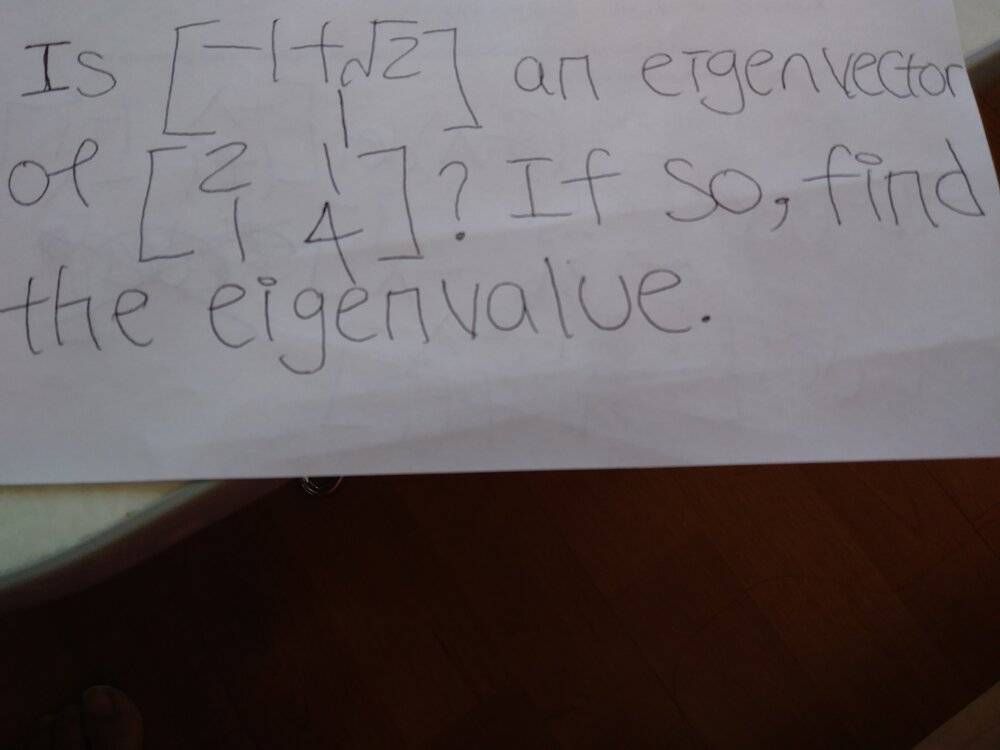
Is [-1+sqrt(2), 1] an eigenvector of [2, 1; 1, 4]? If so, find the eigenvalue.
Relevant Equations
None.
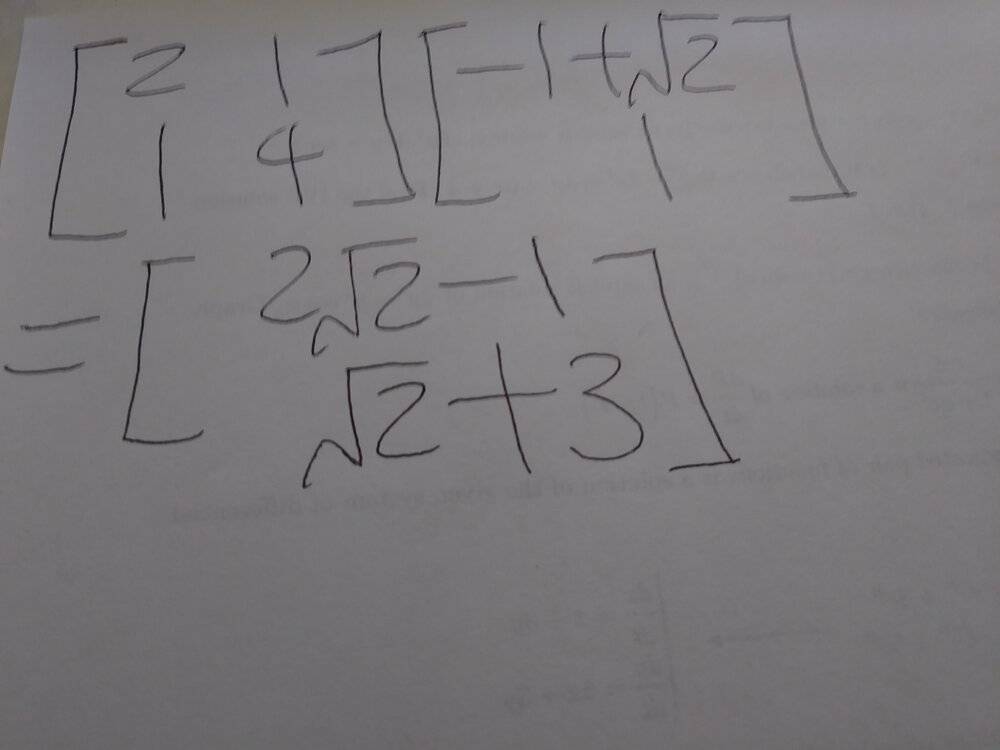
Can anyone please confirm and check my work with answer because I'm not 100% sure if my work with answer is 100% correct. The question is asking if the given vector is an eigenvector and I've answered no. What's the correct answer for this problem? It's Yes or No?
20200815_103202.jpg
20200815_104905.jpg
 
Physics news on Phys.org
I think you need to write a little bit larger. Got any A3 nearby?
 
Sorry, I don't understand. What do you mean about A3 nearby?
 
Nevermind, it was just a bad attempt at humour. As for your question, is the vector ##
\begin{pmatrix}
2\sqrt{2} - 1\\
\sqrt{2} +3
\end{pmatrix}## a scalar multiple of the vector ##
\begin{pmatrix}
\sqrt{2} - 1\\
1
\end{pmatrix}##?
 
I think the answer is Yes, because (√2-1)(√2+3)=2√2-1. Therefore, it's scalar multiple. Am I right?
 
Right. And and if the result is a scalar multiple of the first vector, as in ##Av = \lambda v##, then ##v## is an eigenvector. Does that answer your question? :smile:
 
  • Like
Likes Math100
Yes. Thank you so much for the help.
 
  • Like
Likes etotheipi

Similar threads

  • · Replies 2 ·
Replies
2
Views
2K
  • · Replies 19 ·
Replies
19
Views
3K
  • · Replies 5 ·
Replies
5
Views
2K
  • · Replies 21 ·
Replies
21
Views
2K
Replies
4
Views
2K
Replies
2
Views
1K
  • · Replies 25 ·
Replies
25
Views
2K
Replies
28
Views
2K
  • · Replies 7 ·
Replies
7
Views
2K
  • · Replies 9 ·
Replies
9
Views
2K