Discussion Overview
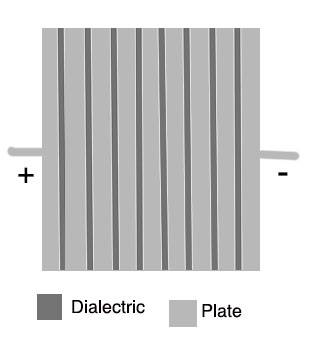
The discussion centers on the feasibility of using bipolar plate technology to create high voltage capacitors. Participants explore the theoretical underpinnings of capacitor design, particularly in relation to dielectric materials and configurations involving multiple plates and dielectrics. The conversation includes considerations of voltage tolerance, capacitance, and practical issues related to leakage and voltage balancing.
Discussion Character
- Exploratory
- Technical explanation
- Debate/contested
- Mathematical reasoning
Main Points Raised
- Some participants propose that a bipolar plate capacitor could function similarly to capacitors in series, potentially achieving higher voltage ratings.
- There is discussion about the dielectric strength of materials and how it affects the overall voltage capacity of the proposed capacitor design.
- Concerns are raised about voltage imbalance in capacitors connected in series, particularly regarding the risk of dielectric failure due to leakage currents.
- Some participants suggest that protection diodes may be necessary to prevent overcharging of individual capacitor elements.
- There is a mention of using thicker dielectrics instead of intermediate conductive plates to achieve similar capacitive effects.
- The role of electrolysis in balancing voltage across cells is questioned, with some participants discussing the implications of using a water-based dielectric paste.
- Participants explore the properties of various dielectric materials, including tantalum pentoxide and calcium copper titanate, and their implications for capacitor design.
- Examples of existing capacitor designs that utilize similar principles are referenced, indicating that such configurations are not entirely theoretical.
Areas of Agreement / Disagreement
The discussion contains multiple competing views regarding the effectiveness and practicality of the proposed bipolar plate capacitor design. Participants express differing opinions on the necessity of protection mechanisms and the implications of using various dielectric materials. No consensus is reached on the viability of the design or the best approach to address the identified issues.
Contextual Notes
Participants note limitations related to the assumptions about dielectric behavior, the precision required in manufacturing, and the potential for chemical breakdown in water-based dielectrics. The discussion highlights the complexity of balancing voltage in a multi-plate configuration and the challenges posed by leakage currents.