Can Conducting Current Through a Bar Magnet Cause Movement?

Click For Summary
SUMMARY

Conducting current through a permanent bar magnet can induce movement due to the Lorentz Force, which states that a current-carrying conductor in a magnetic field experiences a force. The movement occurs only when the current is started or stopped, similar to how a canoe moves when a person shifts their weight. The discussion emphasizes that while a magnetic field from the wires exerts a force on the magnet, the system's conservation of momentum prevents continuous movement. The conversation also touches on the implications of Newton's Third Law in this context.

PREREQUISITES
  • Understanding of Lorentz Force and its application in electromagnetism
  • Familiarity with basic circuit theory and components, including batteries and resistors
  • Knowledge of magnetic fields and their interaction with electric currents
  • Concept of conservation of momentum in isolated systems
NEXT STEPS
  • Research the principles of the Lorentz Force in greater detail
  • Explore the relationship between electric currents and magnetic fields in circuits
  • Study the implications of Newton's Third Law in electromagnetic systems
  • Investigate practical applications of electromagnetism, such as linear motors and rail guns
USEFUL FOR

Physics students, electrical engineers, hobbyists experimenting with electromagnetism, and anyone interested in the principles of motion induced by electric currents in magnetic fields.

StoyanNikolov
Messages
50
Reaction score
0
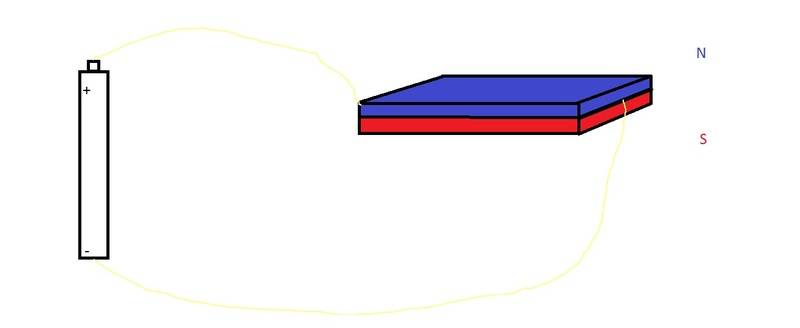
Following the Picture below,
If I Conduct current through Permanent magnet Bar and hold the battery still. Will the magnet move in any direction ? Thank you.
ASGi0.jpg
 
Physics news on Phys.org
How are you intending to connect the battery to the flat magnet? Where do the wires make conductive contact to the magnet? (top/bottom, side-to-side?)

And I'll assume that you have a current limiting resistor in series with that connection. What are you hoping the magnet does?
 
There is connection . Two opposite sides . Opposite sideways. Just they are not very visible on the picture.
 
Are you expecting the battery to influence the magnet. A battery will produce a field if a current if flowing through it but in your 'circuit' nothing is happening afaics. Draw a circuit.
 
StoyanNikolov said:
There is connection . Two opposite sides . Opposite sideways. Just they are not very visible on the picture.
Oh, I think I see the "wires" now. It's pretty confusing, so let me try to introduce a coordinate system. Let ##W## be the width of the flat magnet and ##T## be the vertical thickness. The ##(x,y,z)## axes point right, back and up.

So your Positive wire connects at ##(0,0,T)## and your Negative wire connects at ##(W,\frac{W}{2},\frac{T}{2})##. Does that sound right?

The current flowing through the flat magnet will experience a vertical magnetic field that will cause a slight horizontal deflection of that current via the Lorentz Force: ##F = q\vec v \times \vec B##, so there will be a slight movement of the free bar magnet in the opposite direction. But the movement only happens when you start or stop the current, much like if you are standing in a canoe and take a step one way and stop, the canoe moves the other way and stops. The center of mass of you + the canoe stays in the same place, by Conservation of Momentum of an isolated system.

EDIT/ADD: https://en.wikipedia.org/wiki/Hall_effect
 
Last edited:
  • Like
Likes   Reactions: Lord Jestocost and vanhees71
Faraday Paradox Linear Motion.jpg

Thank you . I've made some changes. Both ends of the Conductor are connected to the center of each opposite side.
Will the magnet experience motion in any direction, considering large enough current passing through? The conductor is is flexible.
Thank you.
 
Last edited:
StoyanNikolov said:
Will the magnet experience motion in any direction, considering large enough current passing through? The conductor is is flexible.
Yes, the magnetic field of the wires will exert a force on the magnet. The same thing happens if you just have a wire instead of a bar magnet as the field from each part of the wire exerts a force on each other part.
 
  • Like
Likes   Reactions: vanhees71
berkeman said:
The current flowing through the flat magnet will experience a vertical magnetic field that will cause a slight horizontal deflection of that current via the Lorentz Force: F=qv→×B→, so there will be a slight movement of the free bar magnet in the opposite direction. But the movement only happens when you start or stop the current
Why wouldn't it keep moving? I'm having a hard time seeing what the restoring force is that establishes an equilibrium position.
 
DaveE said:
Why wouldn't it keep moving?
Conservation of Momentum probably. I think there would be a counter-force from the bunching of the current once that offset forms, but I'd have to think more about it...
 
  • #10
berkeman said:
Conservation of Momentum probably. I think there would be a counter-force from the bunching of the current once that offset forms, but I'd have to think more about it...
On a large scale, I don't see how it's different that a battery powered toy car, but with a linear motor instead of a rotary motor. Momentum isn't conserved when you are discharging energy in a battery to apply force.

It reminds me of a rail gun, although this one is all about the PM B-field, not the induced one.
 
  • #11
The OP's previous threads were about "Reactionless Drives", so I'm guessing that they are asking whether there is a net movement of the CoM in space, not on the surface of the Earth where you have things to push against and this is not an isolated system...
 
  • Like
Likes   Reactions: DaveE
  • #12
berkeman said:
The OP's previous threads were about "Reactionless Drives", so I'm guessing that they are asking whether there is a net movement of the CoM in space, not on the surface of the Earth where you have things to push against and this is not an isolated system...
OK, not so obvious to me now. Let's say the battery, magnet, and wires area all glued to a platform so none of that stuff moves, and it's floating in space. There is a Lorentz force at the magnet, but that B-field wraps around and goes through the battery and the rest. It's stronger at the magnet, so if you integrate around the current loop I think you get a net force.
 
  • #13
Now don't you be posting about Reactionless Drives... :wink:
 
  • #14
berkeman said:
Now don't you be posting about Reactionless Drives... :wink:
Yea, I get it. I'm focused too much on the electrons here. There are also protons present...

This is one of those things that makes me realize I knew a lot more about physics 40 years ago than I do now, and even worse, I'm worse at learning it now. It can't work, because of Newtons' 3rd law. But I do need to think about it some more.
 
  • Like
Likes   Reactions: berkeman
  • #15
If you put a wire in a magnetic field it feels a force, and presumably there's a reaction on the magnet, from the interaction between the wire's magnetic field and the magnet's. If you taped the wire to the magnet, then, presumably nothing would happen (neglecting any momentum carried away by radiation when you turn on the current). Is the circuit described above materially different from a wire taped to a magnet?
 
  • #16
Oh dear.

(1) If I have a current external to a magnetic field, the force on the current is equal and opposite to the force on the magnet.

(2) If I attach the current to the magnet, there is no net force. If I have the current flow through the magnet, that's just a way of attaching them.

(3) "The OP's previous threads were about "Reactionless Drives"" Then why are we wasting everybody's time on this nonsense?
 
  • Like
Likes   Reactions: russ_watters
  • #17
With that good summary post by V50, the thread will remain closed. Thanks folks.
 

Similar threads

  • · Replies 5 ·
Replies
5
Views
1K
  • · Replies 6 ·
Replies
6
Views
2K
  • · Replies 5 ·
Replies
5
Views
2K
  • · Replies 20 ·
Replies
20
Views
2K
  • · Replies 1 ·
Replies
1
Views
1K
  • · Replies 1 ·
Replies
1
Views
2K
  • · Replies 5 ·
Replies
5
Views
656
Replies
13
Views
3K
  • · Replies 2 ·
Replies
2
Views
2K
  • · Replies 5 ·
Replies
5
Views
2K