Can I use capacitors to create a magnetic field with a transformer and coil?

  • Thread starter Thread starter Ziggey
  • Start date Start date
  • Tags Tags
    Capacitors Coil
Click For Summary
SUMMARY

The discussion centers on the feasibility of using capacitors in conjunction with a transformer to create a magnetic field. The original poster, Zig, attempted to connect five capacitors in parallel to a transformer producing 120V AC from a 12V battery. Forum members, including Dave, clarified that charging capacitors with AC is ineffective due to their constant charging and discharging, leading to zero net charge. They advised Zig to use a DC supply instead of a transformer to avoid damaging the components.

PREREQUISITES
  • Understanding of AC and DC electrical systems
  • Knowledge of transformer operation and inverter functionality
  • Familiarity with capacitor behavior in AC circuits
  • Basic electronics safety precautions
NEXT STEPS
  • Research how to safely charge capacitors using a DC power supply
  • Learn about the principles of electromagnetic fields and their generation
  • Explore the differences between transformers and inverters in electrical circuits
  • Investigate capacitor types and their appropriate applications in circuits
USEFUL FOR

Electronics hobbyists, electrical engineers, and anyone interested in building circuits involving capacitors and transformers.

Ziggey
Messages
12
Reaction score
0
Hello.

So I'm trying to work on a project with capacitors. I have a twelve volt battery hooked up to a transformer that produces 120 v ac.

I would like to then hook the transformer up to five capacitors in parallel and then use the power stored i the capacitors to shoot through my coils to create a magnetic field. Something is going wrong though and I don't know what.
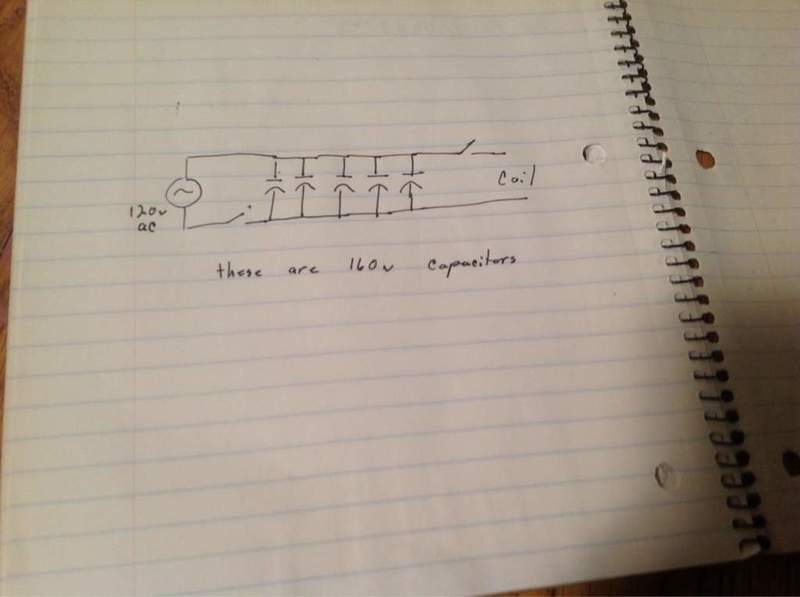
ImageUploadedByPhysics Forums1409391537.835094.jpg


Any help would be great. Am I going to be able to just charge the capacitors up? I know that when running ac the capacitors are constantly charging and discharging. When I hook it up though the transformer makes a noise like I'm shorting something out... :/

Thanks for any help,
Zig
 
Engineering news on Phys.org
sounds like a bit of a dangerous project

putting capacitors across AC is pointless as each plate of the capacitor will be charging and discharging with each cycle of AC ( as you discovered) so you will end up with zero charge on them

forget the transformer and charge them directly from a DC supply

Dave
 
Ziggey said:
I have a twelve volt battery hooked up to a transformer that produces 120 v ac.
Do you mean an inverter? If you hook up a DC supply to a transformer, you'll just short out the supply.

Ziggey said:
When I hook it up though the transformer makes a noise like I'm shorting something out... :/
If you manage to hook up that level of AC voltage to your polarized caps, you're probably just going to see a lot of smoke.
 
Yes sorry I meant inverter... Ok I will have to modify my plan a little then thank you all for the help!

zig
 
Most likely this can only be answered by an "old timer". I am making measurements on an uA709 op amp (metal can). I would like to calculate the frequency rolloff curves (I can measure them). I assume the compensation is via the miller effect. To do the calculations I would need to know the gain of the transistors and the effective resistance seen at the compensation terminals, not including the values I put there. Anyone know those values?

Similar threads

  • · Replies 15 ·
Replies
15
Views
4K
  • · Replies 10 ·
Replies
10
Views
2K
Replies
5
Views
2K
  • · Replies 6 ·
Replies
6
Views
3K
  • · Replies 4 ·
Replies
4
Views
2K
  • · Replies 28 ·
Replies
28
Views
14K
Replies
3
Views
2K
  • · Replies 12 ·
Replies
12
Views
4K
  • · Replies 2 ·
Replies
2
Views
491
  • · Replies 6 ·
Replies
6
Views
3K