Discussion Overview
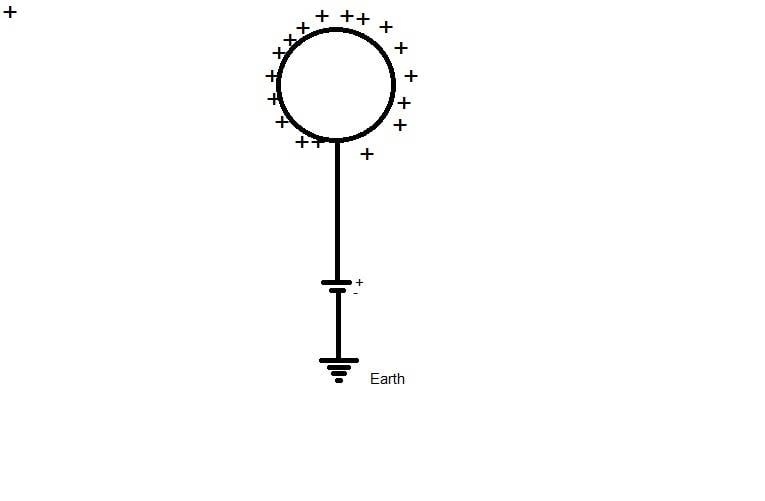
The discussion centers around the feasibility of using a battery to charge a metal sphere, specifically examining the method of connecting the sphere to a battery and grounding it. Participants explore the implications of this method, including comparisons to other charging methods like the Van de Graaff generator.
Discussion Character
- Exploratory
- Technical explanation
- Debate/contested
Main Points Raised
- One participant questions whether connecting a metal sphere to a battery and grounding it would result in the sphere becoming electrically charged.
- Another participant asserts that the sphere will indeed become charged and suggests visualizing the electric field lines between the sphere and the ground.
- There are claims regarding the charge of the sphere being quantified as Q=VR, with some participants noting the use of Gaussian units.
- Participants express curiosity about why Van de Graaff generators are preferred in laboratories despite the simplicity of the battery method.
- Questions arise regarding the voltage differences between Van de Graaff generators and batteries, with one participant suggesting that battery voltage can be increased to match that of a Van de Graaff generator.
- Another participant challenges the practicality of achieving high voltages with batteries, referencing the high output of Van de Graaff generators.
- A suggestion is made to use an electric converter to achieve high voltage DC from a standard battery setup.
Areas of Agreement / Disagreement
Participants express differing views on the practicality and effectiveness of using a battery to charge a metal sphere compared to using a Van de Graaff generator. There is no consensus on the best method or the feasibility of achieving high voltages with batteries.
Contextual Notes
Some claims regarding voltage and charging methods depend on specific assumptions about the setup and components used, which are not fully detailed in the discussion.