jeffkosmo
- 7
- 0
Hi,
I’ve got a general question about wave-particle duality, and the experiments done with slits.
When a laser is beamed through a small slit, we get a diffraction pattern. This pattern is interesting because it contains dark bands.
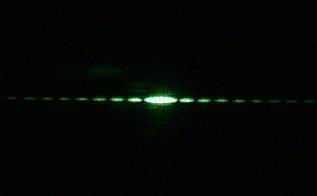
When it comes to explaining the existence of these dark bands, most people invoke the wave aspect of light, and claim that the dark bands are due to photons interfering with each other, and essentially canceling each other out. This idea is analogous to superimposing two sinusoids on top of each other, that are 180 degrees out of phase.
However, experiments done with electrons (and a double slit) produce a similar pattern, even when electrons are shot one at a time. The question then arises, how can a single electron interfere with itself.
Question 1: Is it possible to do these experiments by shooting (and detecting) a single photon?
For the sake of the discussion, let’s assume that it IS, and that we get a similar result with photons (i.e., when shot one at a time, we still get the dark bands).
Question 2: If we claim that these dark bands are a result of “self-cancelling” photons, aren’t we in effect saying that these photons have zero amplitude? If so, isn’t that an oxymoron? I mean, how can a photon exist, and not have any amplitude… and yet still be detectable?
Question 3: If in fact these “dark photons” are theoretically possible, what other phenomena produce them?
Thanks so much,
Jeff
I’ve got a general question about wave-particle duality, and the experiments done with slits.
When a laser is beamed through a small slit, we get a diffraction pattern. This pattern is interesting because it contains dark bands.
When it comes to explaining the existence of these dark bands, most people invoke the wave aspect of light, and claim that the dark bands are due to photons interfering with each other, and essentially canceling each other out. This idea is analogous to superimposing two sinusoids on top of each other, that are 180 degrees out of phase.
However, experiments done with electrons (and a double slit) produce a similar pattern, even when electrons are shot one at a time. The question then arises, how can a single electron interfere with itself.
Question 1: Is it possible to do these experiments by shooting (and detecting) a single photon?
For the sake of the discussion, let’s assume that it IS, and that we get a similar result with photons (i.e., when shot one at a time, we still get the dark bands).
Question 2: If we claim that these dark bands are a result of “self-cancelling” photons, aren’t we in effect saying that these photons have zero amplitude? If so, isn’t that an oxymoron? I mean, how can a photon exist, and not have any amplitude… and yet still be detectable?
Question 3: If in fact these “dark photons” are theoretically possible, what other phenomena produce them?
Thanks so much,
Jeff