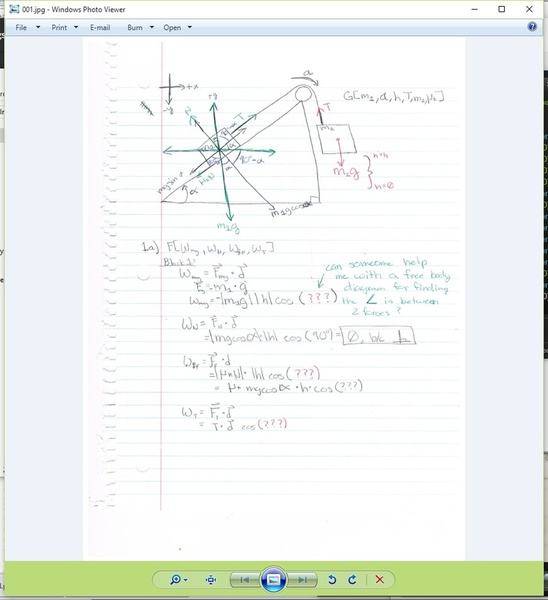
Can someone help me find the angle between two forces?

Click For Summary
SUMMARY

This discussion focuses on determining the angle between two forces, specifically in the context of calculating work done by gravitational and frictional forces. The key takeaway is the use of the dot product to find work, where the angle used should be evaluated based on the context of the forces involved. The participants emphasize the importance of understanding when to apply sine or cosine in calculations, particularly using the extreme case of α=0 to clarify the correct approach. The final conclusion is that for the force of gravity acting on an incline, the correct component to use is m1g*sin(α) when calculating work along the direction of displacement.

PREREQUISITES
  • Understanding of vector components and forces
  • Familiarity with the dot product in physics
  • Knowledge of trigonometric functions, specifically sine and cosine
  • Basic principles of work and energy in physics
NEXT STEPS
  • Study the application of the dot product in physics problems
  • Learn about vector decomposition in two-dimensional motion
  • Explore the role of angles in work calculations, particularly in inclined planes
  • Review the concepts of static and kinetic friction in relation to motion
USEFUL FOR

Students studying physics, particularly those focusing on mechanics, as well as educators and tutors looking to clarify concepts related to forces and work calculations.

Blockade
Messages
68
Reaction score
0
Can someone help me relearn finding the angle between two forces when solving for work of each forces (gravity, tension, fF, normal)?
I remember that cos(90°-α) = sin(α) but what I don't understand is when the angle in between is "90°-α" or when it's just "α". I tried doing this on my own and but my work is always wrong when calculating the angle in between for each dot product.

Problem:
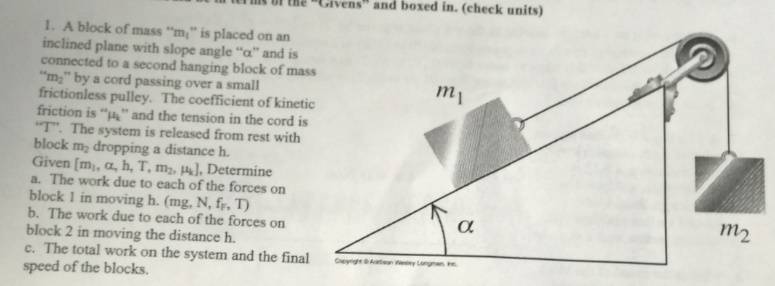
9dbfd9c11b.jpg


Attempt:
61b5a05791.jpg
 
Physics news on Phys.org
I think you are asking how to check whether you should be using cos or sine of the given angle in the dot product.
A method I use to check that I have the right one is to think about an extreme case, such angle = 0. You know sin(0)=0 and cos(0)=1. Which value makes sense in the context?
 
haruspex said:
I think you are asking how to check whether you should be using cos or sine of the given angle in the dot product.
A method I use to check that I have the right one is to think about an extreme case, such angle = 0. You know sin(0)=0 and cos(0)=1. Which value makes sense in the context?

I have done some more work:
81c7fec189.jpg

I think I got Wmg, WT, and WN correctly. However, I am still have difficulty finding the angle between the force of friction "μkcos(α)" and the displacement vector "h". The force of friction is suppose to be opposite from the displacement h for the block on the incline right? May you please check my 2nd attempt and see if my answers are correct?

WfF = -μk*cos(α)*h , by the way since the angle between these two forces is 180° for the dot product.
 
Blockade said:
the force of friction "μkcos(α)"
That is not a force. What is missing?
 
haruspex said:
That is not a force. What is missing?
The mass and acceleration! "m1g * μkcos(α)".

I have another question, for Wm1g, I am suppose to use m1g or it cosine component: m1g*cos(α) for Fm1g?
 
Blockade said:
for Wm1g, I am suppose to use m1g or it cosine component: m1g*cos(α) for Fm1g?
It depends how you are going to use it. What would you do to that to get the work?
 
haruspex said:
It depends how you are going to use it. What would you do to that to get the work?
Yes I would like to get work from it? So to get work should I use m1g or m1g*cos(α)?
 
Blockade said:
Yes I would like to get work from it? So to get work should I use m1g or m1g*cos(α)?
You did not answer my question. What will you do to or with the force, algebraically, to find the work?
 
haruspex said:
You did not answer my question. What will you do to or with the force, algebraically, to find the work?
Dot product the force of gravity and the displacement "h".
 
  • #10
Blockade said:
Dot product the force of gravity and the displacement "h".
You can either find the force in the direction of h, making the dot product a simple multiplication, or take the force in its natural direction and apply the dot product rule when multiplying by the distance. It comes to the same answer either way.
However, it is not cos α you want here. Use the technique I mentioned: consider the case when α=0. Would there be any gravitational force on m1 in the h direction?
 
  • #11
haruspex said:
I think you are asking how to check whether you should be using cos or sine of the given angle in the dot product.
A method I use to check that I have the right one is to think about an extreme case, such angle = 0. You know sin(0)=0 and cos(0)=1. Which value makes sense in the context?
cos(0) = 1 since if you use sin(0)=0 your answer will always be 0?
 
  • #12
haruspex said:
You can either find the force in the direction of h, making the dot product a simple multiplication, or take the force in its natural direction and apply the dot product rule when multiplying by the distance. It comes to the same answer either way.
However, it is not cos α you want here. Use the technique I mentioned: consider the case when α=0. Would there be any gravitational force on m1 in the h direction?

Can you go more in depth with your technique? Right now I am using my best guess to answer your questions since I don't know where this is going. But to answer your question for Block m1 there is force of gravity in the h direction and that force is m1gsin(α)
 
  • #13
Blockade said:
Block on m1 there is force of gravity in the h direction and that force is m1gsin(α)
Quite so. So what is the work done?

To check that it is sin, not cos, consider α=0. There is clearly now no force of gravity along the 'slope' (i.e. horizontal now), and sin(α)=0, so sin must be the right choice.
 
  • #14
haruspex said:
Quite so. So what is the work done?

To check that it is sin, not cos, consider α=0. There is clearly now no force of gravity along the 'slope' (i.e. horizontal now), and sin(α)=0, so sin must be the right choice.

I am sorry, but what? So assume α = 0 so see if there are any forces left on the horizon? If so then sine is the right choice over cosine?
 
  • #15
Blockade said:
I am sorry, but what? So assume α = 0 so see if there are any forces left on the horizon? If so then sine is the right choice over cosine?
When the angle is zero, the 'slope' is horizontal. In that situation, the force of gravity on m1 has no component along the slope, so cannot do any work along the the direction pf movement (h direction). It follows that the work is not mgh cos(α), since that would give mgh instead of 0.
 

Similar threads

Replies
22
Views
2K
Replies
1
Views
1K
Replies
8
Views
5K
Replies
7
Views
3K
  • · Replies 31 ·
2
Replies
31
Views
4K
  • · Replies 9 ·
Replies
9
Views
2K
Replies
46
Views
5K
  • · Replies 9 ·
Replies
9
Views
3K
  • · Replies 32 ·
2
Replies
32
Views
3K
Replies
8
Views
3K