Can you use hand tools on the moon?

Click For Summary
SUMMARY

Hand tools can be effectively used on the Moon, including shovels and drills, provided that the user is equipped with a lightweight and flexible space suit. The reduced gravity of 0.17 g allows for easier lifting of materials, but it also necessitates adjustments in technique to compensate for lower friction and inertia. Tools may require modifications to prevent issues like cold-welding in metal-on-metal contact. Overall, while using hand tools on the Moon presents unique challenges, there are no fundamental barriers to their use.

PREREQUISITES
  • Understanding of lunar gravity and its effects on tool usage
  • Knowledge of space suit design and functionality
  • Familiarity with the principles of levers and mechanical advantage
  • Awareness of the properties of lunar regolith and its impact on tools
NEXT STEPS
  • Research the design and materials of space suits for lunar operations
  • Study the mechanics of levers in reduced gravity environments
  • Investigate the effects of lunar dust on tool performance and longevity
  • Explore historical usage of tools during the Apollo missions for practical insights
USEFUL FOR

Aerospace engineers, astronauts, researchers in planetary science, and anyone interested in lunar exploration and the practical applications of tools in extraterrestrial environments.

Limebat
Messages
17
Reaction score
4
TL;DR
Could you use a shovel the same way on Earth?
No, this isn't a homework question. I'm genuinely curious;

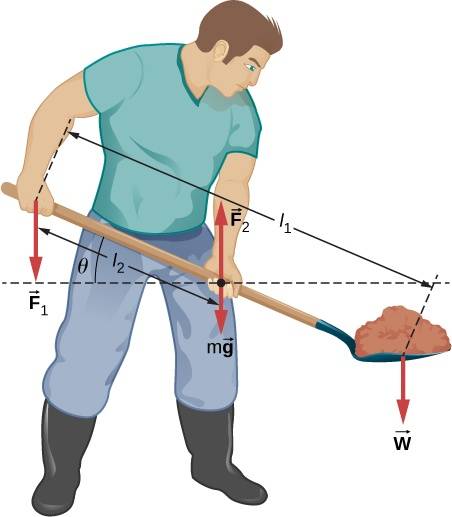
If I were to magically teleport and happenstance with a shovel and survive the harsh climate, could I use said shovel? Maybe hand drills? I would assume the shovel would be a class one lever, and thus the moon's lower gravity would reduce the load on this "lever" (shovel), so the force exerted on the effort arm would be much smaller. Yet, the load arm (the one with dirt pile) would also decrease, as the weight of lunar regolith would decrease as well in reduced gravity. My guess is that the shoveling rate would remain the same. Well, ignoring the fact you'd have to actually get the shovel down into the dirt in the first place.
CNX_UPhysics_12_01_SM11-21_img.jpg


However, I'd like to hear from you guys as well. Would you be able to use a shovel the same way as on Earth? This assumes everything and anything to stop the shovel, i.e. the abrasive nature of lunar dust on equipment.
 
  • Like
Likes   Reactions: Delta2 and Dale
Physics news on Phys.org
Shovels have been used during the Apollo missions. Here is an image from the training on Earth:

Apollo Moon Rock Shovel.jpg

(Does somebody have images or even videos from the Moon?)

It seems the major problem is not the tool but the space suit.
 
  • Like
Likes   Reactions: Delta2, Limebat, vanhees71 and 1 other person
I don't see any reason why you couldn't use most hand tools equally as well on the Moon as on Earth, assuming you had a lightweight and flexible space suit. Perhaps the only exception I can think of immediately might be tools that have metal on metal contact, such as in drills or hinges, as I've read that they can cold-weld themselves together as the oxide layer is rubbed off and no oxygen is present to create it again.
 
I also guess, it's hard to get used to the lower gravity on the moon. We are used to gravity on Earth (with ##g
\simeq 9.81 \text{m}/\text{s}^2##). On the Moon it's only ##0.17 g##. So I guess it would take some time to get used to this much lower weight of things on the moon to handle them with the same routine as on Earth.
 
Drakkith said:
I don't see any reason why you couldn't use most hand tools equally as well on the Moon as on Earth, assuming you had a lightweight and flexible space suit.
There could be problems where weight matters. @Limebat already mentioned that you need to get the shovel down into the dirt. That is harder with reduced weight. You would have a similar problem with a powered drill. Reduced weight also means reduced friction. That might end up with you rotating around the drill.

The reduced gravity could be compensated by the additional mass of the life support. But that comes with other problems (e.g. more inertia and a changed center of mass). Tools would need to be adapted to lower gravity and as @vanhees71 mentioned, it takes some practice to use them efficiently. But I agree that there is no general problem that would prevent us from using normal tools on the Moon.
 
  • Like
Likes   Reactions: Ibix and vanhees71
Your digging style would be quite different.
Since g is less you could pick up a greater mass of material; F = m·g; but the force needed to accelerate it horizontally to the dump site; F = m·a; would remain the same as on Earth, or in space.
 
  • Like
Likes   Reactions: Ibix, Limebat, DrStupid and 1 other person
  • Like
Likes   Reactions: vanhees71, Ibix and Limebat
Baluncore said:
Your digging style would be quite different.
It occurs to me that under some circumstance you might want to hold the shovel as close to the blade as possible. You have the strength to lift far more than your own mass, but the principle of moments says you'll fall over if you try. Simplistically, it seems like the shorter the lever arm of the shovel the more mass you can lift.
 
  • Like
Likes   Reactions: mfb and Limebat
Ibix said:
Simplistically, it seems like the shorter the lever arm of the shovel the more mass you can lift.
But how far can you throw that mass when you are only held lightly to the ground by the "lower g" * "friction coefficient" ? Maybe you need to get weighted boots for use with the longer handled shovel.

I believe a shovel handle is longer than needed for digging because it enables you to throw the material further than from a spade. You slide the handle through your lower hand as you accelerate and cast the contents to the LZ.

The 'D' handle spade is a different issue as the fulcrum is at the soil surface and the handle must be near your hands, that are near your waist.
 
  • Like
Likes   Reactions: Ibix, Limebat and vanhees71
  • #10
Golf was played on the moon. (Okay, not a proper round, but a few balls were hit with a somewhat improvised iron). I am not sure that the distance the balls traveled was accurately measured, however I am confident that the distance would have made Arnold Palmer grumble with envy! :)

Seems that with most of these things, it is mostly a matter of adjusting technique. The difficulties would seem to get magnified as momentum/inertia increase.

---diogenesNY
 
  • Like
Likes   Reactions: vanhees71
  • #11
Baluncore said:
I believe a shovel handle is longer than needed for digging because it enables you to throw the material further than from a spade.
Pretty sure shovels are as long as they are to save human backs.
A torment technique in hard labour prisons was to give the prisoner a short-handled shovel, which would destroy his back when heaving dirt.

(Yes, notwithstanding valid specialized uses for short-handled shovels).
 
  • Like
Likes   Reactions: vanhees71 and jbriggs444
  • #12
DaveC426913 said:
Pretty sure shovels are as long as they are to save human backs.
Yes, with a longer handle you can move the material further, without injuring your back.
 
  • Like
Likes   Reactions: vanhees71
  • #13
Baluncore said:
Yes, with a longer handle you can move the material further, without injuring your back.
I think its more about not having to bend so far over to reach the dirt and lift it.

With a short handle, you are forced to lock your spine and all its tiny muscles in an unnatural, hunched position in order to get the leverage to lift.

You must shape yourself like a lowercase 'r' rather than more of a lowercase 'l'. Before even getting to the throw, you're already mangling your spine just lifting.
 
  • Like
Likes   Reactions: vanhees71 and mfb
  • #14
DaveC426913 said:
You must shape yourself like a lowercase 'r' rather than more of a lowercase 'l'. Before even getting to the throw, you're already mangling your spine just lifting.
You can dig a garden with a short 'D' handle spade because you are working at ground level to cut soil, then dropping or folding it into the hole or trench as you advance.

A shovel is designed not to dig, but to slide along a flat surface to pick up material from that surface, then in the same action to raise and throw the material into a container or onto a heap. When using a long handled shovel you do not bend your back, you plant your forward foot with leg partly bent, with back and arm straight and parallel, then press down on the handle end with the back arm to lift the load while straightening your forward leg. Your forward leg does the work. Once lifted, both arms then control the trajectory of the load. The angle of lean on the straight body will depend on the direction you are throwing the material. The position of your hands on the long handle will set the lever ratio when lifting and throwing. You adjust that dynamically.
 
  • Like
Likes   Reactions: vanhees71

Similar threads

  • · Replies 21 ·
Replies
21
Views
4K
  • · Replies 7 ·
Replies
7
Views
3K
  • · Replies 21 ·
Replies
21
Views
5K
Replies
2
Views
15K
Replies
3
Views
8K
  • · Replies 17 ·
Replies
17
Views
15K
  • · Replies 11 ·
Replies
11
Views
4K
  • · Replies 14 ·
Replies
14
Views
11K
  • · Replies 5 ·
Replies
5
Views
5K
  • · Replies 4 ·
Replies
4
Views
3K