PerfPhys
- 3
- 0
1. The Question
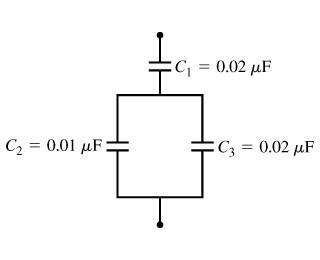
a. What is the equivalent capacitance of the combination shown in the figure ?
b. If a 100V battery is connected across the combination, what is the charge on each capacitor?
c. What is the voltage across each?
2. Equations
C=Q/V, adding capacitance rules
3. Solution attempt
For part a, I added C2 and C3 to get .03, then added the two in series (1/.02)+(1/.03) and took the inverse to get a combination capacitance of .012 microF
I am stuck on parts b and c, though. For B, we know Q=V/C and for C2 it would be Q=(100V)(0.01microfarads) which gives a charge of 1 microcoulomb.
for C3 it would be Q=(100V)(.02microfarads)=2 microcoulombs.
And for C1 it would be Q=(100V)(.02microF)= 2 microcoulombs.
However this answer is not working.
For part C, I tried plugging the charge and C into the same equation to get the V back out, but again this has not worked. I'm not sure if my units are off, or if I am missing something conceptually.[/b]
Any help would be appreciated!
a. What is the equivalent capacitance of the combination shown in the figure ?
b. If a 100V battery is connected across the combination, what is the charge on each capacitor?
c. What is the voltage across each?
2. Equations
C=Q/V, adding capacitance rules
3. Solution attempt
For part a, I added C2 and C3 to get .03, then added the two in series (1/.02)+(1/.03) and took the inverse to get a combination capacitance of .012 microF
I am stuck on parts b and c, though. For B, we know Q=V/C and for C2 it would be Q=(100V)(0.01microfarads) which gives a charge of 1 microcoulomb.
for C3 it would be Q=(100V)(.02microfarads)=2 microcoulombs.
And for C1 it would be Q=(100V)(.02microF)= 2 microcoulombs.
However this answer is not working.
For part C, I tried plugging the charge and C into the same equation to get the V back out, but again this has not worked. I'm not sure if my units are off, or if I am missing something conceptually.[/b]
Any help would be appreciated!