Capacitors with partial dielectrics

Click For Summary

Homework Help Overview

The discussion revolves around the behavior of parallel-plate capacitors, specifically focusing on how the presence of dielectrics affects their capacitance. The original poster presents a problem involving two capacitors, one horizontal and one vertical, and seeks to determine the fraction of area that should be filled with a dielectric material to achieve equal capacitance between the two configurations.

Discussion Character

  • Exploratory, Assumption checking, Problem interpretation

Approaches and Questions Raised

  • Participants discuss setting the capacitance equations equal to each other to solve for the fraction of area filled with the dielectric. There are attempts to isolate the variable f in the equations provided, with some expressing difficulty in manipulating the algebra to achieve this. Others inquire about the correct formulation of capacitance as a function of f in a related problem.

Discussion Status

There is active engagement with multiple participants providing guidance on how to approach the problem. Some participants have successfully derived expressions, while others are still grappling with the algebra involved. The discussion reflects a collaborative effort to clarify the problem and explore different interpretations of the requirements.

Contextual Notes

Participants are working under the constraints of homework guidelines, which may limit the extent of assistance provided. There is a focus on ensuring that the solutions are expressed in terms of the dielectric constant K and the fraction f, as specified in the problem statement.

clope023
Messages
990
Reaction score
130
[SOLVED] Capacitors with partial dielectrics

Homework Statement


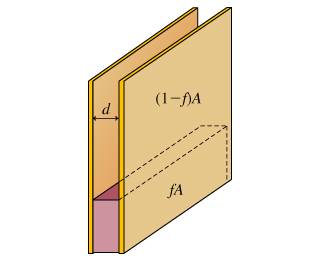
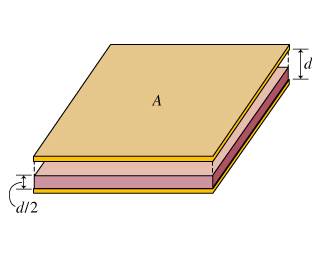
Consider two parallel-plate capacitors identical in shape, one aligned so that the plates are horizontal, and the other with the plates vertical

horizontal:
14985_a.jpg


vertical:

14985_b.jpg


The horizontal capacitor is filled halfway with a material that has dielectric constant . What fraction of the area of the vertical capacitor should be filled (as shown in the figure) with the same dielectric so that the two capacitors have equal capacitance? Express your answer in terms of K


Homework Equations


e = epsilon_0

Ch (horizontal capacitance) = 2KAe/d(K+1)

Cv (vertical capacitance) = Ae(1-f+Kf)/d

The Attempt at a Solution


I've already found the capacitance of both capacitors, however it's asking for a fraction of f by itself, I've tried a few combinations, a ratio, an equivalence and I can't seem to cancel out enough variable to get f by itself in one side such that I have an answer in terms of K, if anybody could point me in the right direction, I would greatly appreciate it.
 
Physics news on Phys.org
Hi clope023,

They want Ch=Cv, so you can set the right hand sides equal to each other:

2KAe/d(K+1) = Ae(1-f+Kf)/d

and solve for f. When you solve for f, all of the other unknowns will cancel except for k.
 
alphysicist said:
Hi clope023,

They want Ch=Cv, so you can set the right hand sides equal to each other:

2KAe/d(K+1) = Ae(1-f+Kf)/d

and solve for f. When you solve for f, all of the other unknowns will cancel except for k.

hey thanks! got the answer, now I actually have another dielectric problem, I've more or less solved it utlizing the meaning of C, but they want the answer in terms of C as a function of f, let me show you:

39460.jpg


I know the total Capacitance = Cdieletric and Cempty

Cdielectric = KeAf/d

Cempty = eA(1-f)/d

C(f) = KeAf/d + eA(1-f)/d

my original idea was to write KC_0 + C_0(1-f), would this be the correct way of writing this equation as a function of f?
 
I'm not certain what you are looking for here. You are missing an f in your last expression (needs to be

KC_0 f + C_0(1-f)

Did they just want an expression for the total capacitance with f in it? Or something else?

If you still have questions, could you post the entire problem?
 
alphysicist said:
I'm not certain what you are looking for here. You are missing an f in your last expression (needs to be

KC_0 f + C_0(1-f)

Did they just want an expression for the total capacitance with f in it? Or something else?

If you still have questions, could you post the entire problem?

they wanted Capacitance as a function of f, here's the question:

Consider a parallel-plate capacitor that is partially filled with a dielectric of dielectric constant K. The dielectric has the same same height as the separation of the plates of the capacitor but fills a fraction f of the area of the capacitor. The capacitance of the capacitor when the dielectric is completely removed is C_0, What is the capacitance C(f) of this capacitor as a function of f?

so as I said it was the Cdielectric + Cempty, so I think what you put will be correct, I'll check it.
 
it was correct, thanks alphysicist!


alphysicist said:
Hi clope023,

They want Ch=Cv, so you can set the right hand sides equal to each other:

2KAe/d(K+1) = Ae(1-f+Kf)/d

and solve for f. When you solve for f, all of the other unknowns will cancel except for k.

...I need help...
My algebra seems to have left me; I can't get the right answer whilst trying to salve for f...
 
  • Like
Likes   Reactions: suicidalbunny

Similar threads

Replies
4
Views
2K
  • · Replies 7 ·
Replies
7
Views
2K
Replies
5
Views
1K
Replies
8
Views
2K
  • · Replies 8 ·
Replies
8
Views
2K
Replies
3
Views
2K
  • · Replies 2 ·
Replies
2
Views
2K
  • · Replies 4 ·
Replies
4
Views
4K
Replies
14
Views
3K
  • · Replies 17 ·
Replies
17
Views
3K