Cauchy-Euler with x=e^t? Differential Equations (ODE)

Click For Summary
The discussion revolves around the application of the Cauchy-Euler method for solving a differential equation with the substitution x = e^t. Participants express uncertainty about whether to substitute into the original equation before converting to standard form or to use the substitution directly for the particular solution. One user identifies an error in the approach, noting that substituting the particular solution incorrectly yields a mismatch in the equation. Another user confirms that their particular solution, derived using a polynomial assumption, aligns with the results obtained through the substitution method. The conversation highlights the importance of correctly applying the variation of parameters technique in this context.
kepherax
Messages
9
Reaction score
1
Homework Statement
Use Cauchy-Euler method with x=e^t to solve the following differential equation.
Relevant Equations
x^2y''(x)+xy'(x)-9y(x)=x^2
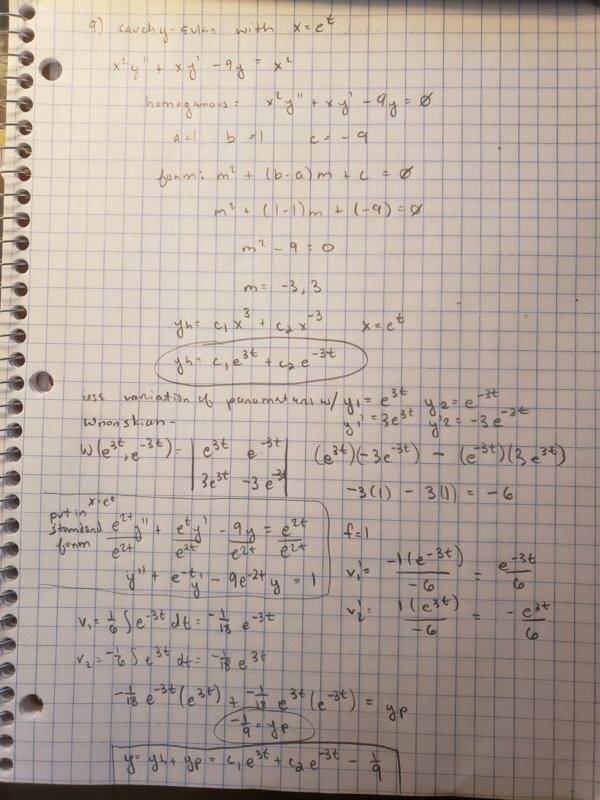
I'm fine with this up to a certain point, but I'm not certain if I'm using the substitution correctly. After finding the homogeneous solution do I plug in x= e^t in the original equation and then divide by e^2t to put it in standard form before applying variation of parameters so f=1, or do I just substitute so f= e^2t? The former is shown, but the latter gives a matching answer to plugging the original equation into symbolab if I were to replace their x with e^t. In videos I've watched and as per the book, you must always put the original equation into standard form and use the resulting f, but I feel like I'm missing something I can't put my finger on.
20191013_142823.jpg
 
Physics news on Phys.org
kepherax said:
Homework Statement: Use Cauchy-Euler method with x=e^t to solve the following differential equation.
Homework Equations: x^2y''(x)+xy'(x)-9y(x)=x^2

I'm fine with this up to a certain point, but I'm not certain if I'm using the substitution correctly. After finding the homogeneous solution do I plug in x= e^t in the original equation and then divide by e^2t to put it in standard form before applying variation of parameters so f=1, or do I just substitute so f= e^2t? The former is shown, but the latter gives a matching answer to plugging the original equation into symbolab if I were to replace their x with e^t. In videos I've watched and as per the book, you must always put the original equation into standard form and use the resulting f, but I feel like I'm missing something I can't put my finger on.

View attachment 251084
You seem to have an error in your particular solution. If you substitute just your particular solution into the differential equation, you get ##x^2 \cdot 0 + x \cdot 0 - 9 \cdot -\frac 1 9 \ne x^2##. Since the two exponentials make up the solution to the homogeneous problem, all of the terms resulting from that part of the solution just vanish.

I got a particular solution of the nonhomogeneous problem of ##y_p = -\frac 1 5 x^2##, and this checks out.

Your solution to the homogeneous problem is fine, but for the nonhomogeneous problem, I used a different technique, assuming that the solution to ##x^2y'' + xy' - 9y = x^2## was a polynomial of the form ##y_p = c_0 + c_1x + c_2x^2##.

I'm pretty rusty on the variation of parameters technique, so I don't have any comments on what you did in the lower half of the page in the photo.
 
  • Like
Likes kepherax
Mark44 said:
You seem to have an error in your particular solution. If you substitute just your particular solution into the differential equation, you get ##x^2 \cdot 0 + x \cdot 0 - 9 \cdot -\frac 1 9 \ne x^2##. Since the two exponentials make up the solution to the homogeneous problem, all of the terms resulting from that part of the solution just vanish.

I got a particular solution of the nonhomogeneous problem of ##y_p = -\frac 1 5 x^2##, and this checks out.

Your solution to the homogeneous problem is fine, but for the nonhomogeneous problem, I used a different technique, assuming that the solution to ##x^2y'' + xy' - 9y = x^2## was a polynomial of the form ##y_p = c_0 + c_1x + c_2x^2##.

I'm pretty rusty on the variation of parameters technique, so I don't have any comments on what you did in the lower half of the page in the photo.

Yeah, even when I use the variation of parameters method with f = e^2t, I get -1/5 e^2t as the particular solution, which works with the substitution... part of the process with Cauchy Euler is to first solve the homogeneous equation and then divide through to put in standard form for parameter variation, though, which either way (with or without sub) will result in f=1 and as pictured, so I'm confused. I may ask a tutor tomorrow morning, I saw one today but he was also rusty on ODE and couldn't clarify this for me. Thanks for trying!
 
kepherax said:
I get -1/5 e^2t as the particular solution, which works with the substitution.
And with x = e^t, your solution is the same as mine; namely, ##y_p = -\frac 1 5 x^2##.
 
Question: A clock's minute hand has length 4 and its hour hand has length 3. What is the distance between the tips at the moment when it is increasing most rapidly?(Putnam Exam Question) Answer: Making assumption that both the hands moves at constant angular velocities, the answer is ## \sqrt{7} .## But don't you think this assumption is somewhat doubtful and wrong?

Similar threads

Replies
4
Views
1K
  • · Replies 3 ·
Replies
3
Views
2K
  • · Replies 18 ·
Replies
18
Views
3K
Replies
2
Views
2K
  • · Replies 11 ·
Replies
11
Views
2K
  • · Replies 2 ·
Replies
2
Views
1K
Replies
3
Views
2K
  • · Replies 6 ·
Replies
6
Views
2K
  • · Replies 3 ·
Replies
3
Views
2K
Replies
8
Views
3K