How Does Friction Provide Centripetal Force During a Car Turn?

Click For Summary
SUMMARY

The discussion clarifies how friction from tires provides the necessary centripetal force for a car to navigate turns. When a car turns, the tires exert an outward force on the pavement, which results in an inward centripetal force acting on the tires due to Newton's third law. This force is transmitted through the car's structure, allowing it to maintain a circular path as long as the centripetal force equals the required force calculated by the formula speed²/r. If the centripetal force is not balanced, the car will spiral either inward or outward.

PREREQUISITES
  • Understanding of Newton's laws of motion, particularly the third law.
  • Basic knowledge of centripetal force and its formula: F = mv²/r.
  • Familiarity with tire dynamics and contact patch behavior.
  • Concept of vector components in physics.
NEXT STEPS
  • Study the principles of tire friction and its role in vehicle dynamics.
  • Learn about the effects of centripetal acceleration in circular motion.
  • Explore the relationship between speed, radius, and centripetal force in different driving scenarios.
  • Investigate how vehicle design influences handling and stability during turns.
USEFUL FOR

Automotive engineers, physics students, driving instructors, and anyone interested in understanding vehicle dynamics and the physics of turning.

sameeralord
Messages
659
Reaction score
3
Hello guys,

I wasn't interested in these stuff those days and I never got it.
car_in_curve.gif


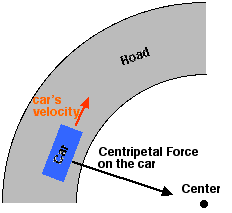
Now when you do a car turn the friction from the tires provide the centripetal force right. I have few quick questions. How does the friction from tires give a force in the centripetal direction, how come it is not in the direction that is opposite to velocity direction? If the centripetal force is towards the centre why is car going in a circle, wouldn't it be sucked into the centre, Am I missing some resulting forces? Thanks guys :smile:
 

Attachments

  • car_in_curve.gif
    car_in_curve.gif
    2.5 KB · Views: 634
Physics news on Phys.org
The tires exert an outwards force onto the pavement, which responds with an equal and opposing inwards force onto the tires (the Newton 3rd law pair of forces). This inwards centripetal force on the tires is then transmitted to the axles, suspension, body, and the occupants of the car.

At the same time the outwards force from the tires casues the the Earth to be moved a tiny amount "outwards", but since it's so massive, it's generally considered not to be moved at all.

The reason the tires genreate a force perpendicular to the direction of travel is that they're oriented slightly inwards of the actual direction the car is moving, including the rear tires (the entire car is yawed slightly inwards in a corner). This results in a deformation at the contact patch that produces the outward force on the pavement. The pavement also deforms, but by a very small amount and this coresponds to the inwards force from the pavement to the tires at the contact patch.

The car only goes in a circle if the centripetal force exactly equals speed2/r. Otherwise the path is a spiral.
 
Last edited:
Jeff Reid said:
The tires exert an outwards force onto the pavement, which responds with an equal and opposing inwards force onto the tires (the Newton 3rd law pair of forces). This inwards centripetal force on the tires is then transmitted to the axles, suspension, body, and the occupants of the car.

At the same time the outwards force from the tires casues the the Earth to be moved a tiny amount "outwards", but since it's so massive, it's generally considered not to be moved at all.

The reason the tires genreate a force perpendicular to the direction of travel is that they're oriented slightly inwards of the actual direction the car is moving, including the rear tires (the entire car is yawed slightly inwards in a corner). This results in a deformation at the contact patch that produces the outward force on the pavement. The pavement also deforms, but by a very small amount and this coresponds to the inwards force from the pavement to the tires at the contact patch.

Thanks again Jeff :smile: However I'm still confused why the car is not sucked in by the centripetal force why is velocity and car moving in another direction. Isn't the force towards the centre?
 
sameeralord said:
However I'm still confused why the car is not sucked in by the centripetal force why is velocity and car moving in another direction. Isn't the force towards the centre?
I posted before I was done editting my response, the path is only a circle when the centripetal force = speed2 / radius. Otherwise it's a spiral, inwards if the force is greater, outwards if the force is less.
 
Jeff Reid said:
I posted before I was done editting my response, the path is only a circle when the centripetal force = speed2 / radius. Otherwise it's a spiral, inwards if the force is greater, outwards if the force is less.

Thanks but if I consider this force like gravity it would suck the car, I mean isn't the directiion of velocity dependent on the direction of force. Is their some component vector I'm missing. I mean how is the car overcoming inward force.
 
Force and velocity don't have the same direction. Consider a ball thrown upward. The velocity is up, force from gravity(and acceleration) is down.
 
Oh I was just rusty with physics. I see the car wants to travel in a straight line and it is centripetal force that makes it go in a circle. Thanks Jeff and sganesh for the help :smile:
 

Similar threads

  • · Replies 15 ·
Replies
15
Views
4K
  • · Replies 6 ·
Replies
6
Views
2K
  • · Replies 6 ·
Replies
6
Views
2K
  • · Replies 12 ·
Replies
12
Views
5K
  • · Replies 10 ·
Replies
10
Views
2K
  • · Replies 16 ·
Replies
16
Views
2K
  • · Replies 5 ·
Replies
5
Views
5K
  • · Replies 16 ·
Replies
16
Views
2K
  • · Replies 10 ·
Replies
10
Views
2K
  • · Replies 37 ·
2
Replies
37
Views
5K